This Novel Is About a Missing Tiger—but Its Story Is About All of Us
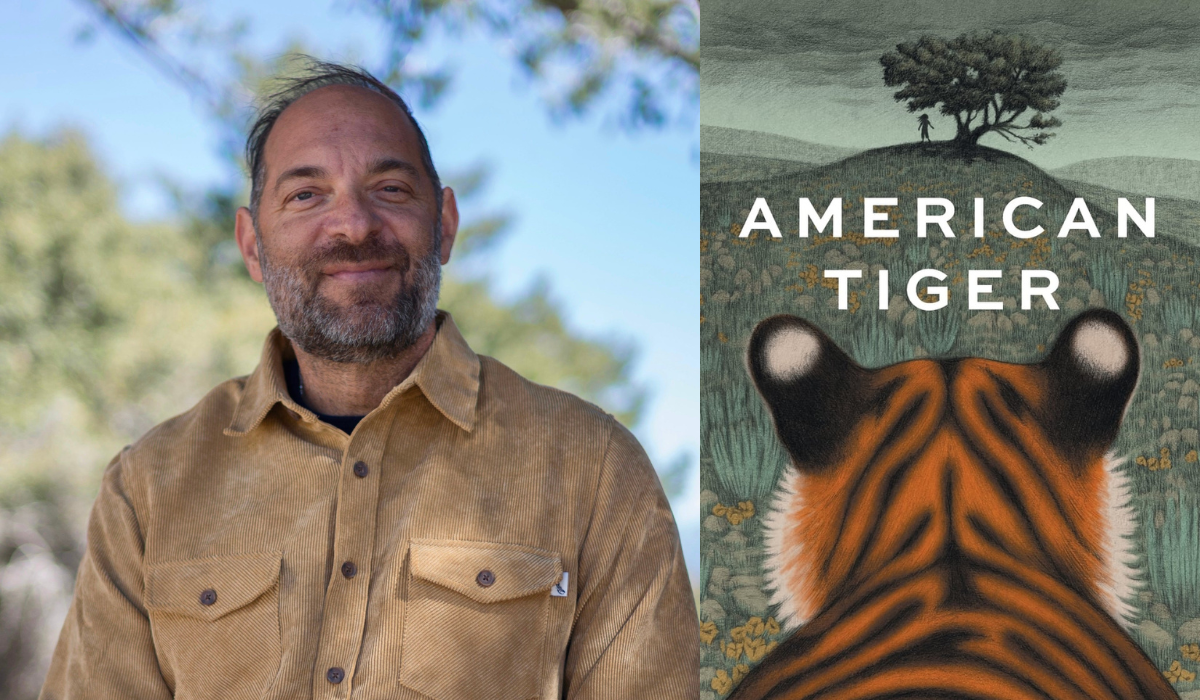
American Tiger is Adam Skolnick’s first novel, but its story—or rather, the incident that anchors the story—is one he’s written about before. In 2005, a tiger got loose and roamed Simi Valley, California, for weeks. That same year, Skolnick reported on the wild-but-true chase for the LA Weekly. “It just stuck with me,” he says about reporting on the event. So, he listened to that and, being the self-described “over-researcher” he is, explored the story more deeply over the following two decades, ultimately spinning its threads into his first work of fiction.
Despite his years of penning articles for global publications, from free diving for the New York Times to environmentalism for Outside Magazine, Skolnick admits to a struggle in writing this book—more than 25 drafts’ worth. He found writing fiction harder. But in reading American Tiger and seeing the vast detail it offers about humanity, how we relate to one another, and our natural world, one might see that his struggle comes from more than that. Skolnick knows the responsibility of good storytelling: to show us who we are. It requires a deeper effort not normally credited, and that is something he’s keen to honor.
A CONVERSATION WITH ADAM SKOLNICK
What did you learn about yourself while writing your first fiction book—as a journalist, a writer, and a person?
I learned fiction is a lot harder than nonfiction! The doubt is louder. I’ve written nonfiction books before, coming from a journalism perspective. You have this source material that you can use as your vessel to get you through the process. For [fiction], you don't really have that. You have source material, but you're not as connected to it. You're not as married to it. And so that gives you some freedom, but it also presents so many pitfalls. So the doubt was really loud—and for me, it was loud for the first 10 or 12 drafts, and I did 25 drafts of this. But what happens every time I've written a book so far is you get to a point where the doubt goes away, and you realize you have something of value, and then you're on the downhill, and it's fun. But for this book, it was probably two years of not that much fun and not that much knowing if it was worth the time and energy. There were a lot of internal battles to contend with, all the uncertainty, the doubt, and the negativity. But once I found the pathway to publication, it was really joyful.
I think that's the creative process. It’s this inspiration, then execution. And at times it's really fun, but often it's really hard.
Your honesty is refreshing because often we get to glimpse into the backend of art, mainly movies, but not as much with books. And the visions of Hemingway sitting there romantically writing away, or Bukowski smoking and drinking while feverishly writing, make the craft look easier than it is.
I mean, why do you think Bukowski was drinking all the time? Were they happy at all? It’s really like, is it going to be a battle, or is it going to be a flow? What I found over the years is that some days are battles and some days flow. But the weird thing about writing, in my experience, is that when it flows, that doesn't necessarily mean the work is better. And when you're fighting every word, sometimes that's better, and there's no rhyme or reason why. That's what's weird about writing. It is a mystery. And every time you start something new, you don't know if you can pull it off, so it's like this act of faith. The way I look at books is that a good book is about what it means to be alive. They can be about any number of subjects, but at the root, it's what it means to be alive.
You use the word “faith.” This work, writing and journalism, is so needed yet it’s hard, as you’ve detailed, and often undervalued, with current times proving such for journalism. What motivates you to do what you do?
It's changed over the years. When I first started, it was just about trying to write my way around the world. Then it went from that to, Wait, I want to actually get good at this craft. I want to get better. I was doing Lonely Planet travel guides, and you can learn to write a better travel guide, and that’s great, and I love service journalism, but for me, I realized I have to tell stories to get better. So, it then became about storytelling. Now I've gotten to a point where I can sit with people who are grieving or have something to say. I can listen and have empathy and channel it into something meaningful for people. It is the skill that I've created, or, I guess, developed through this journey, and it's something I want to keep doing. It's my way of contributing, honestly. For the project I'm [working on] now, I'm dealing with people who've dealt with death and are grieving. It’s like a public service, and as journalists, that's the one thing we forget. We forget that with the deadlines and pressure we’re under, and the economic pressure of the institution kind of collapsing around us, we're trying to find a place where we can still exist and work. As challenging as it all is, our gift is that we can hold space for people. That's our public service.
When it comes to American Tiger, what do you hope readers take away from the story?
I hope they can find an escape from this madness we're dealing with now. It takes it back to a place, 2005, which seems like such a simpler time. I hope it’s an entertaining journey that moves them. The other thing is what I see with all my work, but especially this, that I kind of pop the bubble and let people see that we are more than we think we are. In the sense of American Tiger, it’s that we are nature. We are not separate from nature. We are a manifestation of nature. And so that's what I really hope that people see: that whether they consider themselves a nature person or not, they’re still part of nature. I'm hoping that people connect with that because it's beautiful. When you have that connection to nature, it empowers you in ways that can navigate you through some difficult times.
Adam Skolnick is an independent journalist, author, and podcaster. Learn more here.

Please note that we may receive affiliate commissions from the sales of linked products.