An Awkward Kind of Grief

I think I always knew that, if my brother Michael died before me, I’d hear about it on the news…it’s just what happens in this family. The Reagan family has always lived on fractured earth, wide gullies and uncrossable rivers between us.
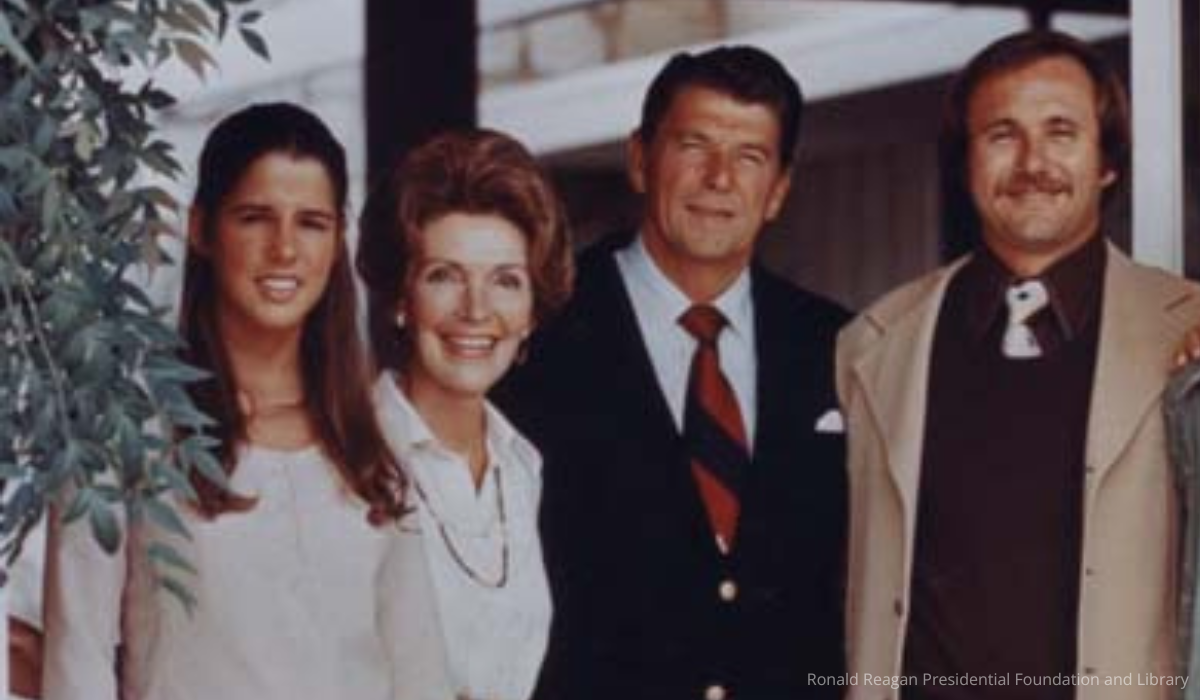
I used to have a long-ago Christmas photograph framed and displayed on a shelf. In it, I look to be around four. My paternal grandmother, Nelle, is cradling me with one arm. Beside me is my half-brother Michael, 11 then, and behind us – striking a pose – is my half-sister Maureen, who would have been 15. Christmas stockings are hung behind us and I’m dressed in a red dress with an embroidered ornament on it. I’m guessing that this holiday gathering – a blended family celebrating together -- was a singular event in my childhood. I have no actual memory of it, just the photograph, and my half-siblings are not embroidered into the fabric of my early years.
A long time ago, I put that photo away in a drawer. It made me too sad. It represented what might have been. I don’t know how my parents introduced Michael and Maureen to me that day when I was just a toddler, but I’m pretty sure they weren’t introduced as siblings.
About four years after that Christmas photo, when my brother Ron had been born and we were in a new house, I was informed that I had another brother – a “half” brother who would be coming to live with us. And, I was told, the tall blonde woman who used to come by occasionally and have private chats with my mother was my half-sister. It was all quite overwhelming. I remember crying and wondering how many other brothers and sisters were going to show up. The world suddenly seemed undependable, full of strange surprises. But we get used to our family, however flawed and dissonant it is. It settles into us, with all its strangeness, its tensions, and even though we know it’s short-circuiting us in so many ways, there is nothing we can do about it.
Michael slept on the living room couch; he never went on vacations with us. I knew, from my mother’s disposition, to not ask where he was. Over time he and I were spoken about in the same sentence, as the two problem kids in the family. I guess that should have bonded us, but there were too many rivers to cross. With his passing, the grief I feel has an uncomfortable familiarity to it, as if it’s an extension of grief I’ve lived with most of my life. A brother with whom I wasn’t able to have a relationship. A family of people who really didn’t know much about one another.
A few years ago, I thought maybe I could change things, and I reached out to Michael. We did spend some time together, avoiding the subject of politics since he was far to the right and a world away from my viewpoints. A friend said to me then, “I’m so happy for you – you’ll have a family now.” That’s how I felt, too. But I learned a valuable lesson which might help others, since I am not the only person with a fractured family history, nor am I the only person who has thought maybe, down the line, they could create a relationship where there was none before. Here’s what I learned: By the time you embark on a reconciliation, your family member has their own life, often their own family, which has carved out its history, its bonds, its internal relationships, its own homeostasis…and you’re not part of it. To assume that this other family will reconfigure itself and fit you into it is magical thinking. It just doesn’t work like that. You might have friendly interactions, but you’re always going to know you don’t belong there.
So, I’m left with a grief that’s awkward, that isn’t like the grief you’re supposed to feel when a family member dies – one that ushers in memories, that makes you laugh and cry at the same time, one that makes your heart long for one more visit, one more conversation. By contrast, the grief I feel is old, worn -- something that has tunneled through me for most of my life. It leaves me on an empty shore with no footprints marking the presence of the brother who is gone.
Michael and I shared the reality that our lives were, in part, eclipsed by the blazing light of our father’s legacy. It was a hard truth we could never get past – that no matter how we composed our own lives, our father lit up the sky in ways that we never could. It gave us something to talk about when we were together. But I always wondered if Michael flew too close to the sun, making so much of his life about our father’s that his own wings might have gotten singed.
The estrangements and fractures that characterized my family, while existing in the rarified world of fame, do not happen only in that rarified world – they happen to many people. Right now, more than ever, we need to be reminded that, with all that is tearing us apart, there are fragile, human truths that bring us together, that leave us wandering across the same rutted landscapes looking for answers, for solace, for understanding. Maybe the best we can do these days, when fear, anger and turmoil swirl around us with every news cycle, is remember that in dark, sleepless nights, it’s not politics and policies that keep us awake. Rather, it’s our reflections on those who are close to us and those who we could never get close to. We think about the frailty of being human, about the resilience of our hearts even when they were broken, and the deep need to have other hearts beating in tandem with ours.
In this country, the distances between us are so wide now and feel so treacherous, it’s as if we are continents drifting away from one another, separated by roiling seas. But the small human moments – reflections on grief, the pull of memories, the weight of regrets, can be the ropes we toss out to one another. They can be reminders that, beyond politics and judgements, we aren’t really that different from one another.
In writing about Michael, I am, in a way, writing about all of us – the tender parts of us, the parts that weep with what we couldn’t change, and the parts that believe, faithfully and stubbornly, that we will someday have an answer for all of it.
Patti Davis is an author of many books, including Floating in the Deep End, in which she explored the experience of caring for her father after his Alzheimer's diagnosis. Her most recent book is Dear Mom and Dad: A Letter about Family, Memory, and the America We Once Knew.
Please note that we may receive affiliate commissions from the sales of linked products.