
5 Facts About Pain That Could Change Your Life

Pain is one of the most challenging and widespread realities of life. An estimated 50 to 100 million Americans suffer from chronic pain, and for countless people, relief proves elusive. "Frankly, there are a lot of myths and misinformation out there," Howard Schubiner, MD says about many conventional pain diagnoses and treatments.
Dr. Schubiner is an internist and a Clinical Professor at Michigan State University College of Human Medicine. He's spent the last two decades conducting clinical trials and authoring more than 100 scientific papers to identify the root causes of a broad spectrum of pain conditions, from back pain, migraines, and fibromyalgia to irritable bowel syndrome and even chronic fatigue syndrome. He's taken his findings and created a program to help people reverse their chronic discomfort—and it's anchored in the mind-body connection. He's found that for many people, their agony stems from their body producing pain because of learned neural circuits in the brain that are stuck in a loop.
What this suggests is both staggering and hopeful. Understanding how the mind plays a critical role in pain offers people a new path toward healing.
Schubiner reveals his program in his forthcoming book, Unlearn Your Pain, a title from The Open Field, which comes out next spring. In the book, he lays out his riveting and unorthodox findings. He also takes us back to when he first became interested in an alternative approach to pain, where he learned from insights from the late revolutionary physiatrist and rehabilitation expert, John E. Sarno, MD—insights that have now been shown to be accurate through solid research studies.
Recently, The Sunday Paper sat with Schubiner to gain an early look at his take on a grave issue that impacts too many of us. The following are five pieces of wisdom from our conversation that will expand your understanding of pain, as well as your capacity to heal from discomfort and embrace more compassion.
#1: Pain Originates in the Brain
No matter the type or cause of pain, the brain generates the feelings we experience. Schubiner uses the example of touching a hot stove: It's not your finger that causes the pain when it comes into contact with the heat. What happens is the "nerve receptors in the hand send impulses via the nervous system to the brain within milliseconds," he writes. The pain is caused by the activation of the brain's neural circuits. The brain is signaling "danger," so you pull your hand away and keep yourself safe.
The reasoning that confirms this is simple: Sometimes, the brain does not activate pain sensations when we experience a physical injury. Take, for example, if you've sprained your ankle while in the presence of a wild bear. Your subconscious will likely tell you to run before anything else. "You're probably not going to have pain, because the brain has something more important to think about," Schubiner tells us. "Our brain decides whether pain will be experienced,” and thus our brain can turn pain sensations on or off. This concept is backed up by years of neuroscience research studies, he adds.
#2: Emotional Wounds Can Produce Physical Pain
This truth anchors Schubiner's work, and it underscores where conventional medicine has missed the mark: Just as a stressful day can lead to a headache, deeper emotional wounds can also produce physical pain. Childhood trauma, past abuse, unresolved stress—this can all manifest in the body and signal the same "danger" response in the brain that kicks off physical sensations.
This is a "mind-blowing" fact, says Schubiner, and it links to the brain's job of keeping us safe. Whether we touch a hot stove or wrestle with agony of an abusive relative, our brain is saying we're not safe by sending pain signals, and those signals can come in myriad forms, from back pain to migraines to fibromyalgia to chronic fatigue. The headache that starts with a stressful day can become chronic because the brain can develop neural circuits of pain that loop on repeat. The process of how the brain can learn pain is called neuroplasticity.
#3: All Pain Is Real—and a Sign
Schubiner says that no matter how your pain shows up, it is real and valid. "That's what is so hard for people to wrap their heads around," he continues. "[They say] 'My pain is so severe. How can that be my brain?' Well, when you have a kidney stone, the pain is still coming from the brain. So that's real. How's fibromyalgia or migraine pain any less real? It's all real pain."
What's critical to know is that pain is a warning sign. It could be warning you that you have a kidney stone, or it could be warning you that there's toxicity or unresolved emotional issues in your life, says Schubiner. This is why it's so important to get your diagnosis correct. Is your pain caused by a physical structural injury or unresolved stress that's sparking the learned neural networks in your brain to signal pain? "Making this distinction is a big part of the work I do every day," he says.
#4: Pain Warrants Discernment
Just as all pain is real, it is highly personal, depending on a person's body, circumstances, and history—and this makes healing personal as well. In Schubiner's book Unlearn Your Pain, he offers a thorough roadmap for understanding and healing from all types of pain, sharing patient stories and his step-by-step approach. That is the ultimate guide, but for the sake of this article, here’s what he suggests to begin your healing journey:
- First, get your symptoms medically evaluated. "That means going to your doctors, and making sure that there's no cancer, no tumor, no infection, no major thing that would be easy to diagnose," says Schubiner.
- Secondly, carefully review what the doctors say and maintain an open, discerning mind. Schubiner suggests considering:
- Are they telling you that there’s nothing wrong or that it’s “all in your head?” (These answers are both inaccurate and dismissive, says Schubiner.)
- Are they giving you a diagnosis that is based upon structural damage in the body when there is not a clearly defined problem? (This commonly occurs in people with chronic back pain when MRIs show mild abnormalities that are also routinely seen in healthy people without pain.) Or are they saying that the pains are structurally caused even when the tests are normal, such as with migraine or tension headaches, fibromyalgia, or irritable bowel syndrome?
- Also, have the doctors listened to your whole story? Are they considering the mind-body connection and taking into account your emotions, stress, and overall life circumstances?
- Thirdly, look for clues that your pain is due to learned neural circuits—i.e., a neuroplastic condition. "The vast majority of chronic pain, anxiety, depression, and fatigue is nonstructural," says Schubiner. So, ask yourself:
- Are your symptoms consistent, which is the case for most structural pain, or are they inconsistent?
- Do your symptoms vary in quality, intensity or location? Are they better some days than others? Do they worsen with certain triggers, be it memories, people, or situations? "We have developed a set of criteria in the book to help people look at it, and it's amazing how obvious it is," he adds. "The clues are there if we look for them."
- Finally, once a clear diagnosis of a neuroplastic condition is made, there are straightforward techniques, such as pain reprocessing therapy, that can be used to train the brain out of pain, essentially to unlearn it, says Schubiner.
#5: Pain Guides Us to More Tenderness
"This work is all about compassion," says Schubiner, who has witnessed "heartbreaking" suffering in thousands, not only from the tremendous burden of pain, but also from so many unresolved issues in their lives. It is in this light that emotional awareness and expression therapy, which he and his team developed, can play a critical role in healing from pain. This includes dealing with all the emotions—the anger, sadness, fear, guilt, and frustration—and moving through them to have compassion for oneself. "When we have ruled out a structural disease, we might want to consider if this headache, stomachache, backache, or the feelings tension or anxiety have a deeper meaning. We might want to ask: Is there a message for hiding under the pain?” says Schubiner.
Ultimately, our body and brain are there to guide us, he continues. So, in addition to taking steps to alleviate the pain, we want to understand it fully. Schubiner states that standard pain assessments often miss the deeper understanding that pain is a warning sign prompting us to make changes in our lives that will help us be healthier and more whole.
"When you view the symptoms with the understanding that they are protective signals, and that they can guide us toward better understanding ourselves and our relationships and lives, that can be a powerful force for healing and wellness."
Howard Schubiner, MD, is an internist and a Clinical Professor at the Michigan State University College of Human Medicine. He is the author of Unlearn Your Pain: The Science of Recovering from Chronic Pain,Fatigue, Anxiety and Depression, to be published by The Open on May 26, 2026. Learn more at unlearnyourpain.com.
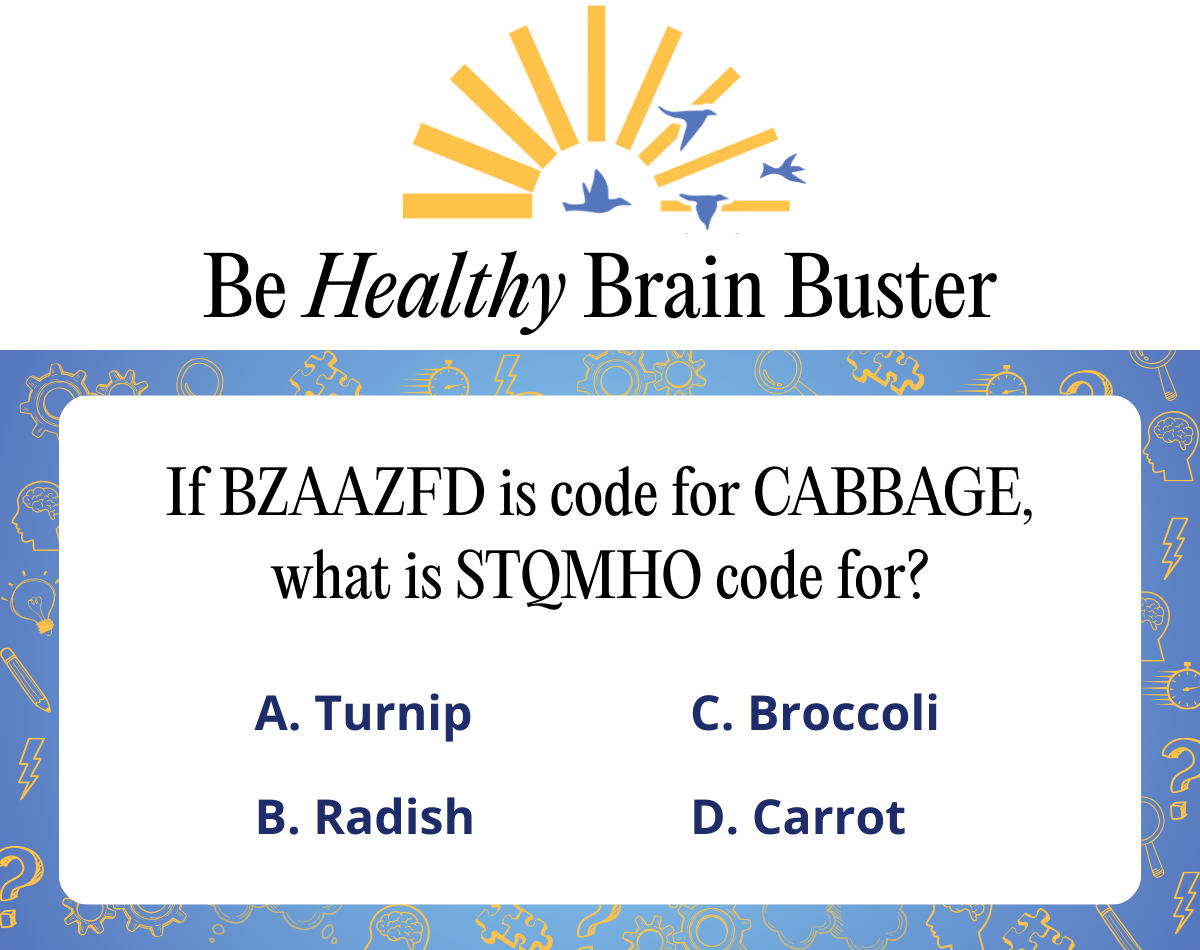
Answer
A. Turnip. CABBAGE → BZAAZFD uses a shift of –1, so STQMHO shifted +1 becomes TURNIP.

Please note that we may receive affiliate commissions from the sales of linked products.