One Year Later, the Greater Los Angeles Fires Are a Story of Our Present and Future

This January marks the first anniversary of the devastating wildfires in Greater Los Angeles. Savage winds and brittle-dry conditions fueled the Eaton Fire, which burned in and around Altadena, and the Palisades Fire, which burned in Pacific Palisades and parts of Topanga and Malibu. The blazes killed 31 people and destroyed more than 16,000 structures.
For weeks, journalist and author Jacob Soboroff was on the front lines covering the devastation. His reporting was thorough, emotional, and deeply personal: The Palisades Fire burned down the home he was born into, the house his brother, sister-in-law, and soon-to-be-born niece were living in, and nearly the entire community of his youth. As he remained steadfast, gathering critical real-time information for the public, his inner world remained full of questions.
Reflecting on this experience, Soboroff—senior political and national reporter for MS NOW—tells The Sunday Paper, “How do you process watching not only your childhood memories but the physical attributes that mark your childhood burn up in front of you? And also, what do you do with that information when you think about the future?”
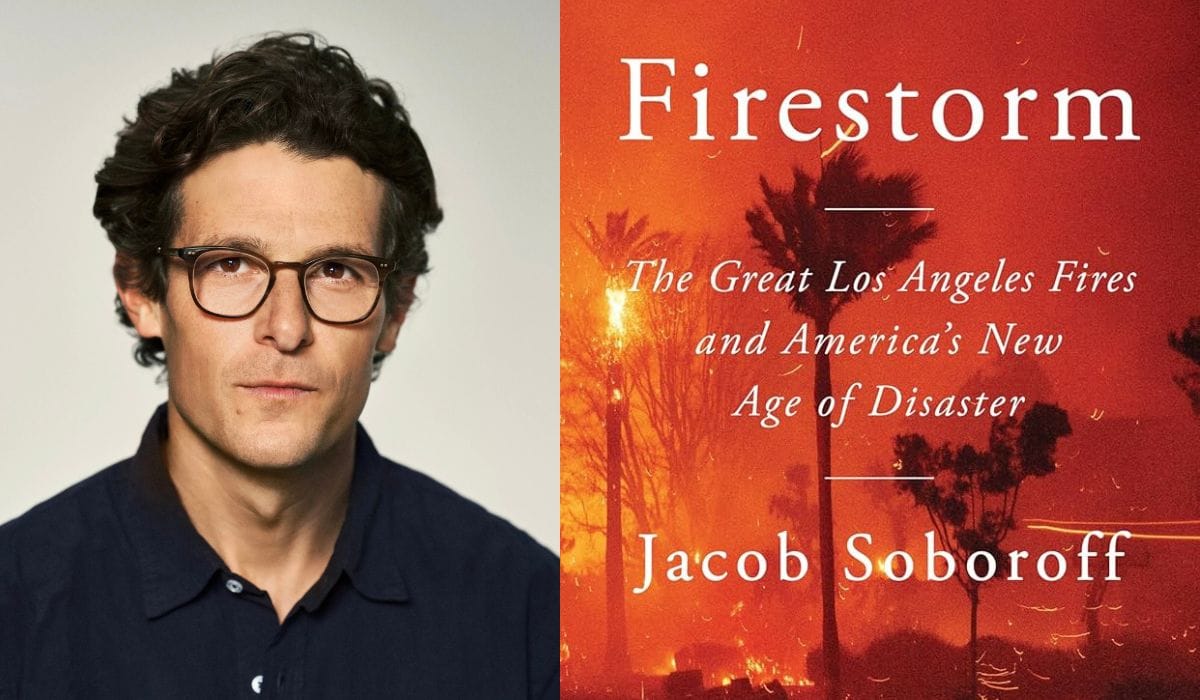
For Soboroff, he took that information, as well as his many more lingering concerns—How could this all have happened? Will this happen again?—and set off on months of reporting, interviewing victims, first responders, scientists, meteorologists, and more, to better understand what these fires mean in terms of our present and future. His new book, Firestorm: The Great Los Angeles Fires and America’s New Age of Disaster, tells, with incredible detail about the costliest wildfire in American history, the challenges and fortitude of Los Angeles, and what we all must know about these times in which we live.
A CONVERSATION WITH JACOB SOBOROFF
Your book, Firestorm, is anchored in extensive research and many themes, from resilience to loss to power to disinformation. What do you hope people take away from it?
What we experienced, in some measure, was the fire of the future. I didn't know it at the time, but in meeting with and getting to know so many people that not only experienced this fire as victims of it, but that fought the fire, that studied the fire, and that make their lives work understanding similar natural disasters, there was a confluence of events here that's played out before and will play out again. Frankly, I was a little bit cavalier about the idea of even covering fires before I went in there—but today I look at it as the greatest gift as both a reporter and a person because it broadened my understanding of the moment that we live in and what we all are going to face together. It also gave me an understanding of what the future is and, in the age of disaster we're living in, what it means to connect with other people. I hope people understand the gravity of this moment, but also how we can get through it today.
Speaking of the confluence of events, one of the many critical conversations you include in the book is with Captain Jonathan White, an officer in the US Public Health Service Commissioned Corps. He showed you—literally drawing it on a piece of paper—the intersecting themes that he says fuel the fires of today: the climate emergency, Infrastructure disintegration, changes in how we live, and the politics of blame and disinformation. How did his perspective shape how you think about the LA fires and our future?
Jonathan White is somebody whom I've trusted as a source since I started covering family separation. [Editor’s note: Soboroff’s first book, Separated, details the U.S. government's systematic separation of migrant families at the border.] When I sat down with him, I knew he was working on disaster recovery, but I didn't realize he had been to every mass-casualty fire in the last five years. When he took my notepad, drew an X on it, and wrote these four interrelated phenomena that he said make up this fire of the future, the light bulb went off in my head. Maybe I should have understood this, but again, I was too close to [the fires]. Jonathan spent time in Lahaina on Maui [during the 2023 fires] and then in Altadena after the fires, and the clarity with which he speaks as a decades-long public health professional and an emergency manager helped me see that there isn't one proximate cause of a fire like this. We’re always searching for who's to blame, or why, and what the reason is. But what Jonathan made very clear to me is that that's just not how it works, and that these four things—climate change, obviously, but also changes in the way that we live, our infrastructure, and misinformation and disinformation—all play into how we experience events like this. He said to me, ‘Take a step back; you have this one particular vantage point, but let me show it to you through my eyes,’ and that's how I've seen it every day since.
It's an understatement to say how devastating this has been for Los Angeles, the second-largest city in the US. Various issues unique to Altadena and Pacific Palisades abound, with most people who’ve lost homes still seeking permits to rebuild. What do you want people to know about how Angelenos are faring?
We’ve experienced a collective trauma together—and in LA, it's been a year of trauma. We went from the costliest wildfire in the history of the country to the ICE raids. It’s been a very destabilizing moment here. And even for the people who are engaged in the rebuilding process, we're all going to be living with this trauma, in some form, for our entire lives. So, I would encourage people, if they come here, to go visit the Palisades and to go visit Altadena and see what it's like to live amongst the thousands of structures that have been destroyed, and to see the incongruency of the houses on the street, with some being built back up and others years away from being built. There’s obviously the bureaucratic labyrinth that people must go through to literally get back on their feet.
When you cover big events like this, it gives you a sort of X-ray vision into the fissures under our society. That happened with me [writing] Separated, where I understood the immigration system in a way I never did, and with this, it was LA. California is the most unequal state in the nation, with haves and have-nots and income inequality. We have more homeless people living on the street in Los Angeles than in any other city in the country, and more undocumented people here. All of these things are part of the answer to, " How are people in LA doing? And the fires exacerbated the different strands of what life in LA is really like. And there are thousands of people, including my brother, who lost their homes and their livelihoods and have to figure out a way to get back. And for those people, the trauma is particularly acute.
You shed light on the countless people on the front lines, including firefighters, day laborers, and undocumented workers, many of whom don't get any recognition and have been critical in helping LA move forward. Tell us more about how their stories have fueled you.
That's what gives me hope about all of this. It's a really, really, really tough story, but as always, you find the people who help you through, and these people, specifically, helped me through, whether it was Albie Fuentes from the Palisades or Herb and Loyta Wilson who lived on McNally Avenue in Altadena or Cate Hennigan, the GPL engineer, or the NASA scientists I flew with, or the firefighters I met from the Palisades and from Altadena. I think about them all the time because they just keep going, and they're up against challenges far greater than anything I face. My challenge was emotional, largely. Their challenges are everyday and practical. They are: How are they going to move forward? I'm inspired by them. And that's part of why I want to write the book, and why the book was so cathartic to me, is that I hope that other people become inspired by them as well.
Disinformation is a grave problem today, as you cover in your book. How do you suggest people stay well-informed when it comes to fires and other natural disasters?
Go to places where you're getting information about facts on the ground. That’s why I included the story about [conservative political advisor and podcast host] Katie Miller: Not only because I feel awful for what their family went through, just like I feel awful for mine, but the politics of the moment is such that it seeps into everything. Within hours, I heard from her and went to check on her in-laws’ house, and her incoming boss at the time, Elon Musk, and Donald Trump were tweeting these pieces of misinformation and disinformation that gave conspiracy theories credence to why the fires were happening, and they did nothing to help, other than to increase stress and anxiety. [Editor’s note: Katie Miller, a political advisor and podcast host, texted Soboroff to check on the family home of her husband, Stephen Miller. The home had burned down. At the time, Katie was joining DOGE. She and her husband were “desperate” for information on the house, as Soboroff reports in his book.]
So, look for the facts on the ground. And that doesn't necessarily mean always looking for a reporter like me. It means to go to people and places you trust. That's why I looked at local news during the fire and said that they were doing a public service. At a time when alert systems weren't working properly, and evacuation orders were coming late, the local reporters were on the ground on a street-by-street way. That's another group of people I'm greatly inspired by: my colleagues in the local journalism community on the ground in LA. That is my antidote to the misinformation and disinformation we get at the national level, too often.
Jacob Soboroff is the Senior Political and National Reporter for MS NOW. He is the author of the forthcoming book Firestorm, and of the New York Times bestseller Separated: Inside an American Tragedy.

Please note that we may receive affiliate commissions from the sales of linked products.