Where Women’s History Happens Today

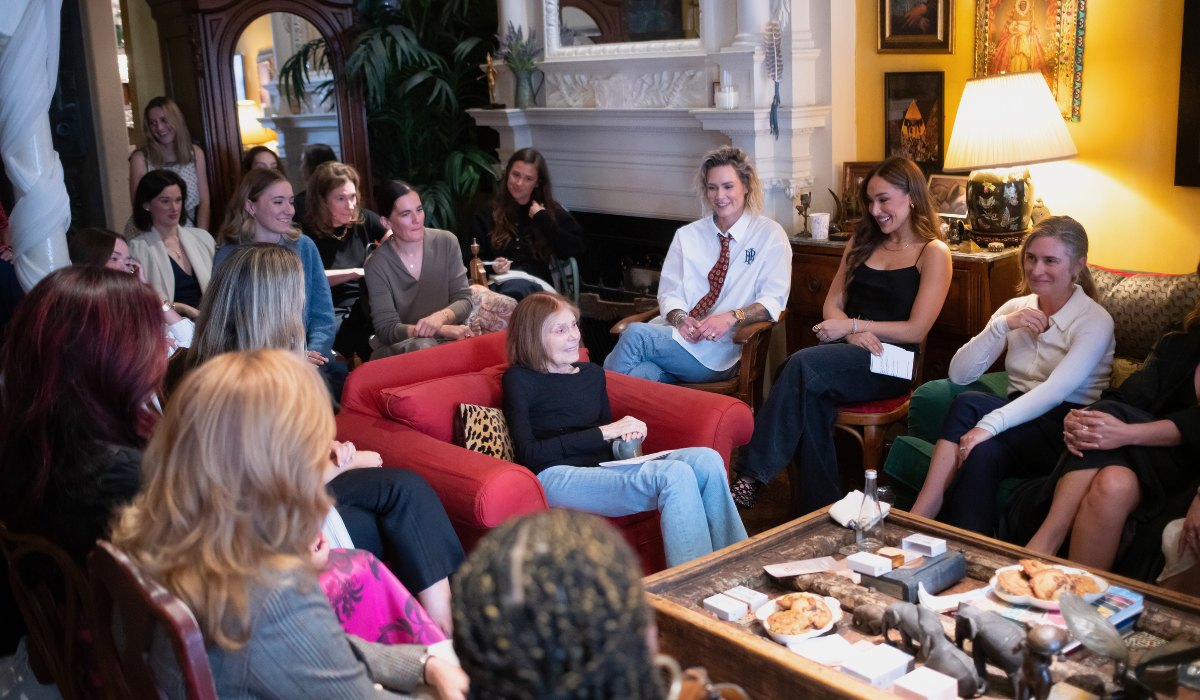
The first time I hosted a Talking Circle in Gloria Steinem’s living room, I thought everything had to be perfect. This was my maiden opportunity as a Gloria Steinem Foundation Fellow to carry Gloria’s legacy forward. In the 1960s, Gloria Steinem and her peers were among the many groups of women who gathered during this time, in hierarchy-free, circular formations to share experiences and listen to the stories of others––similar in tradition to the ancient ceremonies held by Native Americans, and indigenous communities around the globe. In the 60s and 70s, these circles famously birthed the movements that led to historical social change throughout our country.
So, no pressure.
I had the event catered. I made custom coffee cups printed with Gloria’s trademark aviators and the words “in the room” emblazoned across. I came prepared with talking points and questions to encourage productive conversations, made sure the guests and I left with key takeaways, action items, and a WhatsApp group. None of this was necessary. A lot of it was entirely beside the point.
The main point of the Talking Circle, as I have learned from Gloria Steinem during my time as a Gloria Steinem Endowment fellow, is to connect with one another. It’s that simple. No matter how different our backgrounds are, no matter how opposed our politics may be, no matter how trite what I’m about to say may sound, we are stronger together. Take this anecdote that my mentor, Steve Carlston, an expert in connected living shared with me: Sequoias are the tallest trees on Earth. They’re also among the oldest. And yet, their root systems are surprisingly shallow, typically only 6-12 feet deep. What keeps them standing is connection. They hold one another up, share nutrients, strength, provide stability. Because their roots spread wide--often more than 100 feet from the trunk--intertwining with the roots of other sequoias to form a shared underground network, they stand tall in storms that would otherwise knock them over.
The strongest connections come from in-person interactions, which is why Talking Circles are held in person. This is especially crucial in 2026: We are glued to our phones, lulled into stupors by endless notifications about senseless wars, heartbreaking headlines, brutal violence, divisive politics; we are alienated inside the echo chambers of our social media feeds, tricked into thinking we’re “engaging” with one another when in reality, loneliness feels like it might swallow our society whole. And yet, Gloria taught me that when we gather in the same room, when we look one another in the eyes and focus our energy on deep listening rather than waiting to respond, it produces oxytocin, the same “love hormone” released during childbirth, witnessing an act of kindness, and staring contests with your dog. It creates immediate, deep feelings of trust and safety, empathy, and bonding. It’s the antidote, I am convinced, to the schismatic “Us Versus Them” makeup of the present moment.
This doesn’t mean that Talking Circles are all nodding heads and unified opinions. In a room filled with actors, lawyers, influencers, therapists, professors and athletes, activists and comedians, high-powered business execs, and Real Housewives, there are bound to be opposing points of view. Different ways of seeing things. And that’s exactly how it should be. Gloria has taught me that the best Talking Circles are ones with respectful disagreements that invite us to challenge our own deeply-held beliefs. That’s how we escape our echo chambers, expand our worldview, learn to infuse our arguments or our activism with an intersectional lens, and ultimately, find common ground. It’s hard to hate people up close.
I have made a career asking questions that aims to reveal our shared humanity. I'm a journalist by trade, and now a podcaster. I executive produce and host Hello Sunshine’s “Bookmarked by Reese's Book Club,” and iHeart’s “Question Everything,” where, no matter who I interview, I ask questions in search of stories that prove how we’re more alike than we are different. Over the course of my profession, I have witnessed, over and over, the unitive power that comes from sharing these kinds of stories. Gloria will remind you that, during those initial Talking Circles, she and her peers weren’t a bunch of high-profile leaders and activists. They were everyday women who encouraged one another to share stories (one of the most feminist things you can do, in Gloria’s eyes), and in doing so, realized that many of their so-assumed unique, personal experiences were universal. The Women’s Movement caught on from there.
Big movements start in small rooms.
Gloria’s tenured perspective comes in handy whenever I feel particularly despondent, when the news feels too overwhelming, too monumental, the world’s evils too deeply fanged, too rotten. She has taught me that we live in the reverberation of shifts that began long before us, which gives me hope. “I’ve seen enough change to know that more will come,” Gloria often reminds me. When I look back at history, she’s right: Women couldn’t open a credit card without a male co-signer in the U.S. until 1974. Marriage equality took decades of organizing before the Supreme Court ruling in 2015. The civil rights movement didn’t begin with one march; it was the result of years of local organizing, legal battles, and intergenerational leadership. Even workplace norms—parental leave, conversations around harassment and mental health—have shifted, slowly, through cultural pressure and persistence. When I interviewed Mattie Kahn, author of Young & Restless: The Girls Who Sparked America’s Revolutions, she spoke about how, when we stay within our own cohort, everything feels urgent and fragile. When we expand our circles to include a multitude of ages, we’re shown the grand sweep of progressive history through our elders; through those younger than us, we’re offered an optimistic glimpse of the future.
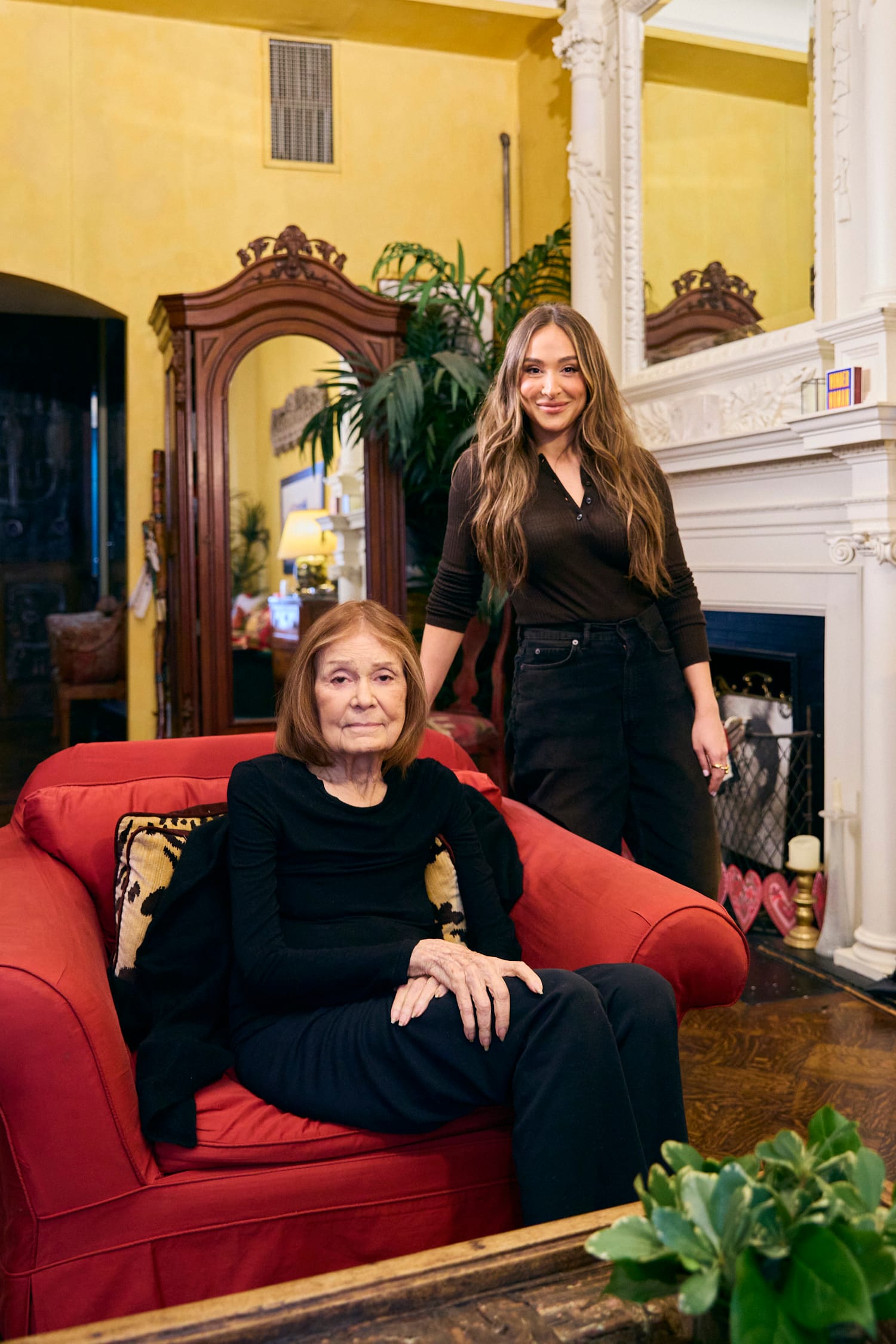
When you walk into Gloria’s apartment, always a little warmer than you want it to be, and inhale the faint smell of wooden bannisters after exhaling a great sigh of relief (you’re back in the womb now, you’re safe); when you learn of her open door policy, where of course guest rooms are made available to artists in need of housing; when you sit down in one of the mismatched chairs pulled from all corners of her home to accommodate the overflow of bodies, and find yourself surrounded by shelves of books, elephant knickknacks from her travels, and changemakers, it is tempting to hand over the entirety of a Talking Circle’s success to her iconic yellow living room–to Gloria in her iconic yellow living room. But she would hate that. She’d much prefer that you and I carry on the tradition of Talking Circles with our own networks.
A Talking Circle, as Gloria will tell you, has nothing to do with the venue, nor the guest list. You don’t need an Oscar-winning actor to engender action. You don’t need an army to show strength. You don’t need Gloria Steinem’s green velvet couch to create change. You need a few hopeful people, gathered together in the same space. Next, you’ll need a topic that interests you—anything: the rise of Artificial Intelligence; inequities in the American education system; women’s sports; Backstreet Boy’s Comeback Tour. (Remember: Talking Circles are about connection, not who can out-scholar whom.) The conversation will take on a life of its own once rolling, but a few warm-up questions always help. I like this one from my conversation card game, Question Everything: “What would younger you not believe about your life today?” Here’s another, a classic: “What’s your diner order?”
Eventually, sure, you’ll want to include people of different ages, backgrounds, and experiences—people who choose curiosity over certainty, courage over silence, and connection over division. But for now, to build momentum, you and your best friend and your neighbor will do just fine. Connection is like practicing gratitude, trying to drink more water, or stretching: every little bit counts.
Please note that we may receive affiliate commissions from the sales of linked products.