Painting Them Back Into the Light
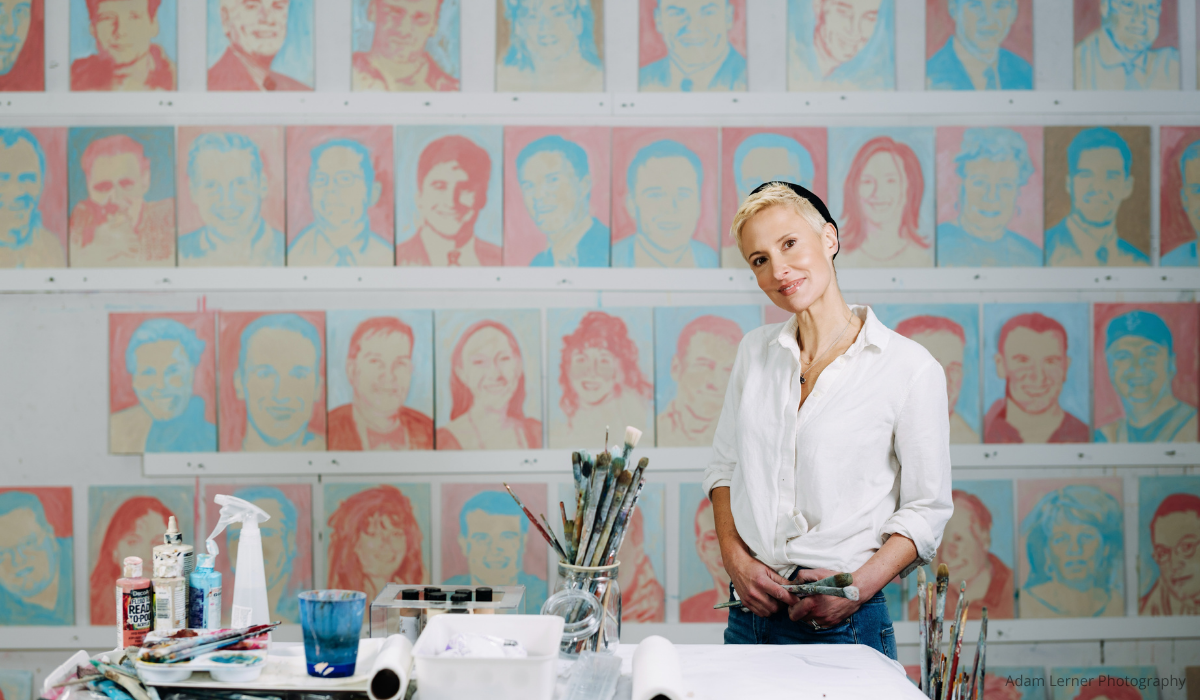
Artist Katie Ré Scheidt has spent the past year turning memory into art. While she usually explores abstract, nature-inspired subjects, Scheidt undertook an unusually personal project for the 25th anniversary of September 11th. For eight months, she focused on the exhibit, titled 67 Portraits, of people connected to her former colleagues and workplace at the equity firm Keefe, Bruyette & Woods, located on the 89th floor of Two World Trade Center.
Scheidt, then 26 years old, was running late that day—the minute hand on her old-fashioned alarm clock somehow broke off during the night, and she overslept. Although she stayed with the firm for another nine years after the towers fell, she became a full-time artist after meeting her husband and having two children.
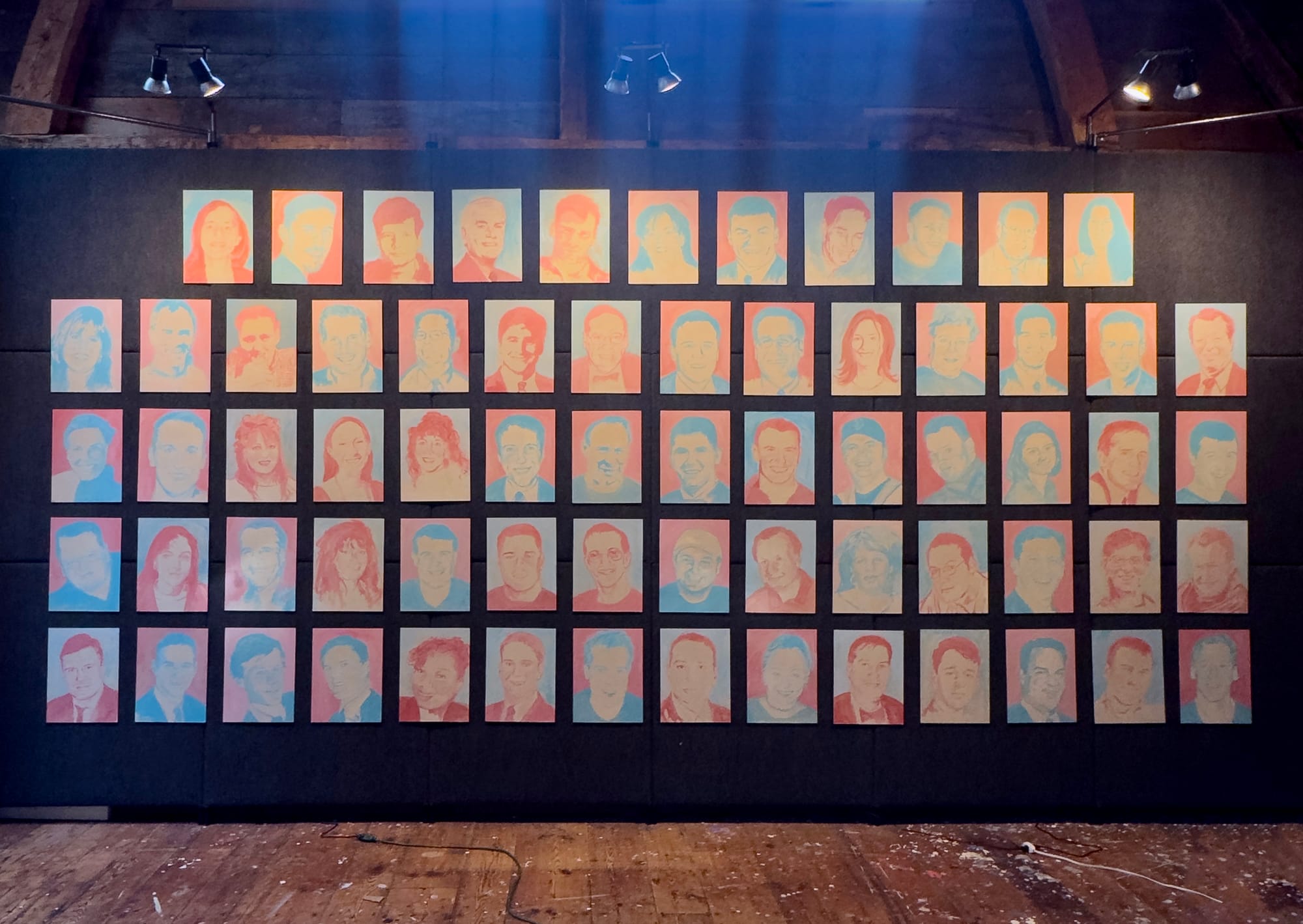
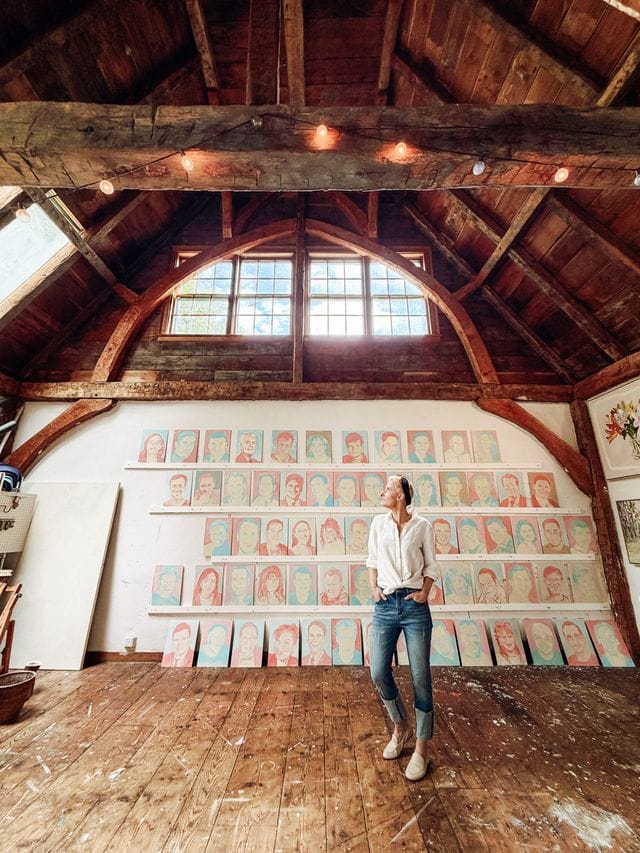
When she decided to start the “67 Portraits” project, Scheidt used photographs published by The New York Times’ “Portraits of Grief,” and materials from the Voices Center for Resilience to recreate her colleagues' faces. The portraits are painted on lightweight canvas panels and arranged alphabetically, creating what she describes as a “unified field of remembrance.”
From her studio, housed in a refurbished barn in Roxbury, Connecticut, Scheidt, 51, explains how painting the portraits was both an act of remembrance and unexpectedly became a way to set down a burden she had carried privately for 25 years.
A CONVERSATION WITH KATIE RÉ SCHEIDT
What inspired you to create these 67 portraits now?
I knew the anniversary was coming, and I wanted to do something for my children. They’re teenagers now, and I started thinking about how little schools teach about September 11th. To these students, September 11th is kind of abstract, but these portraits look like people they could know. They’re not old-fashioned. They look like someone you could meet today, and that was important to me.
For someone who wasn’t alive when it happened, I hope that makes the history more personal.
How did you decide where to begin?
I started with my desk. I was on the New York equity trading desk, and there were 23 people. I remembered the seating arrangement and started painting from there.
As I began lining the portraits up in my studio, something surprised me: it was good to see them together again. They were smiling and happy. They were wonderful people. Of course it was sad, but there was something really beautiful about seeing them again that way.
You chose a very specific three-color palette for the portraits. Why?
I knew I had to simplify the process because of the sheer scope of the project. I’ve never painted 67 of anything before. I also wanted all the portraits to feel connected, so I made them uniform in size and used a limited palette.
But I didn’t want the colors to feel stark or somber. Black, white and gray would have made sense for a memorial, but that wasn’t what I wanted. My intention was more like a sunset palette. I wanted them to feel as though they were being held in a warm light.
The colors—red, rose and blue—give the paintings a kind of vibration. They’re unified, but each face still has its own presence.
What was it like emotionally to paint people you knew?
It was an honor. I also felt a sense of duty, but I felt good while I was doing it. My husband thought I might be sitting there weeping as I painted, but it wasn’t like that.
I had missed funerals because they overlapped, and I never really grieved all of them. When something that overwhelming happens, you grieve who you miss the most because you’re just trying to survive the enormity of it.
Painting gave me a different way to spend time with them. I could sit there and really look at each person in detail—look at a cheekbone, a smile, the details of a face. There was something very meditative about that.
How long did it take to complete all 67 portraits?
About eight months. I started at the end of November and finished around the end of June. I created a spreadsheet for accountability and assigned myself a certain number of portraits each month. I didn’t travel during that period because I really wanted to focus on finishing them.
When I got about halfway through, I realized, “I’m going to be able to do this.” Seeing all of them together in the studio was incredibly impactful.
How did you feel when you finished the last portrait?
I felt very proud. I felt like they would be happy that I had done this. For years, the anniversary had felt like a private weight that came around every year. You roll it back up, and then it comes back again. I didn’t talk about it very much. But now that I’ve painted them, I feel like I can put the rock down.
What happens after you’re done with the showings? Are you keeping the portraits together or have families asked if they can have their person?
I want to keep them together. They’re individuals, but they’re also a community—the community that was lost. I think of them as a unified field of remembrance.
I will make fine-art prints available to families who want them, but I don’t want to separate the original paintings. Together, they say something that individual portraits cannot.
What do you hope people feel when they see the work?
I hope this work can do what art does better than any archive—make the loss feel personal, even to someone who wasn’t there. The portraits look like people you might have known. I hope that’s what makes them impactful for a younger generation who didn’t live through it.
Language doesn’t hold everything you feel. Maybe paint has the capacity to do something that words can’t.
Where would you like the collection to go after the anniversary exhibitions?
I would love for the collection to travel and be seen by more people. I hope it can eventually find a permanent home where it can continue to serve as a memorial.
I think the project is universal. It isn’t only about an anniversary. It speaks to what so many people felt that day—the astonishment at the preciousness of life that was lost.
What are you looking forward to painting next?
I’m ready to move back into the joyful things I usually paint. I recently had a show of abstract florals, and I loved making those. I paint a lot of nature-based work—florals, landscapes, abstracts and children’s portraits.
This project came from love and gratitude, even though it was a memorial project. My other work comes from the same place. I paint what inspires me.
There is always something new to paint, and that feels like a real gift. Painting is very meditative for me. You don’t have to think so much. It just flows through you, and it feels really good.
You can find out more about Katie Ré Scheidt at her website or following her on social media.
Where You can see 67 Portraits:
New York City
3-DAY EXHIBITION
MACDOWELL NYC
521 West 23rd Street, New York, NY
- Tues Sept 8, 11AM - 7PM (Reception 5-7PM)
- Wed Sept 9, 10AM - 2PM
- Thurs Sept 10, 10AM - 6PM
Please note that we may receive affiliate commissions from the sales of linked products.