Anne Lamott and Her Husband Neal Allen Want to Be Your Writing Teachers
Do you remember the last time you read a sentence that was so beautiful, you looked up from the page? Maybe someone was nearby and you read the sentence again, this time out loud. Maybe you clutched the book to your chest or dog-eared the page.
Like all of us, Anne Lamott loves it when this happens. “When you read a wonderful sentence by a good writer, it’s like getting spritzed by a plant mister,” she says. “One of the most beautiful aspects of reading are those moments.”
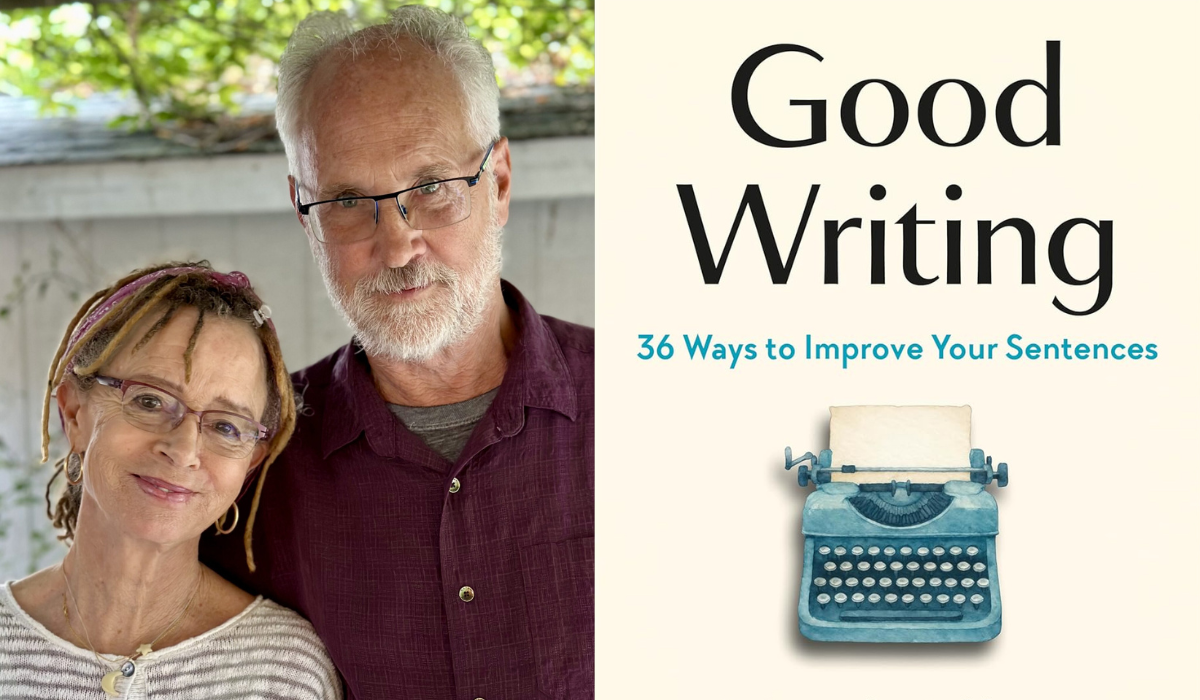
The bestselling author and longtime writing teacher teamed up with her husband, author and spiritual coach Neal Allen, to show all of us how to write more sentences that give readers those moments. However, you’ll get a lot more than smart writing tips in their new book, Good Writing, which is out this week. Lamott and Allen have a witty back-and-forth—something you’ll undoubtedly pick up on in our exclusive interview with the pair below—that makes the book feel less like a lecture on writing and more like you’re listening in on two people who deeply love and respect one another and are genuinely curious about what it means to live, and to write, well.
A CONVERSATION WITH ANNE LAMOTT AND NEAL ALLEN
Writing is a way for so many of us to make sense of what feels overwhelming or confusing. Why do you think writing holds this power?
Neal: Writing is a set of rules that frame things. Anything you write is an exploration; it’s something you haven’t quite figured out or gotten over, and you’re writing to get to the point where you can say, “Oh, that’s it,” and set it down and think about something else.
Anne: And the world and our lives—in the nation, in our families, and in our communities—is such a swirl of noise. To sit down and do the only thing you can do, which is to tell us one story or passage at a time, i.e. bird by bird, is almost a form of meditation. For a lot of us, it’s how we figure out how we even think about something. Writing is a way of gentling the horse instead of spiking all over the place and doom scrolling. You write to learn who you are and what you make of it all.
Neal: You know, we human beings are inveterate puzzle makers. We go out there and look for a new puzzle to make. It might be what we’re watching on CNN; it might be what we're seeing in our garden. And we just pluck out variables, smush them together, see whether they work and call it a meaning. And writing is a way to do that with a 3-year-old fascination with things. Even if the subject is ugly, difficult, or tragic. We’re still curious about it, and we want to create a puzzle we can solve about it.
Anne: Something Neal talks a lot about is that writing offers us the chance to regain our curiosity and our imagination that we had as children, only they stopped grading that at some point. Writing gives us back the gift of curiosity. And if we’re writing fiction, it lets us trip out and imagine—whereas when we were children in school, teachers would snap their fingers at us if we were spacing out. Now we’re supposed to do it. We make up stories. We get an A!
So many people feel the pull to write—but don’t know where to start. What would you say to someone who’s in that boat?
Anne: The first thing I do with all of my students is encourage them to write a long, numbered list of every memory they have that they’ve carried with them. Great prompts are your very first holiday, your very first classrooms. Systematically go through the Filofax of your brain looking for memories that come up. Get them down on paper.
If you want to write, you write as a debt of honor. You don’t wait for inspiration. You don’t wait to have a good idea or a plot outline. You write because you’ve decided you want to write. You sit down, take one of these memories or one story you’ve told people over the years that they really like, and write it down. For memoirs, you just start talking about what you remember from where you grew up, where you knew every dog in the neighborhood.
I taught writing for 40 years, and most of what people share with me is all the excuses they have for not writing. So my main advice is to stop not writing. Sit down. Keep your butt in the chair. And tell us one story.
Neal: There’s a lot of pressure people feel about that first sentence. Then you get the first sentence down, and the second will be easier because now you have a much narrower number of choices. When I was a journalist, I learned that the first sentence I’d just dash down, and then I’d write the article. But the first sentence was never what I ended up giving to my editor. That first sentence got me going and narrowed my choices so that it was a doable thing all of a sudden.
Anne: You just have to talk yourself into getting into that cold water. It’s never great at first. But if you stay there at the desk and you bob around, you’ll warm up. And then you’re in the water.
The book, Good Writing, is about improving your first drafts. The first draft comes basically with these two rules of taking it bird by bird and writing poopy first drafts. A lot of good writing comes from the real miracle of finding someone who’ll help you with your work. In many cases it’s a writing partner, it might be a writing group or collective, a class at the JCC or the community college.
Neal: It might be your wife!
Anne: It might be your husband!
The romanticized version of being a writer is that you’re all alone, the lighting isn’t good, you’re hunched over, pen gripped tightly, and it’s not any fun. But the truth of writing is that when you sit down and just start somewhere, all of a sudden you have something to show, and maybe you have someone to show it to. And when someone else is involved, it becomes fun and intimate and almost a spiritual path.
Neal, tell us about how you came to the 30-plus rules for writers we learn in Good Writing.
Neal: When I began my career as a reporter, I had an editor who told me, “Neal, the trick is to write with your verbs.” He explained that we all think in weak verbs—I walked, I ate. The trick is to go back and replace them with a vivid word. I trudged, I devoured. You’re pulling your reader closer with that rule.
Then, over the years, I heard other rules. Get rid of your adverbs and adjectives if you can. Take out the clichés. One day I realized I had a bunch of these rules and I thought it would be interesting to write them down. I reached close to 30 rules over 30 years. I looked around one day five years ago and I wondered whether there were any lists as long as mine. Hemingway had a list of four rules; Elmore Leonard had eight; Margaret Atwood has 10. None of them were that long. And I thought, Maybe there’s a book there.
Anne: So, Neal wrote these meditations and essays on all of the rules and the tips he had amassed over the years and showed it to me. I loved the book and horned my way into it and asked if I could contribute my two cents. That’s how it turned into a dialogue.
Neal would go first. He’s a little professorial, although very welcoming to the reader. And then I would come in and I’d be like the flight attendant to the reader and say, “Everything’s going to be OK. You can ignore Neal’s rule because he’s clearly overeducated, and I would try this instead.” Or, I would say, “Yes this is exactly right. Here’s an example I’ve always really loved of this.” We started riffing together on it, and that’s how Good Writing came about.
Neal: My job was to explain without it seeming like I was a scold, and to dress it up so it was palatable to people, because nobody likes to be told something. And Annie had the quite different job of bringing the reader to catharsis.
Anne: And encouragement! I always joke that I’m the 3rd grade den mother with the plate of cupcakes on everybody’s birthday, and I come through and say, “You’ve really got this, and we’re going to do it together. You just have to tell me one story and I’m going to write it down for you, because I can write faster than you.”
Neal: An idea behind this book is to demystify what writers are doing when they create beautiful sentences. There’s this myth that for certain writers, beautiful sentences just pop up in their minds. No, they practiced and practiced and made their way through a gazillion clichés before they start writing sentences that don’t have those clichés in them. This book offers some short cuts to abstract out and demystify what makes a good sentence.
Anne: I think that’s really important. In Bird by Bird, I wrote that every single writer thinks that the writers we love write beautifully. But every writer we love is writing these overly long, purple prose things with diatribes and tangents. You write a 600-page book and little by little, you winnow it down to 300 pages. Of course, we hate to take out a word of our deathless prose, but you’ve got to go through it and take out all the stuff you think is so brilliant, and the stuff you think will make everybody think you’re more educated or ironic or erudite or less of a buzz kill. You learn to edit yourself.
Dr. Spock the pediatrician told mothers with 2-year-olds you need to be firm but friendly. Good writing is about being firm and friendly with yourself and with anyone who has asked you to read their work.
I love this conversation because it reflects the back-and-forth in the book. Did writing this book bring you closer?
Anne: Neal did all the heavy lifting. He had these 36 essays on good writing that he handed over to me one day, and then I tugged on his sleeve bitterly and said, “You know I know something about writing too, Neeeeeaaaaaal!” And he let me into the creative process.
Neal: At that point we realized there was an opportunity for there to be a running thread through the book that writing is collaborative. Annie and I pass each other pages, and in doing that we have to respect each other’s insecurities. We have to be careful. So we talk about that in the book, and we talk about how collaboration actually works, how editors fill in blind spots.
Anne: We really didn’t have any difficulties doing this book. It became playful and fun. Neal is so much more educated than I am. I wouldn’t even know what he was talking about in some cases. And so I'd put on my shoes, walk over to his bat cave, and say, “What on earth are you trying to say here?” That would make him write it in a more welcoming way. Then I would go back to my office, which is usually the couch with a kitty, and I’d know exactly what I wanted to say. And I’d come up with examples to support what Neal had said.
I don’t think working on Good Writing changed our marriage, but it burnished the stuff that is so wonderful about us that was already there. We are partners in this life. We’re partners in each other’s writing lives, too.
Neal: If you have a writing life, it’s usually a secret to the people you know. Because we wrote about our writing life, it was thrilling in a modest way, to be able to expose day after day that interest that we have in writing.
Most people don’t talk to their spouse about what they did at their job that day. You talk about other things, or you might share some gossip, or suffering du jour at the office, but you’re not usually talking about the guts of your job. I always had this feeling that other people wouldn’t be very interested in what I do for a living. But this was just fun! We get to talk about what we do for a living.
Why this book on writing, and why now?
Anne: I think the world has never been colder and scarier and more overwhelming, and we both feel that entering into the writer’s life from wherever you are, on page 1, is a calling—like a monk to a monastery. It is one part every day where you can be outside of time and space.
Neal and I both feel that if people sit down and do a 1-hour pod, 5 days a week of writing, it’ll bring something immeasurably precious into what are otherwise scary days and scary times. We’re both sort of missionaries about this saying trust us, try this, give yourself a month and it’s going to be something you get hooked on.

Please note that we may receive affiliate commissions from the sales of linked products.