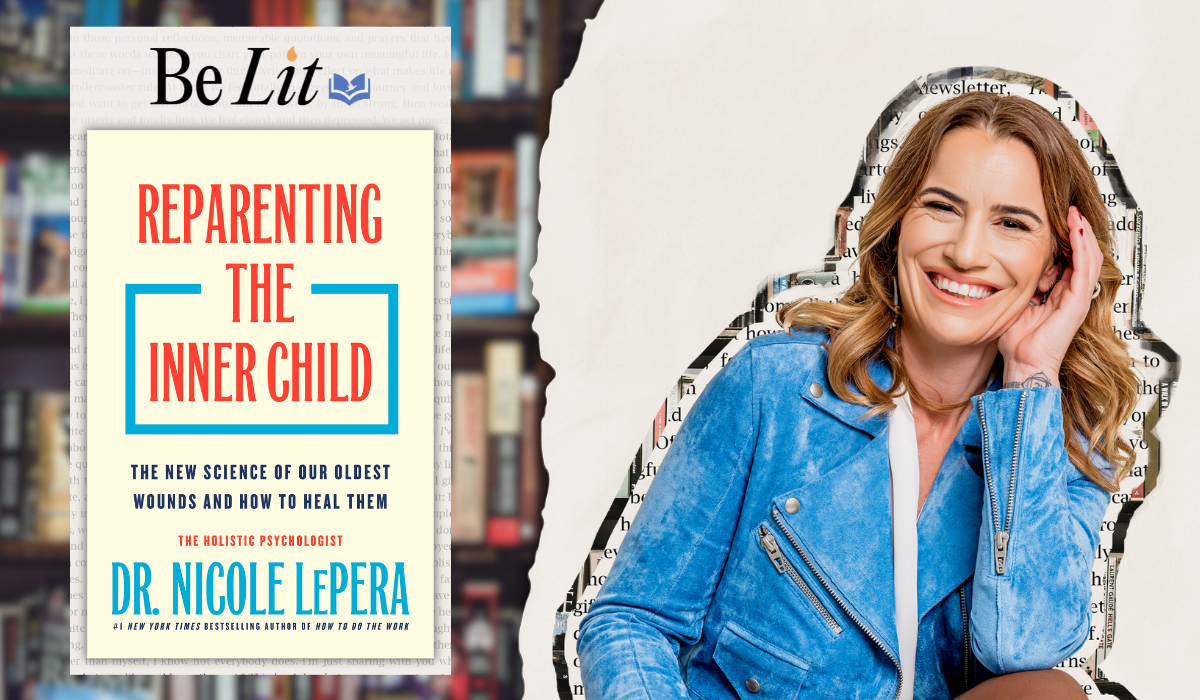
Be Lit with Nicole Lepera: An Exclusive Excerpt from “Reparenting the Inner Child”

During our childhoods, we construct an emotional home base—the automatic coping strategies and reactive behaviors that help us get through life’s challenges. This way of being—shaped or conditioned by experience—often follows us into adulthood.
For me, it meant carrying the constant sense that something was wrong, that I had to stay alert, that it was all too much. For a long time, I didn’t know how to feel at home within myself; that period and the work that helped me find my way back inspired my new book, Reparenting the Inner Child.
Lately, I have been thinking about the idea of home, and what it means to feel whole.
No matter how many different directions we go in—physically, emotionally, intellectually, spiritually—no matter how curious we are, how far we wander, how many people and places and ideas we encounter—don’t we all want to feel centered, grounded, and like there is some immutable core to who we are and where we belong?
I’ve been realizing how many of us yearn for a greater sense of belonging—in our relationships, communities, even within ourselves. What is it that separates us? What is it that creates the disconnection we feel in the course of everyday life, between who we are and how we act, what we think we want and how we feel, what we believe and how we are seen, or who we care about and how we connect with them?
Over time, I’ve come to understand that home isn’t just a place; it’s a feeling. It’s the emotional atmosphere we return to again and again, whether it nourishes us or not. The stress and disconnection that defined my childhood didn’t just shape how I coped; they became what felt familiar. They became my blueprint for love, safety, and belonging. The protective behaviors I developed to survive those conditions? They felt like home too.
It’s no wonder, then, that so many of us carry these early adaptations into adulthood. Many of our childhood homes—regardless of how they looked from the outside—lacked the emotional safety, attunement, or support we truly needed. Parenting philosophies may have shifted dramatically over the years, but one truth remains: Most of us didn’t grow up with a consistent emotional presence. Whether our caregivers were controlling or permissive, distracted or overwhelmed, if there’s one thing my clinical experience has shown me, it’s this: Very few of us have an internal sense of home. Few of us were taught how to feel safe in our own bodies, or how to feel rooted within ourselves and our relationships. That lack—of steadiness, of connection—sends us spiraling into habits we can’t break.
We feel disconnected from our own inner guidance, unsure of what we want or how we feel, frozen in inaction. And in that disconnection, we suffer. Other times, we swing to the opposite extreme and are consumed by emotion, needing everyone around us to feel how angry or hurt we are. This, too, is the voice of our inner child. It’s not just a part of us; it’s the part through which we first learned to survive, often without the guidance, support, or safety we desperately needed.
While we can’t rewrite the past, we can change the way we meet the needs of our inner child—the part of us that still holds our early emotional wounds and unmet longings.
This process is called reparenting: the practice of giving yourself the nurturance, boundaries, and care you may not have received growing up. In this process, you’ll learn to soothe yourself instead of exploding, to notice when you’re uncomfortable and make a change, and to attend to the needs of your body and mind.
By learning to show up for ourselves with consistency, compassion, and accountability, we begin to break dysfunctional habits and patterns that keep us stuck and to build the safety we’ve always needed from within.
When we do this, we begin to live from a place that feels calm, clear, and connected. A home that no longer runs on fear.
INNER CHILD REFLECTION
The work begins by remembering the child you once were. Here’s where to start:
1. Find a Photograph. Choose a picture of yourself as a child. If you don’t have one, simply bring to mind a clear image of your younger self—what you looked like, how you moved, the spark in your eyes.
2. Create a Safe Space. Sit somewhere comfortable and quiet. Place the photo in front of you or hold it in your hands. Take three slow, deep breaths, feeling your body supported by the chair or ground beneath you.
3. Meet Their Gaze. Look into the eyes of your younger self. Notice their innocence, their curiosity, and also the uncertainty or hurt they may have experienced. Allow yourself to really see them—not as a stranger but as you.
4. Acknowledge Their Story. Whisper or write a few words of recognition:
- I see how hard it was for you.
- You were worthy of love then, and you still are now.
- You didn’t deserve the pain you felt.
5. Offer Reassurance. Place one hand on your heart and one on your belly. With each inhale and exhale, repeat silently or aloud: I’ve got you now. Let this become a mantra of safety, a reminder that your adult self is here to care for the child within.
6. Notice Your Body. Pay attention to sensations that arise: warmth in your chest, tightness in your throat, tears in your eyes. Don’t judge them—just notice. These are signs that your inner child is being remembered and felt.
7. Close with Connection. Thank your younger self for showing up. With each slow, deep inhale and exhale, repeat silently or aloud: “I’ve got you now.” If it feels right, place the photo somewhere visible—on your desk, beside your bed, or tucked in your journal—as a daily reminder that your healing begins with this relationship.
Want to deepen your practice?
Take a few moments to explore the prompts below, writing your responses in a notebook or journal:
- What do I notice in my body as I look at this photo?
- What did this child most long to hear?
- How can I offer that message now, as an adult?
- What qualities—joy, creativity, sensitivity—do I see in this child that I want to honor today?
Starting here reminds you that healing is about reconnecting with the child who never stopped deserving love. This simple act of seeing, feeling, and speaking to your inner child lays the foundation for every other practice I offer in my book.
Excerpted from Reparenting the Inner Child by Nicole LePera, PhD. Copyright © 2026 by Nicole LePera. Reprinted with Permission from Flatiron Books. All rights reserved.

Please note that we may receive affiliate commissions from the sales of linked products.