What a Visit to Rome and Meeting Pope Leo Showed Chris Pratt About His Faith

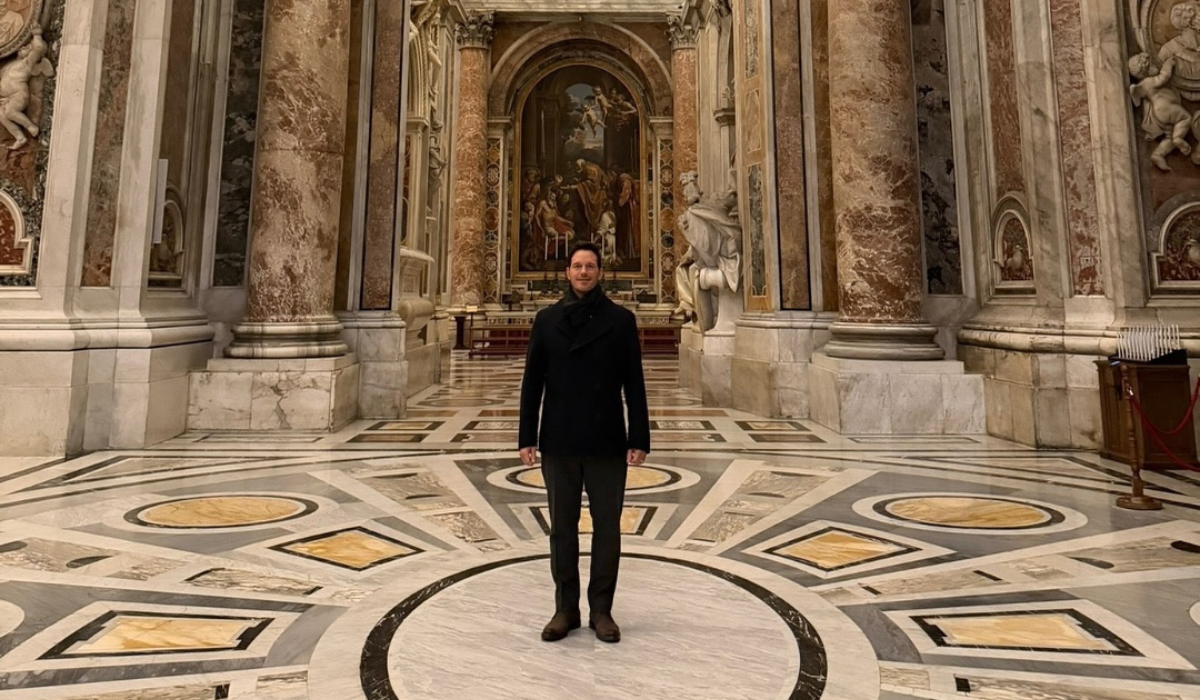
I’ve just returned from Rome, where I was filming a documentary on St. Peter. It was a profound experience to stand deep beneath the basilica, encountering the 2000-year-old bones of Jesus’ disciple, surrounded by the history and mystery of my faith—not as something abstract or distant, but as something I could see and touch.
I was baptized in a Catholic Church and have believed in God since childhood. I attended various religious institutions, including Catholic, Lutheran, and Evangelical churches. I knew little about the distinctions between denominations but so much about the healing power of Grace. Mine was a broken road marked by cycles of sin and forgiveness; a pattern of rebellion, shame and grace on repeat leading to increased extremes of emotional highs and lows. Then, when my son Jack was fighting for his life, I found myself back on my knees, pleading to God for a miracle. I promised that if Jack survived, I would devote my life to sharing God’s message. This time I meant it.
Jack is now a healthy 13-year-old boy. Not a day goes by that I don’t thank God for his life, and for the lives of my other children. I know how fortunate I am. I know there are countless parents who pray those same prayers and don’t receive the answer I did. My heart is with them always.
Ever since that moment, I’ve been trying to understand how best to speak of my faith—especially knowing that not everyone shares it. But whenever I can, I feel compelled to talk about the light my faith has brought into my life.
In Rome, I found myself thinking a lot about that light—and about the darkness that lives in all of us. I thought about the power of the light within each person I meet, and how to help others see it for themselves. Because light is not reserved for the holy or the righteous. Light is something we all have access to.
“You are the light of the world.” — Matthew 5:14
Light seems simple until you start paying attention to what it actually does. We imagine sunlight as soft and warming, a gentle radiance from above. We picture God’s light as pure comfort—guidance, revelation, safety.
But the more I have lived, the more I realize that light not only reveals—it creates. And one of the things it creates is shadow.
Stand with your back to the light, and a long, dark outline forms in front of you. The shadow has no soul, no depth. Yet over time it can feel like the truest thing about you. When you move it moves. Over time we mistake that shadow for our reflection. Because when your eyes are fixed on darkness, you forget that the light is there at all.
So many people live facing the shadow—defined by their wounds, mistakes, fears. The tragedy is that they think the shadow is who they are.
But the shadow only exists for one reason: the light behind them.
And here lies the irony: When a person is turned away from the light, the light doesn’t comfort them; it confronts them. The brighter it becomes, the sharper the shadow appears. Every fear, every flaw, every regret comes into focus. Some people aren’t afraid of God, they’re afraid of what their life looks like under God’s illumination.
There is a word for reorienting yourself in the Christian tradition: repentance. It is often misunderstood as groveling, shame, or punishment. But the word simply means:
To turn.
To pivot.
To face the light.
The turning isn’t the burden. The turning is the healing. Because when you finally turn around—when you face the source instead of the shadow—the darkness falls behind you. You see yourself clearly for the first time: seen, known, and deeply loved.
Darkness is not a presence. Darkness is simply the absence of light.
Naturally I want to share that light. But I struggle with how to speak publicly about my faith, knowing that brighter light casts darker shadows. I want to share the beauty of the light that changed my life. But the louder I shine, the more sharply some people see their own shadows—and instead of turning, they recoil.
If volume alone saved souls, then the man with the cardboard sign on the street corner crying “REPENT!” into traffic would be our greatest preacher. His voice is certainly loud. But volume doesn’t turn hearts. Love does.
People don’t need to be shouted at. They need to be invited. They need to trust that turning toward the light means discovering love, not judgment. Hope, not humiliation. A face, not a shadow.
Jesus told a story of a shepherd who leaves ninety-nine sheep to find the one who wandered away. It makes no practical sense—unless you understand the heart of God.
The shepherd is not content to preach to the choir. He goes after the one who can’t see the light.
Most people who are lost are not lost because they are bad, but because they are blinded by their shadow. If we want to reach them, we must walk beside them. Gently. Patiently. As long as it takes, our love the invitation to turn.
Faith doesn’t eliminate shadows. Faith places them where they belong—behind us.
Christianity does not ask us to outrun our darkness. It asks us to turn toward our light.
Some will turn quickly.
Some will turn slowly.
Some will wait until the Shepherd finds them where they are.
But the invitation is always there: Turn toward the light. See yourself as you truly are. Walk without fear of the shadow behind you.
And maybe that is my calling—not to be louder, but to be more like the light itself: steady, warm, persistent. A presence that doesn’t force the turning, but makes the turning irresistible.
Because in the end, the light does not simply define us—the light finds us.
Chris Pratt is a father, husband, actor, and producer.
Please note that we may receive affiliate commissions from the sales of linked products.