Decorated, Determined, and Olympic Bound

There’s a lot to be found in watching the Olympic Games. Of course, there’s the sheer physical capability on display. A level of athletic talent so captivating, it’s almost medieval. To watch an event is to be astounded.
The main truth propelling the Olympics, however, is simpler: These are games made of dreams. They’re the amalgamation of years of hard work and determination carried out by regular people with families, stories, challenges, and emotions like the rest of us.
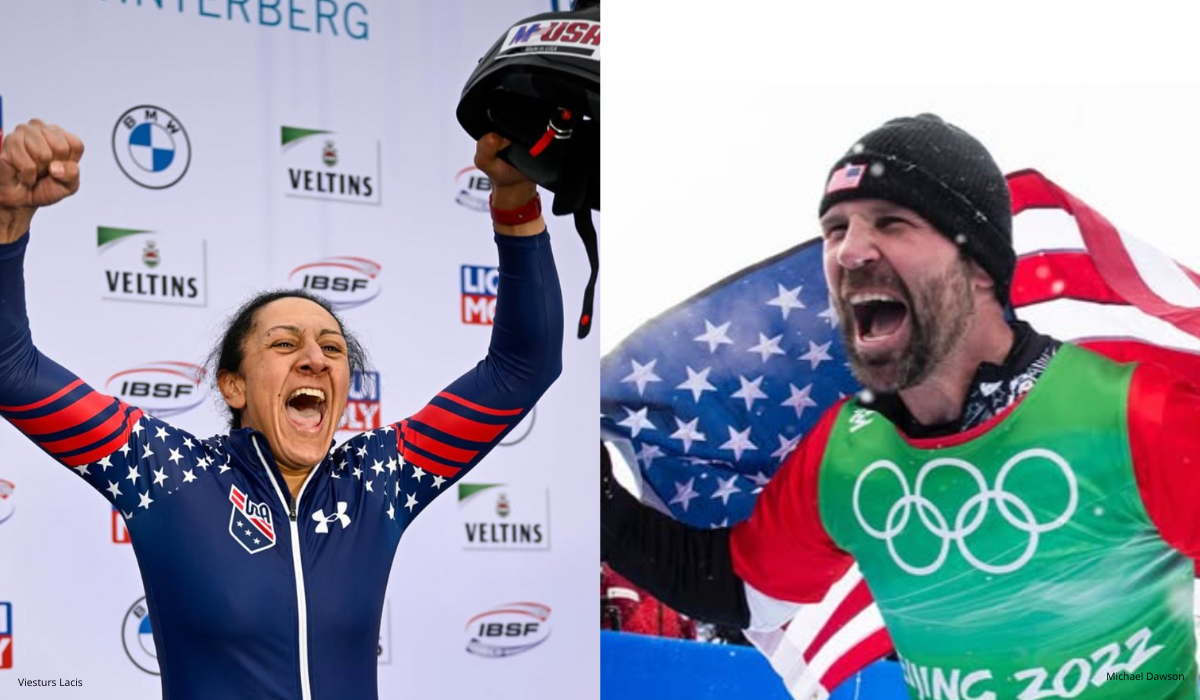
Elana Meyers Taylor and Nick Baumgartner, two of Team USA’s seasoned athletes competing in the Milano Cortina Winter Olympics, show us this truth. We recently chatted with them, both in their forties, to learn more about the person behind all the Olympic sparkle. They were each facing packed schedules when we called: Meyers Taylor was in Europe training for her final race, with her family by her side; and Baumgartner was at the airport, headed back to Europe to continue his training after a quick trip home to Michigan. Still, they were generous with their time and insight.
What is it to be an Olympian and a person who lives in dialogue with the pressures of the grandest sports stage? As these two athletes show us, it is a riveting honor and lesson in endless hard work and taking nothing for granted.
Elana Meyers Taylor
Sport: Women’s Bobsleigh
Olympic Medals: 3 Silver, 2 Bronze
First Olympic Games: 2010 Vancouver
Age: 41
Elana, you grew up playing softball in the warm-weather state of Georgia, and you became an Olympic bobsledder. How did you get from the field to the ice track?
The biggest thing was my desire and dream to be an Olympian, and I was going to do whatever it took to get there. I grew up playing softball, loved it, and thought that might be my path. I played softball collegiately, then I had the Olympic tryout, and it was an absolute disaster. The worst tryout in the history of tryouts! So to be an Olympian and live my dream, I needed to find another sport. And it was my parents who saw bobsledding on TV, and they said, ‘Why don't you give this a try?’ I googled it, emailed the coach, and they invited me to try out.
Wow! How do you feel when you say that aloud, all these years and medals later?
It is crazy to look back. After my first Olympics, I thought that I’d accomplished everything I’d wanted to as an athlete. I didn't need to do anything else. In my first Olympics, I won a medal, which was amazing, and I thought that was the pinnacle. So to continue my career and to be so successful, it's been an absolute whirlwind. It’s been a lot of fun. But it’s not been without struggles. I don't take a single moment for granted; I'm just blessed to be able to keep doing this and keep trying to reach my goals.
You’ve said that “the answer is always no until it's a yes.” What does that mean to you?
So often in life, people will try to tell us we can't do something. We can't do this or that. Or they’ll say the answer is no. Or sometimes, we’re not even willing to ask the question, because we're afraid people will tell us no. The biggest thing I tell myself is: You might as well ask the question and go for it, because what's the worst that can happen? I think so many of us are afraid of failure, afraid of trying something and it not working out, that we don't often try new things. But if you don’t try, then the answer is already no, so you might as well try—and maybe it will turn into yes.
Care is a giant part of your life, and something you’ve publicly spoken about. You’re a mom of two young boys, both of whom have disabilities. What are you willing to share with other caregivers about your journey?
First of all, the most important thing you'll ever do with your life is care for other people. I fully believe that. It’s a very important role, but it's very hard. It’s the most important thing I've done with my life, and it's also the most challenging thing I've done. It’s way harder than making an Olympic team and way harder than winning an Olympic medal. But it's so important.
The important thing—and I'm probably the world's worst at this!—is taking time to care for yourself. When you're in that care mode, you spend so much time looking out for other people that you forget to take care of yourself. For instance, my father's here [in Europe] and last night, we were getting ready for our last races, I thought, I’m going to go sleep in another hotel room, and I'm going to let my dad take care of the kids for the night. You have to be able to refuel and refill yourself.
In the US, we take for granted how difficult it is. We don’t value care in our society as much as we should. So, as I said, it’s the most important work you can do: taking care of loved ones and people who aren’t loved ones. It’s the most noble work.
What helps you through the hard days?
Reminding myself of why I'm doing all this and that my family is my number one. Even on the hard days with my kids, I remember that I’m not trying to raise kids, I'm trying to raise adults. So you will have hard days, and it’s about recognizing that that's normal. It’s very abnormal if every day were rainbows and sunshine. That's not reality! Knowing that this is a challenge for this moment, but it’s going to pass, and I have the perseverance and resilience to get through it.
And, I remind myself to reach out to loved ones when I'm having a really hard time. Sometimes we're afraid to ask for help, but it’s necessary.
As the US faces tough and divisive times, what do you hope the Winter Games bring to people?
What I really hope is that people can look at the Winter Olympic team and see somebody they can relate to, and also see that everyone’s working together: people who don't look like them, people who don't look like they do, people from different religions. In sports, we're all working together, and we're all representing Team USA. I think people are pretty unified behind Team USA, and people are going out there to represent their country. So, I think it's a great time for the Winter Olympics in that sense, because I think people across the country will cheer for Team USA.
Follow Elana Meyers Taylor here.
Nick Baumgartner
Sport: Men’s Snowboard
Medals: 1 Gold
First Olympic Games: 2010 Vancouver
Age: 44
You are still pushing ahead in your sport and you’re 44! How does it feel when people highlight your age?
It feels good! It’s just crazy to think that every four years it's become the normal thing for me to go to an Olympics and to still be doing it at 44, I’m grateful.
It all just goes to show what my preparation and the work I put in do to stay relevant in a sport like snowboarding at the elite level. To be able to continue to chase this dream that I started 22 years ago is crazy, and I'm having the time of my life.
After my first few Olympics, all the pressure and stress definitely took a toll. And after the last Olympics and the success I had in bringing the medal home, the pressure is off. It’s just time to have some fun. And not only will I just be having fun, but I have 20 family members coming to watch, so it's a little different this time.
Imagine what your 22-year-old self would be saying now to your 44-year-old self!
He’d probably think this is crazy—especially because I started chasing the dream of becoming a professional snowboarder, a sport that wasn't even in the Olympics. I was just chasing the X Games. Then, as I got into the X Games, they brought snowboarding to the Olympics. So, it's all just been an amazing journey.
Nick, as you said earlier, you put in so much preparation and work into your sport. How do you take care of your mental and emotional well-being?
I have to make sure that I'm enjoying myself. So for me, that means not spending hours and hours in the gym every day. I do a one-hour workout in the gym, then I'm off doing another sport, which most people would consider fun, but I still consider it a workout and training. I'm on my paddleboard. I'm surfing. I'm riding my mountain bike. I'm doing all these things I love that just so happen to make me a better athlete and help better prepare me for my season. But it’s about enjoying myself.
You were recently training in Europe, but you went back home to Michigan for a fundraiser and to engage with your community. Considering the people back in your hometown of Iron River, and all the kids watching you, what do you hope they learn from your journey?
I hope they see and they learn that anything is possible. I know that sounds cliché, but I'm 44. I'm from a small town with a ski hill of about 400 feet, and I'm going to compete at the highest level against people from the Swiss Alps, the Italian Alps, the French Alps, the Italian Dolomites, and the Rocky Mountains. These are the biggest mountains in the world, and I'm coming from a little ski hill in Michigan, and the last time a gold medal went back there. So, being able to use my story to inspire more stories like mine that come out of these small towns is something I take very seriously. And as you said, I went home, and the rest of my team stayed in Europe. I told my coaches that I had a responsibility to go home and speak at the schools and do the things that get the excitement to the community, so that these kids and these young people can really get some inspiration and go find their way and do what they want in life. Because I'm a 44-year-old child still traveling the world on my snowboard. It's quite a cool thing, and I think anyone can accomplish that. It just takes a lot of work and not believing the excuses.
Our country is facing many hard realities. What do you hope the Olympic Games offer people around the world, but particularly the US right now?
Sports have an amazing way of uniting people and bringing them closer together. I know it seems impossible in these times with everything that's going on, but I still hope and believe that we can make a difference out there in competing and showing our patriotism, and in representing what I still believe to be the greatest country in the world. And I know people, some might yell at me for saying that, but it's the truth. I've been all over the world on my snowboard, and there is nothing like the United States and the opportunities we have. So, to be able to represent that country is an honor, and I love it. I know that I can do good on that stage and find a different avenue to make a difference, and that's by inspiring people and pushing people to go and do their best.
And in the process, always try to be kind to people, because you don't know what other people are going through.
Follow Nick Baumgartner here.
Please note that we may receive affiliate commissions from the sales of linked products.