Life’s Tragedies Left Her “Fractured”—but She Persevered and Found Radical Freedom
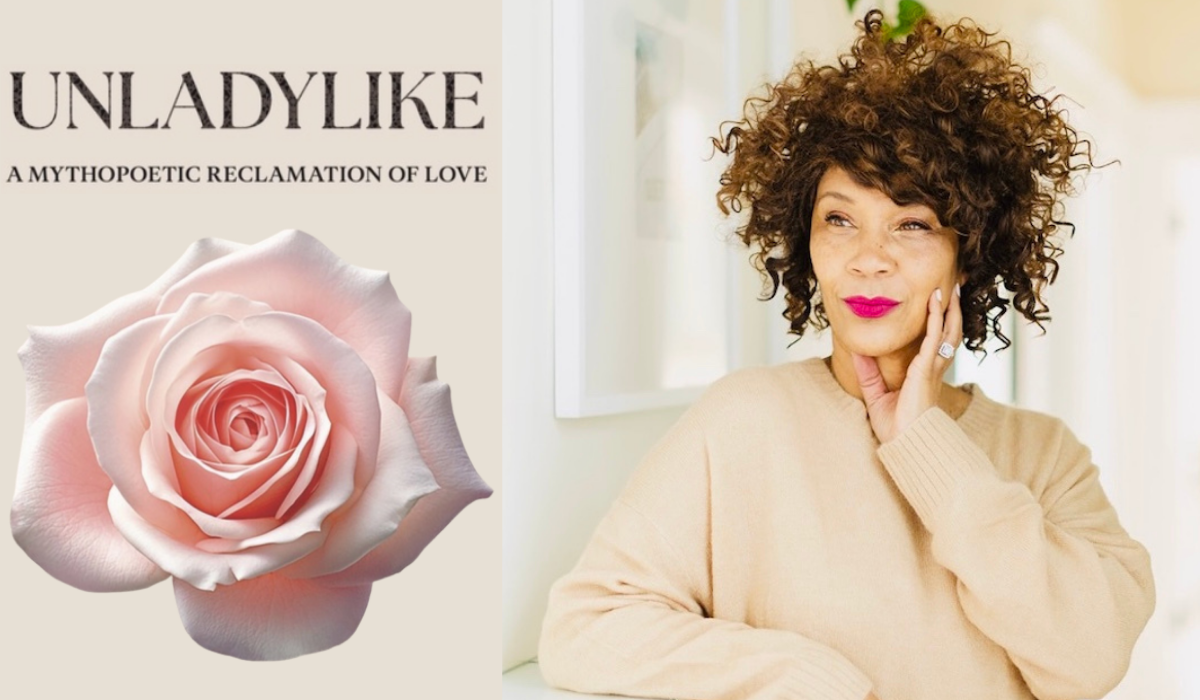
In Unladylike: A Mythopoetic Reclamation of Love, the forthcoming poetry collection by Regina Louise, there’s a line so simple yet so charged.
“Rise up, sugar.
Time to go . . .”
One can decipher its meaning. That’s the gift of poetry: It bears no rules for how to receive it. For Louise—a poet, author, teacher, and speaker—her words tell of coming back to the self.
“These poems brought different parts of my fractured self home,” she says over Zoom.
Many of life's cruelties have left Louise “fractured”—but never broken. Beginning in the 1970s, she spent much of her youth in foster care, moving from home to facility to group home more than 30 times before aging out of the system. She suffered abuse and neglect and wrestled with the relentless story that she was unwanted and unworthy.
Still, she persevered.
In adulthood, Louise has made it her mission to reclaim her self-worth and help others do the same. She’s written two memoirs, and her story has inspired a movie. She’s traveled near and far to share her journey and advocate for suffering children, and she’s become a soulful educator, both as a workshop leader and a Hoffman Process teacher.
Her work, alchemical and true, is about letting go of what no longer serves and emboldening our harmed parts. It has involved “summoning everything I know,” as she says, and “creating this gumbo, if you will; this mixture, this potion, this elixir, this potent personal medicine.”
That medicine moves throughout her new book of poems, Unladylike. Louise’s powerful poems, which she discusses further with us here, reveal deep parts of her story while reminding each of us the preciousness of our self-worth.
They’re a call to “rise up, sugar.”
Because your life is yours.
A CONVERSATION WITH REGINA LOUISE
A feeling that permeates Unladylike is that of self-preservation and belief. For instance, there’s this line, “With every inhalation, keep choosing yourself, baby girl.” Will you tell us more?
It’s interesting because this morning, I asked myself, What are your one or two favorite poems? I picked the one you're referencing, “An Ode to Butterfly McQueen,” and then “Teeth Jewelry,” at the end because that's the penultimate testimony.
All I've ever had was a direct relationship to spirit. There were no parents, coaches, or therapists, so there were no intercessors. I was the intercessor, so by grace, God, and grit, I became my own intercessor. I knew very young, This is it, kiddo. I’m a little bit old school; I think of Helen Reddy, “You and Me Against the World.” I learned very young how to metacognitively see my life objectively, so that I can be my mother, my father, my sister, my brother, my kin. Then I grew into it, and, intuitively, I followed that to this time.
What does putting so much of your soul onto the page evoke for you?
It's a beautiful question. These poems arrived. They employed me as their intercessor. I owe [the late actress] Butterfly McQueen for how I left my own Rhett Butler. And I do that; I leave. I took myself away from a voiceless, diminishing, psychologically, spiritually, and emotionally abusive situation, which is why Butterfly is so important to that poem. Her role in Gone with the Wind was to not have much of a voice, so, in a lot of ways, she's the one speaking, not only to herself, but to the me who was indelibly marked by the role she played. When she says, "Come on, baby girl, get up! It's time to go,” that was the day I had to leave. I had to leave the house, leave the dog while her belly is full, leave everything. And I needed the poems to act as an artifact. I had no language with which to leave, so the poem became the language.
The act of leaving echoes throughout your poems, and it feels like it’s about leaving and going toward yourself. What comes up when you revisit this topic?
So many of these poems are about leaving a love language, a familiarity, a nervous system looping that's trying to resolve. A lot of that is my nervous system trying to close the loop on what was perseverating and what traumas were looping, because that relationship was 50 percent amazing, 50 percent toxic and dysfunctional—and my psyche couldn't do it anymore.
My love language is toxic love, because for me, everyone left me, so I'm not leaving anybody. [I think] Oh, I can fix that. I can stay with my martyr patterns, my fantasies that I'm only good if I can be the magician and the conjurer. Spiritually, I feel like a Swiss Army knife, an elegant one, but one nonetheless. Sometimes I have to leave straight, other times I have to leave slant. Some leavings are precise. Some are calculated.
I think about all the women who leave, and the moment they leave. What do they take or don't take? What parts of the experience do they leave behind in lieu of the one that is calling them forth? I had to leave that I am unwanted. And in those moments—of course, I didn't see it then—I am the one I am calling for. It's this new me that's both holding the little girl who's hungry, which is predicated on knowing she's unwanted, and being the one to solve her hunger, and I'm also the one who's hungry. So I put a hand on my mouth and one on my heart, and began to build that bridge between those fractured selves, so that I could bring her home.
So leaving, in this instance, is synonymous with arriving.
This speaks to another line in a poem: “the audacity to begin again.”
It's audacious to be a woman of a certain age. To think we've found homeland in another or with another for self and other to only recognize, on the deepest, most psychological level, that if it were ever true that all we do is borrow relationships, maybe like checking them out in a psychic library, then it must be true, too, that we have to return them at some point. So the audacity to begin again is to take that book back to the library, hand it in, and return to one's own baseline and selfhood. A lot of my work, at this point in my life, is about self-continuity. When all those relationships resolve, when the borrower has to return the loan, what remains?
What would you say to that person who needs to return the book?
Let’s have a conversation first of all, because that capital S self is imperative in order to do the soulful reclamation of coming home. That is the big pivot: to become curious, to dare to be seen, to dare to be seen by oneself.
I'm here at my workplace at Hoffman, where 39 souls are daring to see themselves, and [seeing] the profound nature of how sometimes when that capital S self has been compromised, and the patterns of hiding, holding on to the harm, because it's easier to identify with the wound. So, for me, it's about awareness. The first step in transforming that more innocent, protected, retracted, regressed, suppressed self is to be with someone who is in themselves and then can mirror the ability to stay—because, quintessentially, it is about staying. Some of this is about leaving, but even in the leaving, we stay with the self.
What allowed me to look into that mirror was that I had to stay. Glennon Doyle has the most perfect word: “brutiful.” How to stay, and even mash up, the brutal and the beautiful into brutiful. I'm not saying all life is like that, but for some of us, it is. So how can we create a place for both to coexist? How do you hold the brutal? How do you hold the beautiful? [My poem] “Teeth Jewelry” is what that is. How to not become the victim, but to transform the harm into personal regalia.
Regina, what do you hope Unladylike brings to its readers?
I want every reader, every woman who has ever wanted to leave but couldn't and who feels the weight of her own victimization, whether that's self-perpetrated or other, to know that every one of these poems is about a certain personal forgiveness, so that you no longer have to identify with the wound and build an identity around that. I want each human who is brave, fortunate, and brilliant enough to engage with this collection to see, feel, and know that there is a path to move from pathology to mythology. My pathology, as a child, was: You're bad because you're Black. You're bad because nobody wanted you when you were born. That became a disease of sorts. So, instead of seeing myself through that lens, what if my broken heart was my brilliance? What if my running away, the instability of that, was because I was intuitively connected to Harriet Tubman and I knew I had to get away in order to save my soul?
So, I want to encourage women to be their own medicine. They are their own know-how, their own leaving, their own staying. They are all of those things. The multiple intelligences that exist within the human soul are profound. I want them to trust themselves enough that they are stronger than they imagine.
Regina Louise is an author, a child advocate, and motivational speaker. You can pre-order her new book, Unladylike, below, and follow her here.

Please note that we may receive affiliate commissions from the sales of linked products.