Forget Manifesting. Try This Instead.

Many of us have tried some version of manifestation—writing intentions in a journal, assembling a vision board, or repeating optimistic affirmations in the hope that our lives might follow suit. But for all its popularity, wanting something isn’t the same as wiring your brain to pursue it.
Scientists now understand that the images we rehearse internally have a powerful effect on our beliefs and behaviors, and sensory-based visualization is emerging as one of the most effective ways to harness that connection. However, to understand why visualization is so effective, it helps to understand what, exactly, the brain is doing during the process.
What Sensory-Based Visualization Actually Is
Sensory-based visualization is exactly what it sounds like: a method in which someone engages all their senses in order to visualize a particular scenario that they would like to see come true. In the process, what may start as a seemingly impossible dream begins to take shape as a potential–perhaps even likely–reality.
At first glance, this might sound just as farfetched as manifestation. But scientists have been studying visualization as a tool for self-improvement for years. Research shows that those who practice intentional visualization perform better under pressure (across a wide variety of activities and fields) and are generally happier and more optimistic about the future. World-class athletes, like the Olympic swimmers Michael Phelps and Katie Ledecky, and successful businesspeople like Oprah Winfrey and Spanx founder Sara Blakely have gone on record to say that visualizing has helped them achieve many huge milestones throughout their careers.
Like manifestation, visualization promises to help you achieve the outcome you most desire by first conjuring a detailed picture of it in your mind. But the similarities basically end there. While advocates of manifestation hold that you can will something to happen (or not happen) simply by wanting it enough and putting positive vibes out into the universe, visualization uses the brain’s natural chemistry to methodically shift your beliefs to ones that are more in line with your intentions. In this way, it acts as a tool to increase optimism, priming your brain to act in ways that better serve your goals, instead of undermining them.
Visualization works because it honors several truths about human psychology and the brain.
Truth #1: Our Brains Are Biased Toward What We Already Believe.
As we’ve established, our brains are extremely efficient. From the time we are born, they constantly collect and process information in order to help us make the decisions that are most likely to help us survive. Unfortunately, this efficiency sometimes leads to glitches, especially when it comes to abstract concepts like interpersonal relationships or self-esteem. When we receive inputs—from our parents, from society at large, from our peer group, from our own limited observations about how the world works, etc.–we can start to believe things that are, at best, false and, at worst, destructive. We see how this bias can work against us when we witness (or practice) discrimination based on irrelevant details or make assumptions about how a situation will play out before gathering all the facts. In our own lives, this bias is what leads to self-fulfilling prophecies. If we believe an outcome is unlikely to happen, we are less likely to perform the actions necessary to achieve that outcome, even if our belief is based on bad or at least incomplete information.
Truth #2: We Can Shift Our Beliefs by Shifting Our Attention.
Chances are you know what it’s like to be caught up in your own self-fulfilling prophecy. You harbor beliefs that you know are irrational, but when confronted with a situation to challenge that belief, you freeze or resort to default patterns that only reinforce what you already believe. You are sure that you’re not qualified for a job, so you get anxious and bungle the interview and don’t get the job. You think your crush is out of your league, so you avoid them in social settings and thus never form a relationship. You believe you’re not the type of person who will ever be wealthy, so you don’t negotiate your salary or create a savings plan, and thus always feel financially insecure. You tell yourself to snap out of it, that if other people can achieve their dreams, then why not you? But you’re stuck.
Sensory-based visualization helps us shift these beliefs by allowing us to create scenarios in which we can experience what’s possible in a safe, controlled environment. When we visualize the outcome we want and imagine ourselves in that scenario, our brains gather evidence that that outcome is possible. When sending signals to the rest of your body, the brain does not distinguish between fantasy and reality. When we think about doing something, our brains respond as if we’re actually doing it. When we visualize a scenario that in real life would elicit a particular emotion, we experience that same emotion just as intensely.
Truth #3: The Familiar Is More Powerful Than the Abstract.
Common manifestation practices usually encourage us to imagine the most perfect life for ourselves, even if it bears no resemblance to our current reality. But what if it’s difficult for you to conjure this image because it seems so far out of reach? How can you predict how you’ll feel in a scenario when you can’t even visualize the scenario?
The trick is to start with the familiar. When we visualize ourselves in a familiar setting, we take advantage of the memories, associations, and emotions our brains already associate with that setting, thus improving our ability to connect the visualization to reality.
The more you practice visualizing yourself in a familiar setting, the more your brain will associate that setting with the feeling you’re trying to elicit. For example, living in Los Angeles, I work with a lot of actors. Obviously, the main goal of any actor is to land their dream role, and usually that requires a lot of auditions. If you try out for enough roles, you quickly become familiar with the audition rooms at each of the main studios (they’re basically all the same). So when an actor client comes to me for help preparing for a big audition, I usually guide them through a visualization in which they perform the audition exactly as they want it to go while paying attention to the specific sensory surroundings. What is the temperature in the room? Are there any ambient noises? What color are the walls? What does it smell like? What do the casting directors’ voices sound like? If there is a bathroom on the way to the audition room, I have them visualize walking into it, standing in front of the mirror, and taking a deep breath. Then when they actually show up on the big day, they can reenact this moment, precisely as they visualized it, and prompt their brain to prepare for what follows. Every bit of information helps the brain prepare them for the actual audition day.
Truth #4: We Can Hope for the Best but We Must Prepare for the Worst.
Even if you believe that the energy you put out into the world comes back to you, there is no denying that sometimes, no matter how optimistic you are, bad things happen. But the best way to handle life’s challenges isn’t to ignore them, but to prepare for them. This is how we build resilience. This is how we do the hard things we must do to create the lives we want.
This may seem counterintuitive, especially if you’ve been schooled in the good-vibes-only theory of manifestation. But if you’re practicing visualization in an effort to change a belief or behavior or to realize an important goal, you must incorporate the challenges you will inevitably face into the visualization itself. By doing so, you prepare yourself mentally and physically to meet those challenges if, or when, they arise.
When we consider these four truths together, we see how visualization and this process of changing our brains can help us manifest what we want, not through magical thinking, but by altering our mental processing to help us make better choices.
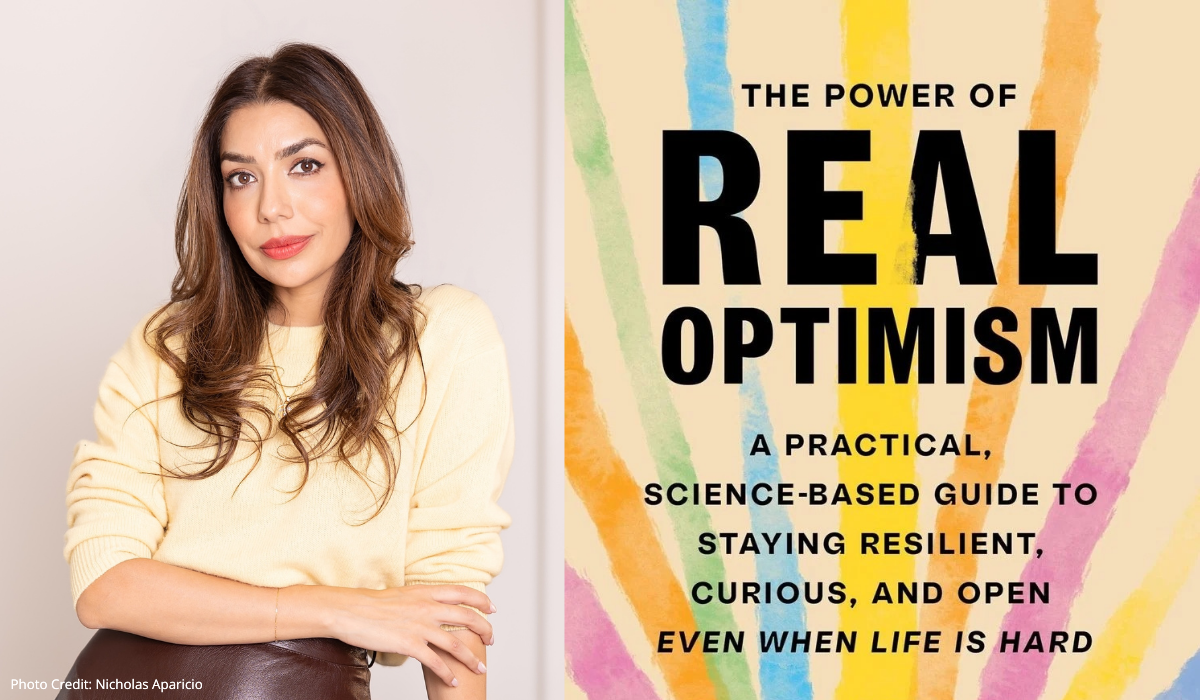
Excerpted from THE POWER OF REAL OPTIMISM. Copyright © 2026, Dr. Deepika Chopra. Reproduced by permission of Simon Element, an imprint of Simon & Schuster. All rights reserved.
Dr. Deepika Chopra—a.k.a. The Optimism Doctor®—is a professional psychologist, visual imagery expert, and founder of Things Are Looking Up®, a consultancy devoted to the intersection of science and soul. Learn more at drdeepikachopra.com.

Please note that we may receive affiliate commissions from the sales of linked products.