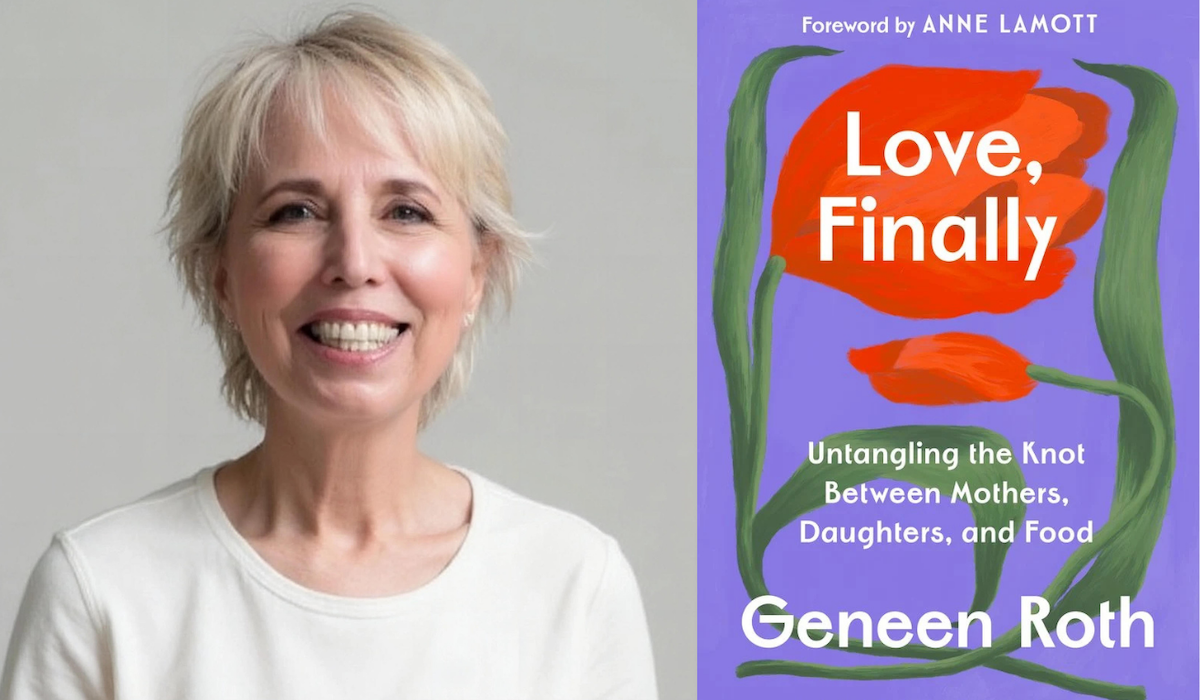
Geneen Roth Is Finally Learning to Love Herself

My best friend Christine of twenty years ended our relationship the day I returned from radiation from breast cancer. She didn’t tell me why. She didn’t tell me anything at all. She just disappeared.
I was so convinced that she had finally discovered the selfish, mean, wreck of a human I’d hidden for years that I didn’t tell Matt, my husband of thirty years, because I was afraid he’d suddenly see my twisted heart and ask for a divorce.
After two weeks of weeping in my cloud pajamas, walking around with my hair stuck to my wet cheeks and turning down food, even chocolate (which, believe me, is cause for alarm) I told Matt about Christine. He was horrified, called her brutal. Then I told a few friends who were equally horrified. “What a bitch,” they said.
But my secret shame was that I deserved what Christine did. That when you scratched away the shiny layers, you’d find the Meanness of Me at the bottom of everything.
Forty years of therapy and forty-five years of meditation had not dissipated the shame of being myself. Or of turning against myself, first through gaining and losing more than 1,500 pounds—the equivalent of a small horse—and then through a refusal to rest or stop pushing for more of anything, everything: food, sweaters, success, love. I was also ashamed of the shame, since I knew how privileged I was to have enough money, work I loved, a satisfying marriage.
A few therapists suggested I stop talking to my mother, who, one of them said, was only a little better than a hamster mother who eats her own offspring. I told them about the way she dragged me across the floor by my hair, told me I was fat and that my ankles were like piano stools, gallivanted around town with various men and didn’t come home until 4 in the morning. I told them that I felt hated by my mother. That I believed she was disgusted by me. And that I’d spent my life hating myself the way I believed she hated me. Being in therapy modified the shame and self-rejection but did not dispel it. I still woke up every day with the feeling that something was wrong and I was to blame. And with what I’d once heard Joseph Goldstein, the Buddhist teacher say: “Oy Vey, another day. Didn’t we just have one yesterday?”
When a friend told me about an 87-year-old blind woman who worked with buried lifetime conclusions, I sighed and thought: Another teacher that I will end up feeling snookered by because I will believe that it’s possible to dissipate the shame only to discover, once again, that it isn’t. Still. I decided to meet her because I figured I had nothing to lose but self-rejection.
During my first meeting with Coco, the blind woman, I told her about Christine, my erstwhile best friend. “And I had breast cancer! And I’d just returned from radiation!” I said in a “Can-you-believe-this-happened” voice.
Coco nodded her head, murmured “Oh pooh.”
“Isn’t oh pooh something you’d say to someone who burned the meatloaf not someone whose best friend disappeared?”
“You think this is about her. It’s not, it’s about you. Whatever was triggered by her disappearance was going on long before you met her. It’s that that we need to look at.”
“But…but…but,” I sputtered. I didn’t like having the situation thrown back on me. “I LIKE blaming,” I said. “Christine deserves it.”
Coco repeated that whatever I was feeling was not about being left but about the conclusions about myself I’d made by the time I was seven years old, and that those conclusions/beliefs were the source of the shame.
Turns out she was right. As I worked with Coco, I saw that it wasn’t what my mother said or did, it wasn’t what Christine did, but the meanings I gave to what they said or did that was so painful—and that I’d made up those meanings—I’m ugly, I’m fat, I’m disgusting, I’m worthless. And if I made them up, I could unmake them.
Which I did. And am still doing. But each time I question the shame about having a mean and twisted heart, I see that it is/was a child’s interpretation of what her mother said or did. And a lightness is revealed.
Dissolving shame, it seems, is a subtraction process. It’s not about putting sugar on shit, as Coco says, and piling up affirmations on top of the old beliefs. It’s about the kindness that automatically arises when I see that of course I believed that I was damaged. What child wouldn’t have concluded that from what her mother said? But it was a lie. And when I feel the kindness and see the lie, what is underneath, what was always underneath, is made visible: ease, a big quiet, and love. Always love.
Geneen Roth is a #1 New York Times bestselling author whose latest book is Love, Finally: Untangling the Knot Between Mothers, Daughters, and Food.

Please note that we may receive affiliate commissions from the sales of linked products.