How FDNY Chief Joe Pfeifer Finds Hope Even in the Darkest Days of 9/11

For New York Fire Chief Joseph Pfeifer, his memories of September 11, 2001 include the planes, the collapsing towers, and the enormity of the tragedy. But mostly he chooses to focus on how people responded.
Pfeifer was a battalion chief at the time, and had answered a call for a routine gas leak a few blocks from the World Trade Center—as documented by the French filmmakers Jules and Gedeon Naudet—Columbia University's School of International and Public Affairs who had been following his firehouse all summer. They all saw the first plane fly into the building.
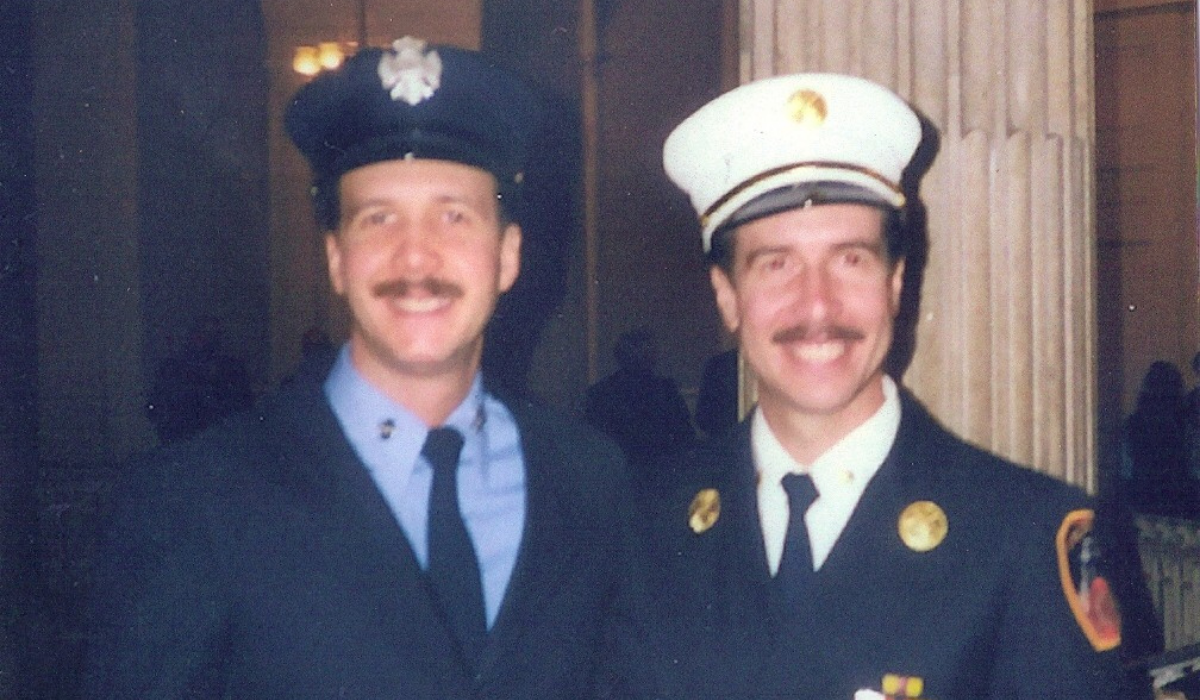
As the first chief on the scene, Pfeifer took charge, turning the lobby of the North Tower into the command center, and saw his younger brother, Lt. Kevin Pfeifer—also a firefighter—for the last time before Kevin headed into the North Tower. In the years since, and in his book Ordinary Heroes: A Memoir of 9/11, which includes a 25th anniversary epilogue, Pfeifer has turned that horrendous day into lessons about crisis leadership, resilience and community.
After 37 years on the force, Pfeifer is now chief of counterterrorism and emergency preparedness for the FDNY, and teaches at Columbia University. Many of his students are too young to remember 9/11, and how the country and world responded in the days after.
In our conversation about the 25th anniversary, what came through clearly was Pfeifer’s genuine kindness and willingness to share his experience in the hope that someone might learn from it. There was no anger or bitterness, no dwelling on what could or should have been. Even as he acknowledged the profound sadness of that day, he kept looking forward, returning to the importance of hope, resilience and community.
A CONVERSATION WITH FIRE CHIEF JOSEPH PFEIFER
Let me start by asking if it’s helpful for you to talk about 9/11?
Actually, it is—it's part of resilience. Part of resilience is reflecting on the past, gathering together because you don't want to be alone, looking to the future with hope and enhancing the present with purpose.
As I mentioned in my speech to the U.N., we don't ignore the pain of being victims of terrorism. Instead, we give it purpose to bring about change. Without purpose there is no hope, and without hope there's no call for global action.
I think by recounting the stories and listening to other people's stories, there's a sense of resilience. I've been doing this for 20 years, or close to it, and for me, that means I have to put it into concepts, so it's not just the story - it's what I've learned from telling the story, and what I pass to other people.
[Editor’s note: Pfeifer’s speech to the U.N. begins at the 8:12 mark.]
What happens at the firehouses now on September 11?
Every firehouse does its own thing. We lost 343 members, so it touches many firehouses. They bring back people who retired years ago, and families who lost people are invited back.
My brother's firehouse lost 10 people. They pull the apparatus out and turn the apparatus floor into a place where everyone has lunch.
I go back to the site for the ceremony, the ringing of the bells and the names, and then I go to my old firehouse and my brother's.
You say the heroes of 9/11 weren't superheroes. Why is that important?
Our heroes on 9/11 and the days following were not superheroes. They were people who did ordinary things at an extraordinary time.
They told people in the stairs, “Don't stop, keep going. You can make it out of here.” Those simple acts made a difference.
I think people look at the firefighters and think of superheroes, larger than life. But we did ordinary things in an extraordinary time. Sooner or later, each of us will be called to be a hero.
What do you remember about that sense of unity after 9/11?
On 9/11 there was the heroism of the firefighters, but on 9/12 the entire country came together. And not just the country—the entire world.
People came to New York asking, “How can I help?” They weren't just firefighters, police officers and medical personnel. They were construction workers and people with other skills. 9/11 was about courage and kindness, but it was also about global unity.
The challenge today is whether we can find that sense of unity without having to wait for another catastrophic event.
What do you think younger generations need to understand about 9/11?
A lot of my students are too young to remember. All they have are history books, documentaries and the news. They think about planes hitting the buildings and the buildings collapsing.
What we have to teach them is the message behind it: firefighters running into the buildings to save lives. It's a message of courage and kindness. In extreme events, instead of running away, we run into danger to help other people.
My firefighters knew they were running into the most dangerous fire of their lives. They made a personal, courageous decision to go in, and they went in with a sense of hope.
How has your perspective about 9/11 changed over the years?
It's changed by putting it into concepts and moving it into the academic world.
For me, it's connecting to other people, not only here but around the world. I've gone to Paris after the attacks and met with the fire brigade, the SWAT team and victims.
It's this connection to other people and influencing their decision-making through stories and lessons learned.
How has emergency training changed since 9/11?
Everything has changed. It's understanding the threat environment: What are we up against? What could happen? It's anticipating what could happen, and realizing you can't do it alone and working with your partners.
I did that in the planning session because I started a Center for Terrorism and Disaster Preparedness, which is now our headquarters. It's a beautiful place in Fort Totten. I would invite my fire folks, police, medical folks, and would sit around and either write a procedure or a training exercise, but either before, after, depending when we had the meeting, I had firefighters make lunch, and there's nothing better than a firehouse lunch.
We have to trust each other with our lives. So what I think has happened is that preparedness has become more real and more interdependent than ever before.
You lost your brother on 9/11. You were there on the worst day, when he ran into the North Tower. What is a memory of him on the best day that you hold onto?
We would always talk about the firehouse. We also sailed on a Hobie Cat in Jamaica Bay and the Atlantic Ocean.
My memory is of us sailing, sometimes flying a single hull of the Hobie Cat, and talking about a fire job we had and what we did.
I'm lucky I was able to see him in the North Tower. Those are special moments that I'm grateful for.
What do you want people to learn from 9/11?
Connect, collaborate and coordinate.
Connect to voice, video and data. On 9/11, five seconds of video would have made a big difference because I didn't know the South Tower had collapsed.
Collaborate by listening to your counterpart and then articulating their concerns, fears and what they want to do. I call that “crisis empathy.” It builds trust.
Then coordinate. We put interagency teams together, with unified command and decentralized control at the scene.
You don't have to be in a disaster like 9/11. You can be in your office and have a crisis. Connect to information, collaborate with others and solve the problem collectively.
What can ordinary people do to be better prepared?
Be aware when you go into buildings and when you fly on a plane. Don't just count on the pre-flight instructions. Listen to them and remember them.
Key awareness is important: Where is the way out?
Communities also have to understand the threat environment, including extreme weather. It's not just about depending on first responders.
What do you hope people take from 9/11?
Don't look at it through fear, but through hope: Something happens, I know what to do. My kids know what to do.
Being courageous can be stepping up and helping another student when everybody else is running away. It can be helping someone with a math problem or standing beside someone who's being bullied.
You wrote about giving a speech on the 60th anniversary of the attack on Pearl Harbor. What do you hope people remember about 9/11 decades from now?
“Never forget” means carrying forward the quiet heroism of ordinary people who, in the darkest hours, showed the world what community actually looks like.
The heart of crisis leadership is the ability to sustain hope by unifying efforts to solve complex problems in the face of great tragedy.
Our memories of 9/11 sow the seeds of resilience, unity, compassion and hope, with the enduring message that together we can make a difference.
Joseph Pfeifer retired from the NYFD as an assistant chief and founding director of the FDNY’s Center for Terrorism and Disaster in 2018. He is now an adjunct professor at International Public Affairs and the Director of Crisis Leadership at the Columbia Climate School’s National Center for Disaster Preparedness.

Please note that we may receive affiliate commissions from the sales of linked products.