I Want to Be Someone Who Is Ready to Say Yes

Reading Kate Bowler’s writing is to feel like you know her and she knows you. Her books, two of which include the bright and hilarious No Cure for Being Human and Everything Happens for a Reason, say what we feel but have trouble expressing. As she shares about her struggles with “live-your-best-life” platitudes, the existential gut-punch of a grave health diagnosis, or her confusion about life’s ironies, Bowler reaches for hope but never attempts to offer false cheer.
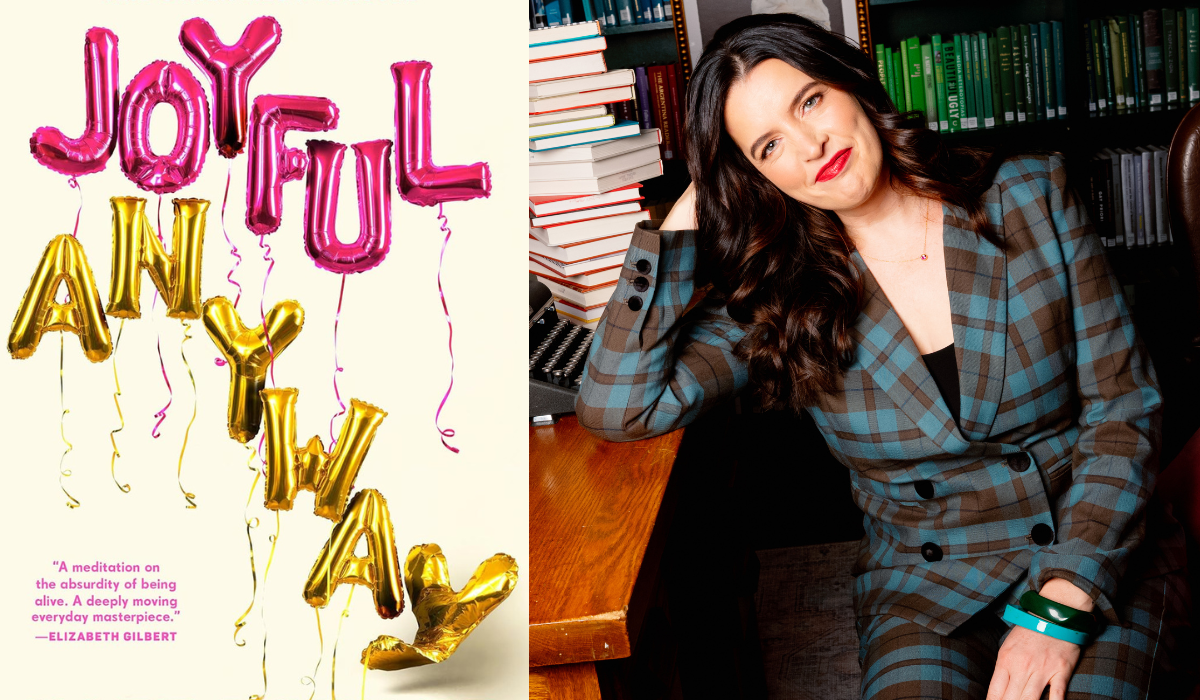
Building on this, in her new book, Joyful, Anyway, she continues this mission—pursuing joy amid intense difficulty. “Some seasons really are as bad as they feel, but then around the corner, something really beautiful is also waiting for us,” she tells The Sunday Paper.
Bowler is a four-time New York Times bestseller, Duke professor, and award-winning podcast host—roles that might balloon someone’s ego. Not Bowler’s. She’s an admittedly messy human trying to make sense of this hard, messy thing called life. And she wonders aloud: As we navigate this fractured world, can we even find joy in that hardship?
Bowler believes it’s worth trying—and she hopes all of us can stay open to this possibility.
A CONVERSATION WITH KATE BOWLER
Near the beginning of your book, you write how there is nothing “predictable” about joy. So, what do we get wrong about joy in our culture?
We have confused joy with a happiness project. It's very tempting to want to be happy some of the time, preferably most of the time, but happiness is built from good moods, lucky circumstances, and a lot of five-step plans. And frankly, also a lot of money and headlines that are better than what we have now. It requires a life that comes together. And I am really worried that we have gotten very confused about how hard life really is, and then we begin to hate ourselves for how it feels. So my real hope is that if we can recover the language of joy, we can gain back some of that emotional expansiveness and allow the lows to be as low as they really are, but know that the highs, the joy—that big, surreal, bright, enlivening gift that reminds us how good it is to be alive—can allow us to map out our life with a little more accuracy.
Some seasons really are as bad as they feel, but then around the corner, something really beautiful is also waiting for us.
In one chapter, you talk about how someone told your close friend that she wasn’t special. And you wanted your friend to know that person is not the secret to her universe; she is. What do you hope people take from that story?
It’s about that feeling that is sold to us in every rom-com, or that we can get a glimpse of in other people's relationships, either with their partner or with their kids: That somebody else out there always seems to be whole. Somebody else out there always seems to have found all the pieces and put them together, and then they will mail you a Christmas card about it. That somebody else's life is so beautiful. And… I've had my heart broken by life so many times now, and I frankly don't know a woman who hasn't.
So, the despairing version is to say we're all a little bit bleeding out. We’re all a little bit hemorrhaging hope, energy, and goodwill. But I think the more grounded way, the wiser way, is to say that for the most part, we will feel a little bit incomplete all the time, and we will have moments of temporary wholeness. And thinking about joy as temporary wholeness felt like oxygen in my lungs. Then maybe, for the parts where somebody else was supposed to love us, care for us, and protect us better, we get a little bit more grace for ourselves when we wish someone else had been that wholeness.
I love thinking about the idea that maybe we're not defective just because we have very leaky hearts.
Joy can be a mystery, you say. What has trying to figure out joy taught you about yourself?
I think a lot of the trying to figure out joy was me trying to understand whether there was something wrong with me or with all my closest, wisest friends. Is there something wrong with all of us, where it feels like complaining means that we are bad women? That failing to be satisfied with what's been given to us means we’re a bad mom or, for me, a bad Christian? Shouldn't I have found my rest in God by now? I wanted to think about: What are the only things that we feel comfortable promising people going through the worst moments of our lives? And I really think that we can promise each other joy.
How does writing help you access your joy and your feelings about life overall?
It’s only when I write that I can see how frustrated or constrained I am with a particular cultural script. I can see how that cultural lie is making me miserable, is making us miserable.
For every book, both as a historian and as a person trying to find their way in the world, I mostly think about my writing in terms of trying to dismantle a cultural myth. Everything Happens for a Reason was about why bad things happen to good people. No Cure for Being Human was about why wellness will feel so attractive and so incomplete. And [Joyful, Anyway] is about what we should be wanting when people talk about their best life now. I know the prosperity gospel version: God wants you to be happy, healthy, wealthy, and that you should be able to achieve that with your positive words and actions. But I felt, given how lightly apocalyptic this moment is, that it requires that we dig out something not just hard, but something beautiful for ourselves. What actually is the loveliest thing that we can offer each other?
I had spent so much time studying #blessed, so then I started trying to figure out: What are the actual blessings that we cannot just hope for, but run toward? Because joy is an actual mystery, it felt so important to find out what story that mystery is trying to tell us. And I think it’s that, even now, despite how it feels to be a person, we somehow need more language to recover a deep sense of our own unshakable goodness, as Father Greg Boyle would say. And so, every time we get the gift of joy in the most ordinary things, which are really the most extraordinary things, we get a reminder of our worth that is better than any Instagram show-and-tell. It feels like it is somehow the greatest thing in the world for us who have been born.
A few years ago, Miroslav Volf shared on your podcast that keeping himself open to opportunities that might emerge rewarded him with a shift in perspective, especially when he faced despair. Kate, considering how it’s so easy to doom scroll and lose ourselves in hopelessness, how do you keep yourself open to joy?
It gets me emotional just talking about it. I think we’re all in a hard conversation with our fears right now, and whether there's enough for all of us. I talk to people all the time who are scared about the future of work and what to tell their kids. Everything is precarious; democracy is as precarious as it is. I always find myself back in a room having a tough talk with a doctor, wondering if anything good ever happens and whether anything bad ever changes. So, for me, that question digs up the biggest homework, which is: Be surprise-able. Be someone who is not just awake to the world, but ready to say yes. I want to practice being someone like that. I want to be ready to say yes. Whenever you meet someone like that, it sticks with you because it's like they've fallen in love with the world again. I need that in order to shout down the loudest parts of despair.
Learn more about Kate Bowler here.

Please note that we may receive affiliate commissions from the sales of linked products.