What the Young Men in My Chair Are Saying

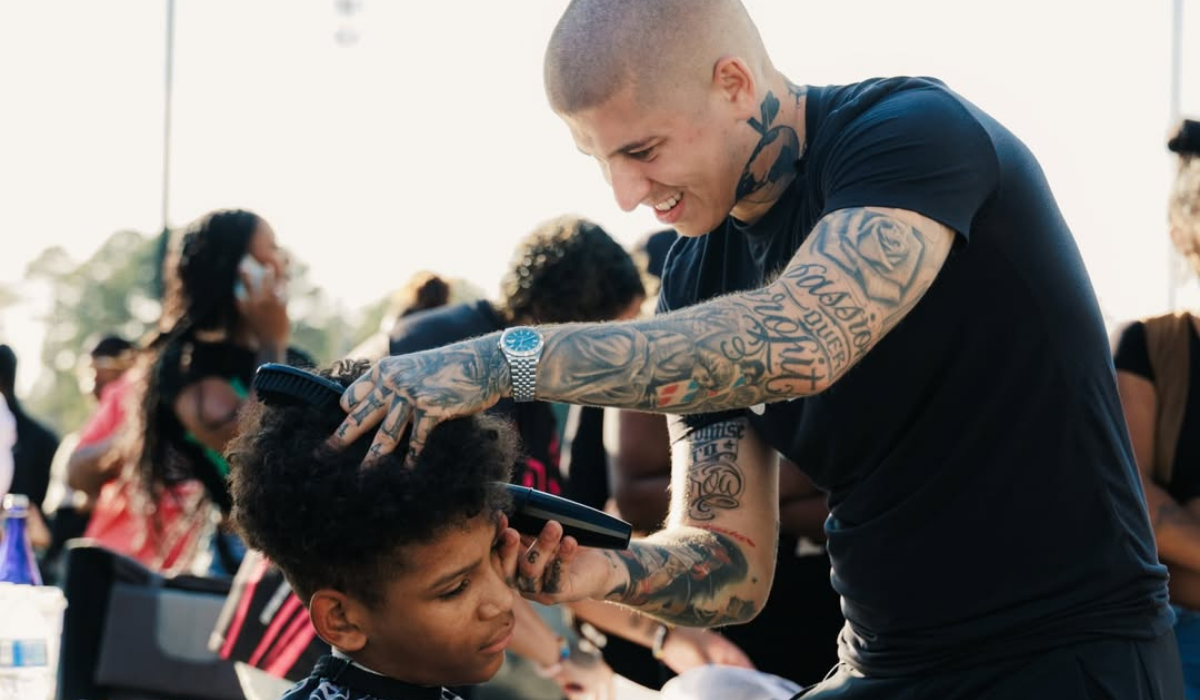
“The chair is always a vulnerable place for men,” says Victor Fontanez, aka VicBlends, a barber, motivational speaker, and philanthropist.
Fontanez’s “chair” has seen its share of vulnerability—and wisdom.
In 2021, after the pandemic impacted his barber business, he began offering free cuts to strangers in parks. As he blended and faded, people shared their struggles and dreams. Fontanez began posting some of those conversations, and since then, they’ve attracted more than 25 million followers across his social platforms.
These days, Fontanez gives speeches and chats with notable public figures, including President Obama and Tom Brady, for his podcast series Deep Cut. His work is infectious, as is his willingness to share about his own struggles. Yet at its core, those free cuts in the parks remain. The majority of his videos focus on his conversations with boys and young men who offer Fontanez such mature wisdom in response to his encouraging questions.
And that's what the world needs more of, Fontanez tells The Sunday Paper: listening to our youth, teaching each other, and remembering that no matter what, you’re worthy—in and out of the chair.
A CONVERSATION WITH VICTOR FONTANEZ—AKA VICBLENDS
What is it about the chair that gets men talking?
The chair is one of the most vulnerable places that a man could be in. Imagine: You meet somebody for the first time, and you're trusting them to put a razor blade to your neck. Already, you have to have trust in this stranger. So, being in that trusting position opens the door to a conversation.
The chair is such a vulnerable place people go to when they look their worst and feel their worst. People go to the chair when they're on the way to a wedding, or they're on the way to a funeral, or on the way to a graduation. It’s such a special place, and it’s a natural gateway for people to open up about mental health experiences, stories, conversations, good news, bad news. We don't have a lot of those outlets, so the shop, culturally and traditionally, has always been that. It’s almost like a speakeasy for men.
It’s such a self-esteem builder, too: a fresh cut.
Yes! No matter what's happened to you, you will feel a little bit better if you get a fresh cut!
You’ve had countless people in your chair, from famous athletes to politicians to women and men you’ve just met, all of whom have opened up to you. In that lot are many boys and young men. What have you been hearing from these kids and young men that concerns you?
When I talk to the young kids and I ask them, ‘What would you change in the world?’, they all say violence—especially those I meet in Atlanta, where we live. Kids have been exposed to violence so much today, whether it's online, shootings in neighborhoods, or violence in schools. Now that we’ve got social media, violence is around now more than ever. Back in the day, you'd have to watch the news, but as a kid today, you open TikTok, and you see tragedy left and right. So when I see young kids and ask them what they’d like changed, they say gun violence, or they say they want more kindness. That makes me sad when they talk about violence and what they see at that age.
What are they sharing that gives you hope?
I get to see how emotionally intelligent and emotionally affected these kids are at a young age. I don't think you would expect that from a lot of these 12-year-olds—to be so in tune. I've talked to some of these kids, and they've got plans to change all of this in their community, so that gives me hope. To already recognize that things are not feeling good for you, and to be in tune with things you want to change at a young age? Those are the future leaders of this world! These kids give me hope.
For a young man who may be struggling right now, what do you say to him?
You are worthy just because you are alive. A man's worth isn't off of what he could provide, how much money he makes, his status or his economic standing. You're worthy because you're alive—and to be alive means you have purpose somewhere.
I don't ever want young men to feel that they need to be validated off of achievements or girls or cars; what they drive, where they live. The fact that you're here, you're already validated. That's what I would tell him: Your worth isn't based on anything else other than the fact that you're here, and you're you.
Your work gives so many of us hope, showing us the power of listening and kindness. How can we show up better for each other?
When people see my work, it’s on a big platform, and so you [may] think you got to make a crazy video, and you have to get a lot of views to be impacting people. But impact doesn't need a number to it, and I've always said this. It doesn't matter if it's a million people or one person. Saving one person or helping one person is the same impact as a million people. I think people expect that they need to reach a certain amount of money or have a certain platform or things to give somebody, but man, just one conversation at a time affects so many people. I can't tell you how many haircuts we do with these kids that don't ever make it to be a video. If we could just have more of these conversations, just one at a time. Those are the seeds being planted. That’s what we need.
I can't imagine—or I can't wait, actually—to see all these 12- and 11-year-olds I'm cutting in my neighborhood: What are they going to be at 18, 19, 20? How many kids and other people are they going to affect and help because we had one interaction?
This makes me think of when you taught Jayden how to give a good handshake.
I could cry right now. I just cut this kid the other day, and he saw that video, and he asked me if I could teach him how to do a good handshake. His mom passed away suddenly, he had no father present, and he lives with his grandma. This kid was like, ‘Can you teach me how to do a good handshake?’ And I said, My gosh, of course! These are the little things that we need— more role models for young men, showing them simple things like that. It’s what we need.
On a more personal note, you’ve been forthcoming about your mental health. These days, you’re on the road a ton, working, meeting people, all while growing a massive audience. How do you take care of yourself and stay grounded on a daily basis?
A couple of things. In 2023, I got diagnosed with bipolar I disorder, so I went through a big mental health crisis. That was a big turning point for me to think about how I take care of myself. That happened when I was 23, and I was a young hustler. I thought I could physically push through anything. There was no need for therapy; there was no need to slow down. I was just having the time of my life, blowing up online. I pushed my body to the limits—and then I realized, it's mind, body, and soul. It’s three things that a person needs to take care of. Man, I neglected all of them and didn't realize that it’s going to take more than just powering through and pushing through life. I didn't know how to just take a step back. So, after that mental health crisis […] I learned how to just walk. When you're coming up in your life, and you're chasing the dream, you're sprinting, you're running hard, you're trying to make it. But the first thing you ever learn in life was to walk. Just take one step. In life we get caught up in the sprint and running towards what we want to achieve that we forget that we know how to walk.
After that, of course, I started therapy, got a psychiatrist, and started medication, and I haven't missed my medication—let me tell you, right now—in 888 days! I've never missed a day of my medication. And medicine is one part of me being able to be healthy. You’ve got to balance that with your lifestyle. So, sleep is not something I compromise. My diet, I eat super well now. I go to the gym now. All those little things—gym, eating, medication, therapy, checking in with my psychiatrist, and reflection time. And I celebrate wins now. Before, I was so focused on the next one. I would have great things happen and I’d be like, What's next? What's next? What's next? So I didn't take time to sit back and see that I have come a long way. So now, I do. If my life stopped now, I’d still feel that I’ve served my purpose.
What has taking care of yourself taught you?
To not take care of yourself is a disservice to your loved ones. My family, and my fiancé, and my closest friends went through the worst of times, seeing me go through a manic episode and depression. I saw that I can't be there for them if I'm not there for myself. So when I look at my medication, I see that it's bigger than just me. I don't want my family to have to see me go through that again, and I don't want them to ever have to feel that. I couldn't possibly function for anybody in this world when I was going through that hard time. So, if I want to be there for my loved ones, I got to be there for myself.
It’s refreshing to hear you be so honest about your struggles because it's normal for a man to keep it to himself.
The strongest thing a man can do is ask for help.
Victor Fontanez is a barber, motivational speaker, entrepreneur, and author of the forthcoming book, Stay Planted. Learn more and watch his work at @vicblends.
Please note that we may receive affiliate commissions from the sales of linked products.