Why One of Hollywood’s Most Revered Screenwriters Is Turning to YA Fiction

In junior high, Billy Ray aimed to be the first Jewish president. He got to work early and won the student body presidency but, after seeing "the seamy underbelly" of politics, changed course. “I decided politics were not for me,” he tells The Sunday Paper.
So he became a writer.
Over the decades, Ray has written stories for Hollywood that have shaped the zeitgeist, including the fall-from-grace tale Shattered Glass (which he directed), the high-seas thriller Captain Phillips (which earned him an Oscar nod), and the first film adaptation of The Hunger Games. His stories are wildly entertaining, but they also explore deeper themes that seek to answer humanity’s biggest questions.
And his new book—a work of YA fiction—is asking these questions more loudly and boldly than ever.
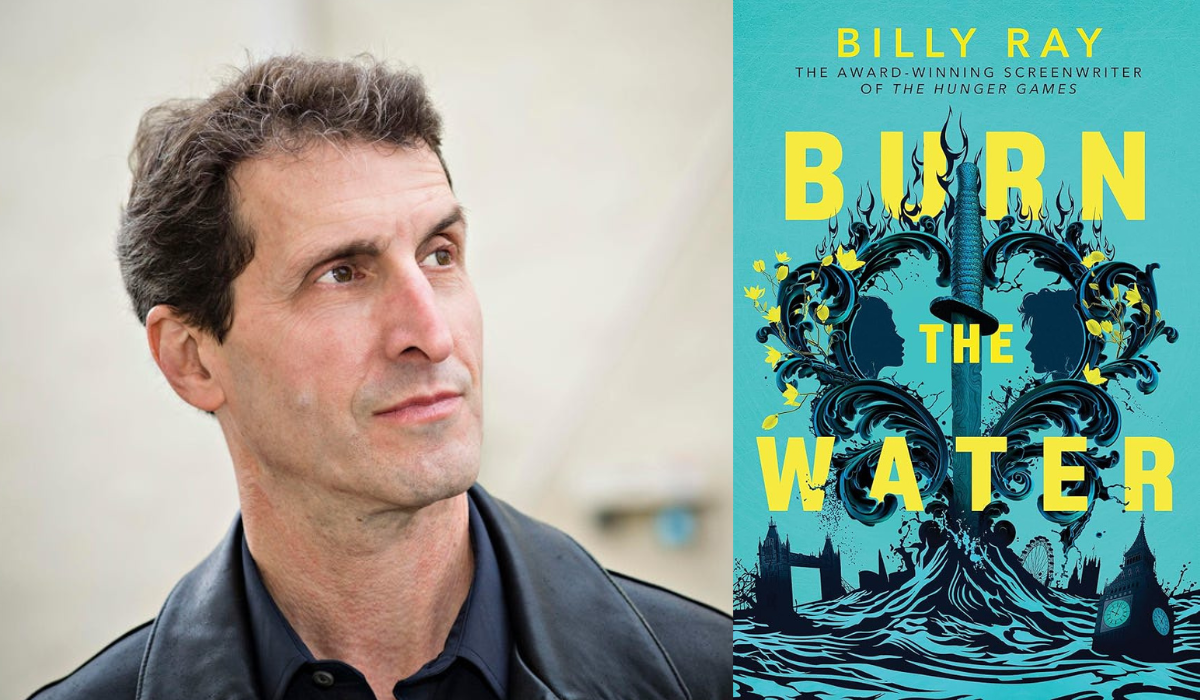
What kind of person do I want to be? What kind of world do I want to live in? Who are the leaders I look to? These questions anchor Burn the Water, his first young YA novel. It follows two teens in love as they discover themselves in a collapsing world. Ray hopes this novel can offer readers of younger generations a moral compass in the most challenging of times.
"It was a love letter from me to my kids and to teens everywhere to tell them that they can make a difference," he says of Burn the Water. "That they can lead."
Perhaps that young man yearning to be president is still kicking inside of Ray. Except he's found a different way to make an impact—and he's hoping to pass it on to readers, young and of any age.
A CONVERSATION WITH BILLY RAY
Your work has landed at this intersection of storytelling, politics, humanity, and history. What is at the forefront of your writer's mind these days that you wish people would be talking about more?
I’ve always been very America-focused in terms of things that I write. It’s the country I know best. I've always written things that were either true stories or stories that mirrored true ones. When Trump was elected in 2016, I could no longer work on anything that didn't, in some way, reflect my country back to itself. It had to be about democracy and our Constitution and our rights and our civil liberties. Even if it wasn't expressly about that, it had to be in there. That, of course, is hugely on my mind, and it was when I sat down to write Burn the Water. Even though it's not set in America and doesn't feature Americans, the values we're talking about now are all over that story. And even though it's largely romantic and it's got lots of things that make it a YA book, for me, there's so much thematic material that's running through it that speaks to this exact moment.
I don't know how writers write about anything else right now, I really don't. It's so present, and on my mind, always.
You already have the sequel to Burn the Water in the works.
It’s funny, the timing of this and the way YA books work. You have to write the sequel before the original hits the stands, because you want to be able to follow it up within a year. So the sequel is already written, and it goes even deeper into these themes about: What kind of people do we want to be? What kind of values do we want to espouse collectively?
A central theme running throughout your novel is bravery, as evident in the main characters, Jule and Rafe. What sparked the inspiration for these characters and the story, and what do you hope readers take from it?
I have a daughter and a son. This book started as a love letter to Shakespeare. I wanted to try to re-explore Romeo and Juliet, which is the best love story of all time. I thought, what would happen if Romeo and Juliet were set 400 years in the future? That was where it started, but as I was writing, it became very clear that this really was not a love letter from me to Shakespeare. It was a love letter from me to my kids and to teens everywhere to tell them that they can make a difference. That they can lead.
Ultimately, this book winds up being about leadership. Again, it’s that idea of what kind of people we want to be. And what kind of leaders do we want to follow? This book became a gift to two young people who I know feel so disenfranchised and so disoriented about where the world is going. What I think you need to do in a country that's in the shape that my country is in, and in a democracy in which you have an entire political party that is treating the Constitution like it's an inconvenience, we need to get back to principles. And that is: What kind of country do we want to be? What kind of people do we want to be? What kind of leaders do we want to follow? Rafe and Jule become emblematic of that.
After writing for the big screen for decades, this is your first novel. What has writing fiction taught you, and what do you believe fiction uniquely gives readers?
I go back to what Pablo Picasso said: Art is a lie that makes us realize truth. That's about as good as it gets in terms of where fiction sits in our society, and what its role is in that society. I’ve told so many true stories in my life. Shattered Glass, Captain Phillips, Breach, or The Comey Rule. There have been a bunch of them, but there's nothing that I've written that has touched as many people as The Hunger Games. I wrote the first [screenplay] and the one that's coming out in November. The Hunger Games is fiction, but it certainly doesn't feel like fiction when you're reading or watching it. It feels more like a warning. In that way, you can explore human behavior and the human condition in a relatively safe way, because it has that “fiction” around it, yet it's extremely revealing about how people treat one another.
It's not surprising to me that fiction is something people are leaning on, because real stories can feel pretty grim. We are looking either for the escape of fiction or for fiction to take us into an exploration of where the human experiment is in its arc—and fiction can be laser-like in its examination.
As a father, an advocate of democracy, and a writer, how do you drown out all the noise and stay focused on what matters to you?
There are the parts I can control. And that is about what kind of person I want to be. Speaking of how fiction plays a role in our lives, I think about the fictional characters from my childhood, where I said, ‘That’s how I want to behave.’ How would Atticus Finch? How would Mike Brady respond? The part you can control is what kind of person you want to be. How do you want to treat other people? That's a big part of it.
Then there’s focusing on my work. I'm at my desk at 8. I take a break at 1. I'm back at the desk at 1:15, and I go until 6. I'm not surfing the web. I'm not gambling online. I’m not on Facebook. I'm working.
Then, placed in between all that work is doing what I feel I can do to help my country. Today, I'm having lunch with someone who represents a huge body of Christian voters. I'm going to sit down with that man to talk about how we can help move some of those voters toward a more democratic path. Then I'm talking to a candidate running in a state that is not my own about how he can communicate his message more effectively. Every night I go to sleep knowing I did everything I could humanly do, and I sleep fine. I'm not worried about some of the things that I see my country doing. I am. But if you do your part and encourage the people around you to do theirs, you're winning victories. And that has to be enough at this moment.
For the person reading this—a young adult or someone of any age— who wants to take one step toward doing their part today, where do they start?
Stop watching TikTok. Stop watching YouTube. Find the location of the nearest food bank near you. Go there and volunteer. You will find a couple of things happen instantly:
- First, everyone you meet is a nice person. Nobody who's a jackass comes to volunteer at a food bank. You’ll be surrounded by kindness and decent people who care about their community. Then you’ll start to build out a network, because they will know other people who are like-minded.
- Second, you see that you will have helped people. You'll deliver a meal to someone, or you'll volunteer at a senior citizen center or a Vet Center. You'll be doing something that just makes you feel better because you're helping someone else's life.
- And third, you will find that if you start to put your energy into those kinds of places, just by definition, you will be drawing in people who care about their country and care about their community on the same level that you do. And together, you can actually get stuff done. You can change elections. You can change the way our government functions, either locally, on a state level, or federally.
What you'll find is that if you do the good work, no one benefits from it more than you do.
It’s a reminder that we can make change within our reach.
Yes. And I would also say to write. It really helps. Write a story, write an article, write something that's not a tweet, and start to express your feelings. I read this amazing study in which they took a group of fourth graders and separated them into two groups. They told both groups that they would have an important written test. One group they let sit in the classroom and stew over how nervous they were. For the other group, they gave them journals and told them to write down their feelings. That second group did markedly better on the test. The group that got in touch with how nervous they were and expressed it. Their brains were clear when it was time to take that test. There's a lesson for all there.
Billy Ray is one of modern Hollywood's preeminent screenwriters and directors. His new book is Burn the Water.

Please note that we may receive affiliate commissions from the sales of linked products.