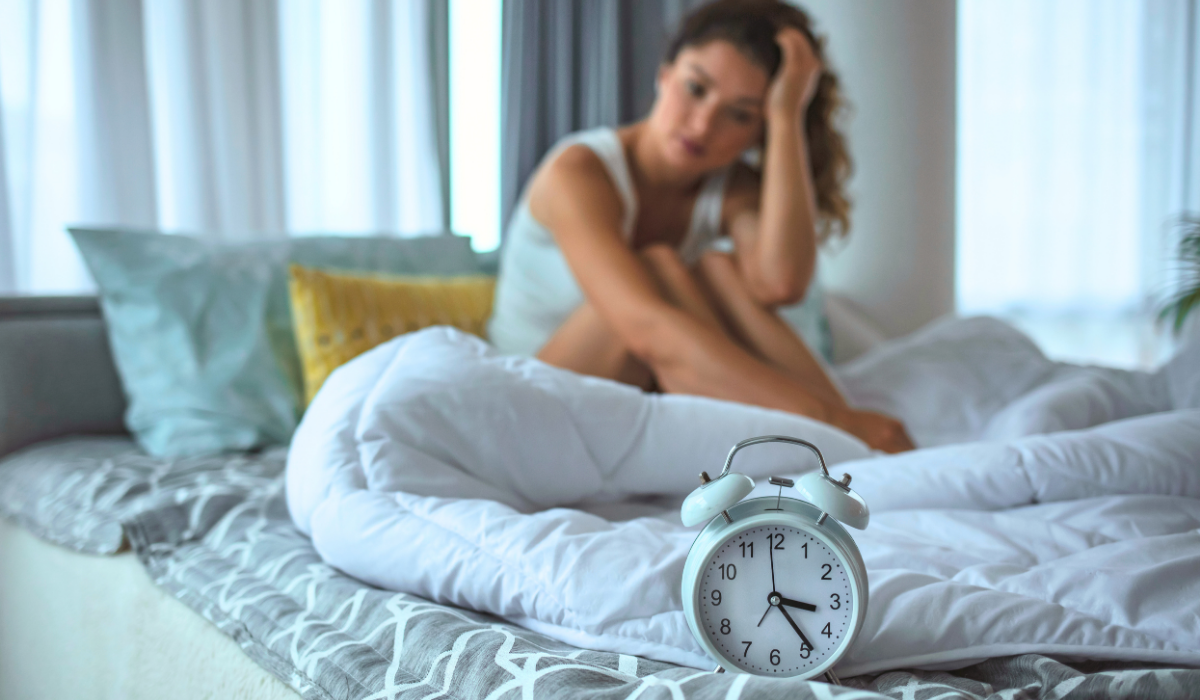
Has Every Sleep Hack Failed You?

You’ve read the headlines:
“These simple tricks will improve your sleep tonight.”
“5 Tips for when you’re wide awake at 3 a.m.”
“Trouble falling asleep? Try this tactic!”
Sleep advice is everywhere these days—likely because too few of us are getting enough shut-eye.
But before you bounce, read on: I interviewed some of the country’s leading sleep experts for my book, The New Rules of Women’s Health: Your Guide to Thriving at Every Age, and they shared a lot of information that can help all of us improve both the quality and the quantity of sleep we get. Even better, the advice doesn’t just involve tips you’ve heard a million times before (like creating a bedtime routine and keeping your bedroom cool).
These are some of the most surprising tactics they shared with me.
In this article, you’ll learn...
- Why you don’t actually have to avoid screentime before bedtime
- The simple setting change on Netflix and other streaming services that can help you get more sleep
- Why your wearable may be giving you bad sleep data
- How to support your body’s melatonin production without taking a supplement
- And more…
You don’t have to avoid screens before bed.
That’s right. It turns out that even more important than the blue light exposure you get from the TV and other screens before bed is what you’re looking at on those screens, says Shelby Harris, PsyD, a licensed clinical psychologist who specializes in behavioral sleep medicine.
“If you’re doomscrolling or watching something that’s going to stress you out or keep you hooked in—like your social media feeds, which are meant to be addictive—it’s more likely to keep you awake longer than if you’re watching something that relaxes you.”
Turn off autoplay on streaming services like Netflix.
Most of us watch TV at night, and telling us not to is unrealistic. One reason is because life is busy, and “revenge bedtime procrastination”—a new term for an age-old scenario where you’re so busy throughout your day that you get defiant at night, desperate to steal back some time just for you—is real. However, if you turn off autoplay on streaming services, it forces you to make a conscious decision as to whether you’re going to watch the next episode, says Dr. Harris. “This is often enough to give you that little pause to ask yourself, ‘Do I want to choose sleep, or do I want to watch another show?’” says Dr. Harris. “If you choose to watch another episode, that’s fine every once in a while!” But that pause will help you make it the exception, not the norm.
Don’t always trust the sleep data your wearable is giving you.
Fact: Wearable sleep trackers aren’t actually capable of measuring the minute details of your sleep, like how many minutes of deep sleep you’re getting each night. They measure how much we move around while we’re sleeping, and sometimes heart rate and possibly a few other metrics, like body temperature. That information is then used to estimate whether you’re asleep or awake. And while these trackers are pretty good at estimating, they’re not good at knowing what type of sleep you’re getting (light, deep, or REM) or how long you’re staying in each sleep stage.
“My patients will often say things to me like, ‘My wearable tells me I haven’t had REM sleep for six weeks,’ and I don’t believe it,’ says Jennifer L. Martin, PhD, a sleep psychologist, researcher, and professor of medicine at the David Geffen School of Medicine at UCLA. “Where I think a sleep tracker is helpful is if you’re wearing one for accountability.”
Trying to stick to a regular sleep schedule? A wearable can hold you accountable to those goals. That said, if you start stressing out because of the poor sleep data your wearable is giving you and it’s causing you to lose sleep (a condition that actually has a name, orthosomnia), Dr. Martin suggests taking it off.
“The goal is for these devices to help you stick to healthy sleep habits, not to mess with your quality or quantity of sleep,” she says.
Support your body’s melatonin production without taking a supplement.
Melatonin is a powerful hormone that tells the body it’s time to sleep and regulates the timing of your overall sleep-wake cycle. Melatonin supplements are so ubiquitous these days that it can seem as if they’re harmless. Yet sleep experts warn against taking them without consulting a medical professional. Why? Because you can’t be sure how much of the synthetic hormone you’re actually getting when you buy an OTC supplement. In fact, one study found the concentration of melatonin in more than 70 percent of supplements varied widely from what the labels claimed (from 83 percent less melatonin than the amount listed to 478 percent more).
Thankfully, there’s a lot you can do to help your body’s own production of this important sleep hormone, says Emily Manoogian, PhD, a chronobiologist and clinical researcher at the Salk Institute for Biological Studies. Here’s where to start:
- Spend fifteen minutes outside in the daylight first thing in the morning. Go outside without wearing sunglasses (and without looking at the sun!) within thirty minutes to an hour after you wake up. If you can’t go outside, sit by a window. Morning light exposure can help reset your internal body clock, signaling that it’s time to be awake during the day and to sleep at night.
- Work near a window during the day, if possible. Exposure to daylight during the daytime, even if you’re not actually outdoors, can go a long way toward helping you produce the ideal amount of melatonin (and at the right time) at night. “Just keep in mind that while direct light is good, looking at a window or getting too much bright light can be hard on your eyes,” says Dr. Manoogian.
- Spend some time outside during dusk, a few hours before bedtime. Being outside in this natural low light signals to your body that it’s time to wind down and prepare for sleep.
- Stick to a consistent bedtime and wake-up time, even on weekends. Going to sleep and waking up around the same time every day helps to regulate your body’s master clock, which in turn improves your melatonin production.
Consider a “sleep divorce.”
Sleeping next to a significant other can be incredibly beneficial—and in fact, it can create many positive emotional and physiological benefits that can help you sleep. However, if your bed partner is keeping you up at night (for example, if they snore), it could lead to sleep problems. Just look at women who are partnered with a snorer, who are three times more likely to have insomnia compared with women who are paired with a nonsnorer.
If you’re struggling to get quality sleep when sleeping next to someone, you might consider sleeping separately—what’s being coined as a “sleep divorce.”
“For many years, there was no science behind shared sleep, so we just followed the shoulds,” says Wendy Troxel, PhD, licensed clinical psychologist, senior behavioral and social scientist at RAND, and author of Sharing the Covers: Every Couple’s Guide to Better Sleep. “Many of us thought, We’re married, so we should sleep in the same bed. We’re a couple, so we should go to bed and wake up at the same time. Now we know better.”
If you’re struggling to get quality sleep when sleeping next to someone, it’s important to identify what your issues are and then talk about how you can share important ritual time in bed without forcing yourselves to sleep in the same bed or at the same time, says Dr. Troxel. Using “I” statements is key when you have this discussion. You might say, “I’m not sleeping well, and because of that, I can’t be the partner I want to be.” With a statement like that, you’re not blaming or nagging; you’re setting the tone for how to address this as a “we” problem.
“And while the term sleep divorce has become popular, what you’re really doing is creating an alliance around sleep because it’s so foundational to the quality of your relationship,” adds Dr. Troxel.
For a lot more about sleep, including the different sleep stages, sleep conditions that impact women the most, and many more tips that can help you get a better night’s rest, pick up a copy of The New Rules of Women’s Health.

Please note that we may receive affiliate commissions from the sales of linked products.