A World on Fire, 30 Minutes to Leave
You have thirty minutes to leave your house. You don’t know how long you’ll be gone. Or if you will be able to return. What do you take with you?
Either you’ve seen it on the news or smelled it in the air: wildfires are burning all over the globe.
Smoke is rolling into places that aren’t used to it like Chicago, Detroit, Washington D.C. Tens of thousands have evacuated in Spokane, Washington in what one reporter called “detonation.” Fires are raging in Canada, Europe, Africa, Australia, and on and on. If you go to the NASA world wildfire map, it looks like there’s just about nowhere that’s not somehow affected by fires, or smoke, right now.
Here in the U.S. this past week alone, there are 101 active large fires, with 3,969,179 acres currently burning, mostly in Oregon and Washington, according to the National Interagency Fire Center. Only seven are contained. Firefighters are beyond exhausted, risking their lives as they fight unprecedented, fast-moving blazes stoked by high winds, drought, and record-breaking heat.
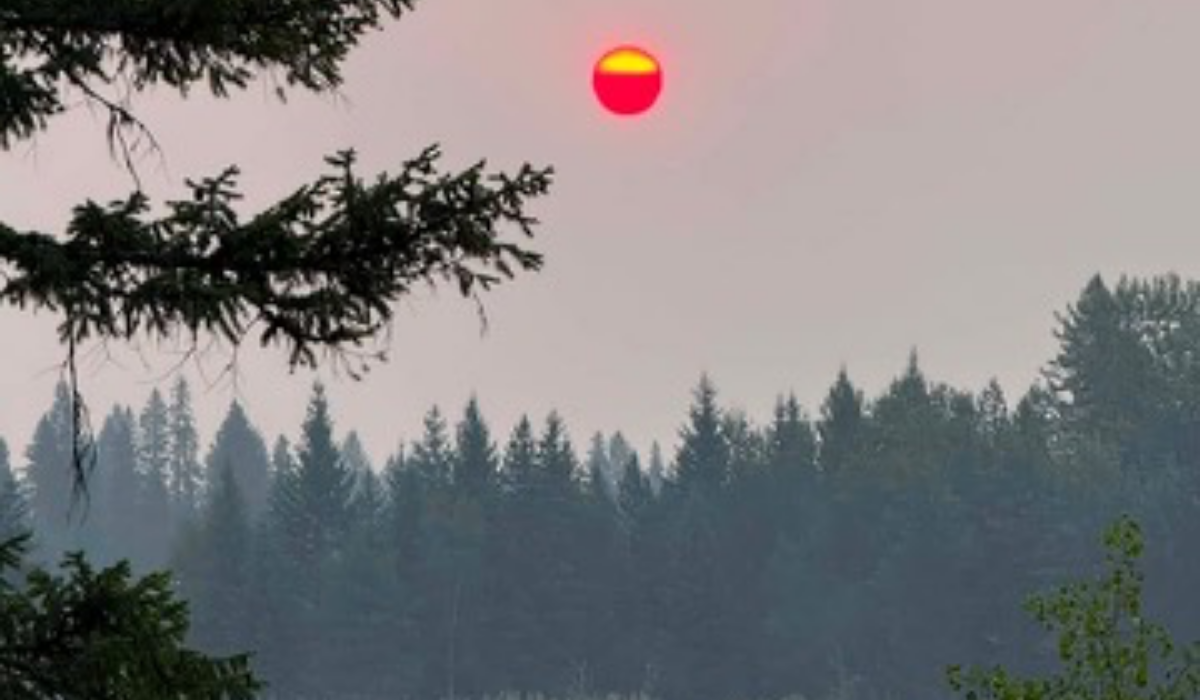
Where I live in Montana, the smoke has been coming and going. Some days it’s all sepia and blurry, the sun a tangerine orb. Even when the skies are blue, we know that our smoke has blown into what was someone else’s blue sky just yesterday…and will likely return. Our mouths will be dry. Our voices will be rough. And those who are sensitive and at high-risk, especially with lung or heart related health challenges, pregnant individuals, children, and older adults, will need to stay inside, preferably with an air purifier.
Smoke doesn’t know state nor country lines. Smoke is smoke and it belongs to all of us.
Wildfire Talk is a Global Conversation
I’ve lived in Montana for thirty years and we’ve had “lucky” fire seasons and devastating ones. This year we’ve been mostly lucky, at least in the northwest corner of the state, where the fires are relatively small and increasingly contained every day. But still, there are evacuations happening across the state, and every grocery store check-out line is buzzing with wildfire talk.
How many acres? How much of it is contained? Are there evacuation orders? How are the firefighters faring? They can make a basecamp on my property. What about your friends up in that area? Do they need help relocating their horses, just in case? I have room in my pasture. I can lend them my spare truck.
Fear, powerlessness, and a humble dose of acceptance abounds. The power of Mother Nature is real, and during the fire season we can’t ignore it. Most Montanans don’t have air conditioning so when there’s smoke, it means windows closed, fans on, open/close the door fast, recirculation button in the car activated. Yet there’s only a modicum of complaining in small mountain communities. We choose to live in the woods. This is part of life out here, but wildfires are affecting a lot more than just us right now.
Can Fires That Destroy Teach the Value of Community, Not Possessions?
I’m not writing this to instill fear. Nor to dive into the subject of climate change. Instead, I’m writing to make the case for community, connection, and self-awareness. There is air to breathe, even in times of smoke and wildfire. And to me it begins with getting real about our relationship with stuff.
Ask anyone whose home has been taken by wildfire what life lessons they learned. I have two such friends, one in California, and the other in Colorado. Both of them will offer an iteration of: “It was highly traumatic. But…I feel free in a way I never have. I was way too attached to my stuff.”
These wildfires have people talking far beyond the subject of their personal things, and instead about what really matters. I like to ask questions and learn, so I’ve been asking a potent one: “If you only had thirty minutes to evacuate your home…what would you take?”
This question is as much about preparedness as it is about mindfulness. But it scares me. Which is why I’ve been asking it and making room for the answer, whether I’m at the gas station or speaking with friends around the world in the line of wildfire. The responses have stunned me because they are so diverse and yet sometimes so exacting.
The Power of Good Questions
In many cases, I’m finding that the asking and answering of this question can center, ground, and even calm people in a time of deep stress. I have no idea what my answer would be. At all. Just thinking about it elicits anxiety in me. So maybe I’m asking it as a collective field study—to glean wisdom from how other people have let go, and what they would let go of if need be. I am admittedly way too attached to my belongings. Embarrassing but true, and in a time like this, it’s important to be honest about your inconvenient truths.
Many have an immediate answer: “My family and my pets. The rest can burn.” Another rapid-fire answer is: “My computer, my cell phone, and my chargers.”
One said, “Well I’m very worried about proving my U.S. citizenship with all that’s going on in that regard, so I’d bring my citizenship papers. My U.S. passport. And my driver’s license.” Another said, “My journals and photo albums. But there are so many. If it was an unexpected evacuation, I think I’d just grab my purse and jump in my car.”
I can sense sentimental suffering rumbling around in their minds. People love their stuff. I am no exception.
What Brings Real Worth and What Is Worth Letting Go?
I have been repeatedly accused of having far too many things in my home. Not of great monetary value. Mostly sentimental. My parents were both only children, so I have generations of ancestral legacy in my home. A wooden, legless (!!!), doll from Civil War times. My grandmother’s Steinway Spinet: a consolation prize from a robbed opera career, due to a non-existent #MeToo movement in 1911. Daguerreotypes of forgotten faces. Any number of little pretty porcelain boxes. One holds my children’s baby teeth.
In duty, I polish the silver of sterling pitchers, utensils, candlesticks, and imagine my grands and great grands polishing them too. I literally have a stack of bibles, one from the 1600s, notes in the margins like: “May you live according to these precepts.” Letters of worry and warning from my great-grandmother to my grandmother when she was pregnant with my father during the flu epidemic of 1918. Two chairs with caned seats, and a tea set, that traveled unscathed in a covered wagon from Vermont to Illinois during the Homestead Act. Hand-tatted lace. So much lace. And needlepoint—an Edwardian era footstool, piano bench, chairs, worn to the canvas in places.
Those dexterous women were always making things of beauty and use. These things mark bravery, pride, creativity—vestiges of a life lived. And they all call out to me: Take care of me. Tell my story.
I’ve learned these stories, carried them, told them, and sustained them. It feels like a responsibility. A way of somehow keeping it all alive. Where would I even begin? Thirty minutes??? I guess I would have to betray it all. I would take my dogs. Hop in my truck. And say a prayer for what I’d be leaving behind. Another nearly impossible question: What would I even pray for? The grace to let go, I suppose.
So I’ve changed my question to something less stressful and more sentimental: “If you were to pack a Go Bag, but were not in pressing danger, in addition to the basics, what would you put in it…and why would you choose those items?”
This one has people (myself included) reaching into what they most care about versus most need. “Oh gosh. Well, maybe the pearl necklace my mother always wore. And my copy of The Secret Garden, which my grandmother read to me. And my very first journal. Maybe a few of my father’s handkerchiefs. They still smell like him.” They choose things of comfort and legacy, not practicality nor worth.
So what would I take if I only had thirty minutes to prepare? Aside from essentials?
Well…my mother’s gold bracelet, I guess. Even though it’s not really my taste. But it touched her skin and I played with it in church when I was little. And a few pieces of art. The ones that stand for beloved times in my life. Plus, they would be easy enough to load in my truck.
The truth is: I really can’t imagine the grief of losing my home and the stuff in it, and my heart is with all who have. Let it all burn? I simply…can’t…imagine. But just parsing these questions lets me know that in the end, there could be freedom, as my friends who have lost their homes to wildfire have promised. And that the stories of my stuff will live on as long as my memory serves and my pen can move.
A Writing Prompt: Clarity in the Smoke
Writing is the best tool I know to help process this beautiful and heartbreaking thing called life. I’ve seen it in the over 1,000 people I’ve worked with on my writing retreats, and I’ve practiced it all my life. So to help you examine your relationship with your own stuff, here are two questions to ask yourself. Ask them in private, with a pen and a piece of paper. Be honest with yourself. Let the words carry your truth. Your essence. Not the shoulds but the real and the raw.
1) If you only had thirty minutes to evacuate your home…what would you take and why?
2) If you were to pack a Go Bag, but were not in pressing danger, in addition to the basics, what would you put in it…and why would you choose these items?
If you’d like to explore your writing this fall, my Haven Writing Retreats still has room! Email me to set up an introductory call: Laura@lauramunson.com. Your voice matters, especially when it’s feeling lost in smoke and worry. There is freedom there. I promise.
Laura Munson is the New York Times and international bestselling author of the memoir This Is Not The Story You Think It Is: A Season of Unlikely Happiness, the USA Today bestselling novel, Willa’s Grove, and her most recent release, The Wild Why: Stories and Teachings to Uncover Your Wonder. She is the founder of the acclaimed Haven Writing Retreats in Montana, and has worked with over 1,000 people globally. She lives in Montana with her family. You can find more about her at lauramunson.com.
Please note that we may receive affiliate commissions from the sales of linked products.