America Runs on Sister
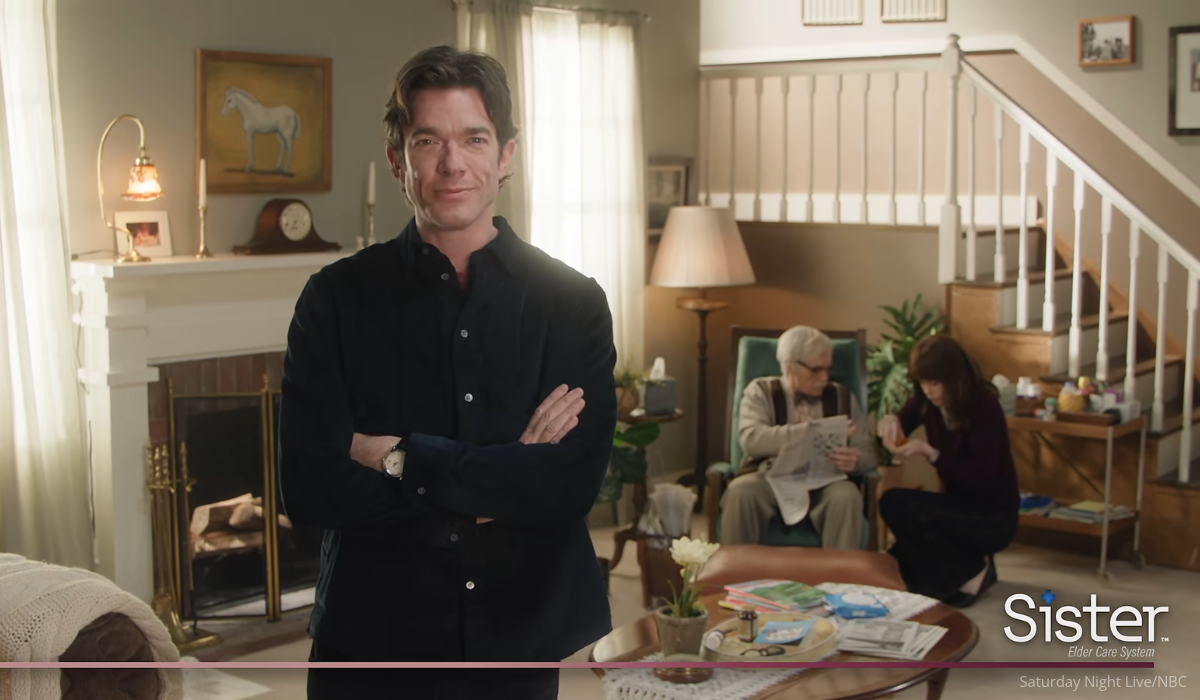
Last weekend’s viral SNL sketch, “Sister,” ingeniously and searingly taps into a societal expectation familiar to many of us: women are the default caretaker of elderly parents. Maybe you also laugh-cried in recognition when host John Mulaney stated, “Simply text ‘dad fell’ to Sister, and she will quit her job, break her lease, and move halfway across the country to take care of him.”
The sketch has already garnered more than 8 million views on YouTube and sparked across social media like wildfire. Thousands of women quickly posted their versions of the sentiment, “This is my life”:
- “This sketch was sent to me by a dozen different women. It hits right between the eyes.”
- “I laughed hard but at the same time felt like crying.”
- “Yep. I’m the sister. And if you’re the first daughter-in-law to marry into a family with no sisters, run like hell.”
Many of us had the same reaction when Taylor Swift released “Eldest Daughter,” a clarion call for millions of women whose lived experience has received a long-awaited, and in many cases, long-suffered spotlight. According to AARP and the National Alliance for Caregiving, 63 million Americans are family caregivers right now, most of them women, and more than half say they didn’t really have a choice.
But, as with all great jokes, there’s a deeper truth here. What is happening to the sister's own body as she abandons and suppresses her own needs for her caregiver duty’s sake?
Picture it: Austin, Texas, in the 1980s. As the eldest and only daughter from a Southern Lebanese family, I was raised to caretake and self-compromise in equal parts, raised to embody the role of the selfless good girl. It became more than a part to play; it became my identity. My worth was determined by how in service I could be to those around me.
From girlhood to womanhood, I graduated with the same self-neglecting skill set that made me feel I had value. As a documentary filmmaker and event director, I took pride in being the one who produced my mom’s cancer journey with the efficiency and organization of my day job. I reveled in being the first call for my father and brothers when they needed me. And I took satisfaction in keeping our team afloat while silently draining my savings to do it. The safety of my “goodness” protected me from the terror I felt from disappointing anyone or being any trouble. The one thing my goodness didn’t protect me from was illness.
At 42, I was living in a body riddled with autoimmune disease, chronic illness, and cancer. I was so uncomfortable receiving care that I hid my symptoms, until I physically couldn’t anymore. My integrative doctor gently asked me, “Why are you killing yourself, one wrong choice at a time?” My dots clicked when I read the words of Dr. Gabor Maté and his son Daniel Maté in their New York Times bestseller, The Myth of Normal, “Time after time it was the ‘nice’ people, the ones who compulsively put others’ expectations and needs ahead of their own and who repressed their so-called negative emotions, who showed up with chronic illness.” BINGO.
I had been “Sister,” unquestioningly, until illness had brought me to my knees—my body calling me to wake up and take care of myself for once. To understand why I might have become so unwell, I funded the first national research at the intersection of autoimmunity and empowerment, through the independent research firm, Proof Insights, surveying 1,000 American women living with at least one autoimmune disease. Of the women surveyed, over 50 percent said they had been raised to be a caregiver, like me. And as women living with an autoimmune condition:
- 94 percent said they found it easier to caretake than to receive.
- 87 percent said they suppress their own needs and wants because they were more comfortable being responsible for others.
- 72 percent said their choices are made by whether it will make them be seen as ‘good’ or ‘nice’ by others.
Just like that, I knew I wasn’t alone. None of us are.
When the virality of the “Sister” sketch fades, millions of women will go back to the shadows of their daily duties. But we must not allow ourselves to be more afraid of disappointing others than doing what is needed to begin our own care. Changing my relationship to this construct revolutionized everything for me. Was it uncomfortable? Yes. Has my health improved? YES. Every diagnosis is in remission or has disappeared.
I would love to invite you to consider this moment as the permission slip you didn’t know you needed. To invite you to befriend your inner little girl who never got her turn—until now. To invite you, no matter your age, to see that it is never too late to prioritize yourself and work with your family to begin to balance the scales. Use the “Sister” sketch as a conversation starter, with your parents and with your siblings.
Get comfortable speaking new phrases, such as, “Can I please ask for your help with something?” Or “I’m hurting, and here is what would be comforting…” And when people offer help, please take it. We can work with our families to shift the balance of care while we are still well or we can wait until our self-abandoning “goodness” leads us to illness, which would make us no help at all.
“Sister” is funny because it’s true. And it is tragic because it is true. We love it because it makes us feel seen, even if it holds an edge of pain. We laugh because humor has a way of softening the blow of something sharp and human. We have shared it with abandon because, like “Eldest Daughter”, we finally feel that it is our turn, and maybe, just maybe, it might incite change among those watching us suffer in our caregiving.
But first we have to give ourselves permission to rewrite the role we were given. Most of us feel like asking for help contradicts our worth—but it doesn’t. Most of us feel like lightening our responsibilities violates our goodness—but it won’t. Those are old stories and fears we have clung to that have only made us feel small, silent, and sick, and they are desperate for a rewrite and a reclamation.
America might be running on “Sister,” but your family doesn’t have to, my sister. Not anymore.
Sara Hirsh Bordo is a 15-time award-winning documentary filmmaker of women and girls’ stories through her production company Women Rising® and the author and researcher of the book “Autoimmunity and the Good Girls: How the Permission to Put Ourselves First Has the Power to Keep Us Well” (HarperOne, 2026), available everywhere now.

Please note that we may receive affiliate commissions from the sales of linked products.