An Unlikely Cure for the Loneliness Epidemic? It’s Hiding in Plain Sight (And on a Bookshelf Near You)
To borrow from Penny Lane, a character in the film “Almost Famous,” “If you ever get lonely, you just go to the record store and visit your friends.”
Ditto for the indie bookstore.
Growing up, my family would take trips to our local bookshop. As my brother and I charged in, I’d rush to grab the latest Saddle Club book, as he headed for The Hardy Boys, and my parents went to their favorite sections. We’d each go on our own literary adventure while being in the company of each other. Some days, there’s be people gathered around for an author signing.
Those trips were magic—and that bookstore gave us a place to be ourselves and with our “friends.”
That’s the beauty of indie bookstores. They offer a welcoming corner and soft landing. They’re a place to experience the rare solace found in simultaneously being out in the world and alone with a story. They’re a spot to nestle into a cozy couch with a novel, as thousands of writers’ boldest admissions throb on the shelves around you.
They’re the answer when you’re seeking, craving, or simply looking to fill a Saturday afternoon—or when you need a friend, in paper or human form.
And they’re fueling the heartbeat of our country.
The Need for Salons
Not merely a place to buy books, indie bookstores across the US are fostering meaningful in-person conversations and communal gatherings. Author signings, community events, salon-style discussions. These non-denominational, inclusive occasions are giving people a place to be together beyond the divisive headlines.
There’s a meeting of the minds, laughing, crying, and seeing each other that happens at these gatherings, and it all makes author Zibby Owens happy. As the founder and owner of Zibby’s Bookshop in Santa Monica, Owens and her team have opened their doors to countless authors and community members for their thought-provoking events.
“What makes me most proud of people gathering at my bookstore is knowing that the connections they’re all making among the chairs waiting for an author event or browsing the shelves or lining up for an author book signing might never have happened otherwise,” Owens told me about her small-but-mighty shop. “It’s the sizzle of new synapses firing as strangers become friends. It’s the joy on their faces as they leave.”
A Growing and Communal World
In 2026 so far, 605 new indie bookstores have opened across the US, according to Allison K. Hill, CEO of the American Booksellers Association. That’s an incredible number, even surpassing the 422 that opened in 2025, and several hundred in years prior.
From Massachusetts to Texas to California, bookstores on suburban sidewalks and city blocks opened their doors, offering the world a revolutionary cry against the monoliths who deliver on instant shipping but zero camaraderie.
On average, the US is home to more than 3,783 independently owned bookstores—a number that grows when you consider all the “pop-up” bookstore models blossoming all over.
“The significant increase in the number of independent bookstores in the U.S. these past six years is great news for all of us,” Hill told me.
What’s even more encouraging is how these stores offer a truer reflection of our nation—a place where people of varied races, backgrounds, identities, sexualities, and belief systems live. Of the hundreds of new stores that have opened in 2025, about 13 percent or higher are founded by people from marginalized groups. Inclusive hubs that are still too rare in our country’s mainstream landscape are found—more and more—in indie bookstores. Shops like Marcus Books in Oakland, California; Books & Burrow in Pittsburg, Kansas; and Left Bank Books in St. Louis, Missouri, that celebrate Black, Indigenous, and queer voices, respectively, are among the growing places offering the human right to safe, inclusive, and stimulating spaces with like-minded people.
And also with those of different viewpoints.
Attend an author event at an indie bookstore, and you’ll find a quilt representing varied viewpoints. Katrina Mendrey, co-owner of Chapter One Book Store in Hamilton, Montana, believes that when a community attends its local bookstore’s events, it “signals that the people in the community seek knowledge, support discourse and a diversity of ideas—all things that are essential to the human soul and on a larger scale the health of our society.”
When we sit next to one another, listening to an author read an excerpt or talk about their process, our walls come down. People lean in; shoulders drop. Even if the topic at hand varies from one’s own interests, there’s no denying the vulnerability that permeates the room.
I experienced this firsthand at my author event at Mendrey’s store.
Given that my book focuses on women declaring their voice in their 40s and choosing lives of their own design, you’d be forgiven for thinking it wouldn’t draw an audience of men in their 50s, 60s, and 70s from the rugged parts of Big Sky country. But it did.
As I looked out into the crowd, I saw big cowboy hats. At one point, I looked over at a man who’d asked me a soulful question a few minutes prior. His eyes were watery, mirroring the nearby river.
“It feels good,” Mendrey told me, “to live in a rural community that comes out for these conversations.”
Get Involved in the Bookshop Scene
The world of indie bookstores is certainly auspicious and growing. Still, the reality for owners is constant hard work and obstacles.
In May of this year, Allison Hill stated in a letter to American Booksellers members that while there’s been incredible growth for indie bookstores, there are also immense challenges. Shop owners and workers faced rising costs, tariffs, the impact of ICE, book bans and climate change, and other hurdles “in addition to the perennial challenges of thin margins and Amazon’s monopoly and monopolistic chokehold on our industry,” wrote Hill.
But Hill brought in the light, stating that independent bookstores “continued to do the important work they do in the world,” including “providing an antidote for the loneliness epidemic; championing diverse and debut authors; contributing to the local economy; and putting books in readers’ hands that could change their lives.”
Because we know that one book can change a life, just as one bookstore gathering can, too.
That’s where you come in. That’s where we all come in.
Seek out your local indie bookstore and pop in. (Head to indiebound.org to find one near you!) Ask about upcoming events. Attend one, alone or with a friend. Support bookstore owners and authors. (It’s vulnerable to be an author at these events, trust me!) Show up for an hour, and you will not regret it. (If you live or are destined for New England, this is a fantastic resource to find author gatherings.) As you travel, go to local readings and gatherings in foreign towns. It’s a way to get a pulse on the places you visit.
Plus, you never know. As Zibby Owens said, you could meet your next friend.
By helping to keep indie bookstores not only alive but thriving across the country, we’re doing our civic duty. We’re facing down tyranny and algorithmic oppression and celebrating art. We’re saying yes to vulnerability and embracing the weirdness of what it means to be human.
We’re supporting the larger story of our species—one that tells of each of us unique in our make-up and origins yet united in our need to feel safe and seen.
There’s no other place that allows us to be both sovereign and part of a whole.
The Sunday Paper Team’s Favorite Indie Bookstores
What’s the name of your local bookstore? What’s your favorite bookshop of all time? Below is a shortlist of The Sunday Paper team’s beloved bookstores—but we want to include yours! Add yours to the list in the comments below.
Annabelle’s Book Club (Studio City, CA)
Bart's Books (Ojai, CA)
Black Bird Bookstore (San Francisco, CA)
Black Pearl Books (Austin, TX)
Book Love (Plymouth, MA)
Book Society (Berkeley, CA)
Books & Books @ The Studios of Key West (Key West, FL)—Co-owned by Judy Blume!
Books Are Magic (Brooklyn, NY)
Book Larder (Seattle, WA)
Boulder Bookstore (Boulder, CO)
Chapter One Book Store (Hamilton, MT)
City Lights (San Francisco, CA)
Curious Iguana (Frederick, MD)
Dog Eared Books (San Francisco, CA)
GODMOTHERS (Summerland, CA)
Good Girls Books (Los Angeles, CA)
Elliott Bay Book Company (Seattle, WA)
FMC Books (Missoula, MT)
Iffy Books (Philadelphia, PA)
InkFish Books (Warren, RI)
The Last Bookstore (Los Angeles, CA)
Literati Bookstore (Ann Arbor, MI)
Malik Books (Los Angeles, CA)
Parnassus Books (Nashville, TN)—Co-owned by Ann Patchett!
The Painted Porch (Austin, TX)
Powell’s Books (Portland, OR)
Print: A Bookstore (Portland, ME)
Rainy Day Books (Fairway, KS)
The Ripped Bodice (Los Angeles, CA and Brooklyn, NY)
Shakespeare & Co. (Missoula, MT)
Slant of Light Books (Chicago, IL)
The Strand (New York, NY)
Trident Booksellers (Boston, MA)
Zibby’s Book Shop (Santa Monica, CA)
Stacey Lindsay is a journalist, senior editor of The Sunday Paper, and the author of BEING 40: The Decade of Letting Go—and Embracing Who We Are.
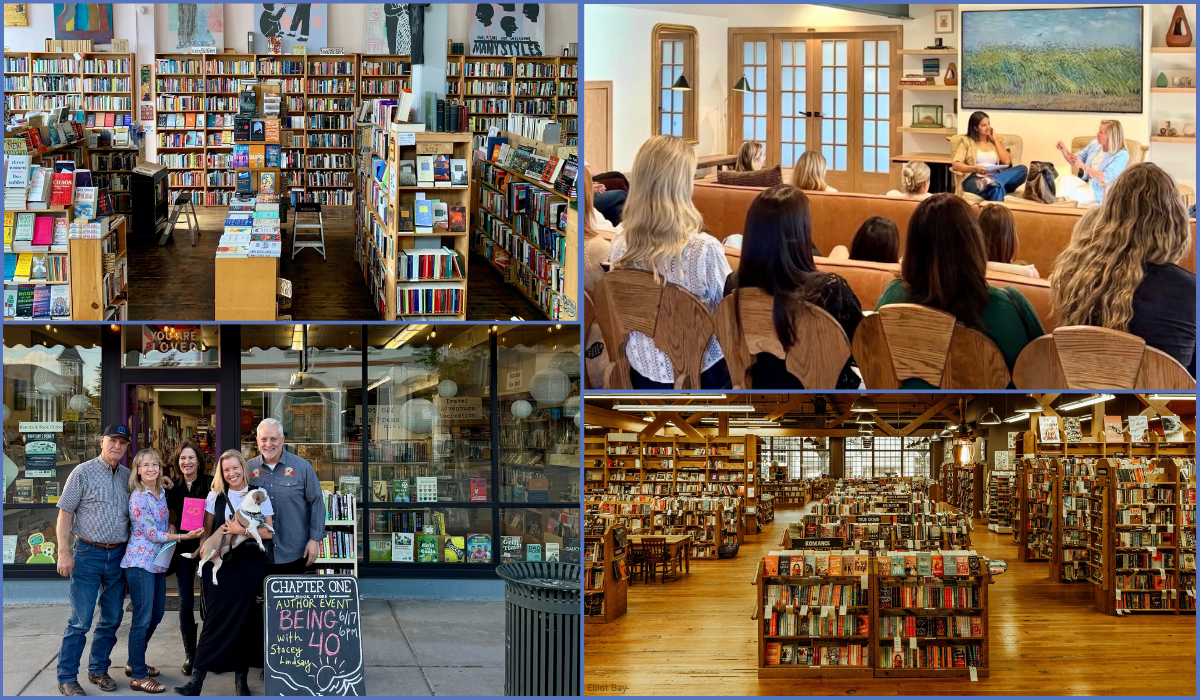
Main image, clockwise from top left: Dog Eared Books, GODMOTHERS, Elliott Bay Book Company, Chapter One Book Store.
Please note that we may receive affiliate commissions from the sales of linked products.