Are You Okay With This?

“I salute the light within your eyes where the whole universe dwells. For when you are at that center within you and I am in that place within me, we shall be one.”
I’d already written my column this week when my friend Bob sent me the quote above, which is often attributed to Crazy Horse, a renowned Oglala Lakota leader. I don’t know if the attribution is exact, but here’s what I do know: the sentiment had a real impact on me.
I read the words over and over again. They struck me as perceptive, intuitive, and wise. Who doesn’t want to be seen for the light in one’s eyes, where the whole universe resides? What a concept, that someone can see the real you so clearly. What a goal, to be seen not for what’s on the outside—one’s performance, job title, or physical attributes—but for something quieter and more essential.
Reading this quote put me at ease this week. It made me feel calm. It also helped me realize, yet again, how what’s playing out on the world stage makes me feel the opposite of that.
What unfolded this week as our president went after the Pope made me feel off-kilter. If I’m being honest, I don’t feel like our president sees into anyone’s eyes. And it drives me crazy that no one will rise to speak up against him or tell him to take a timeout.
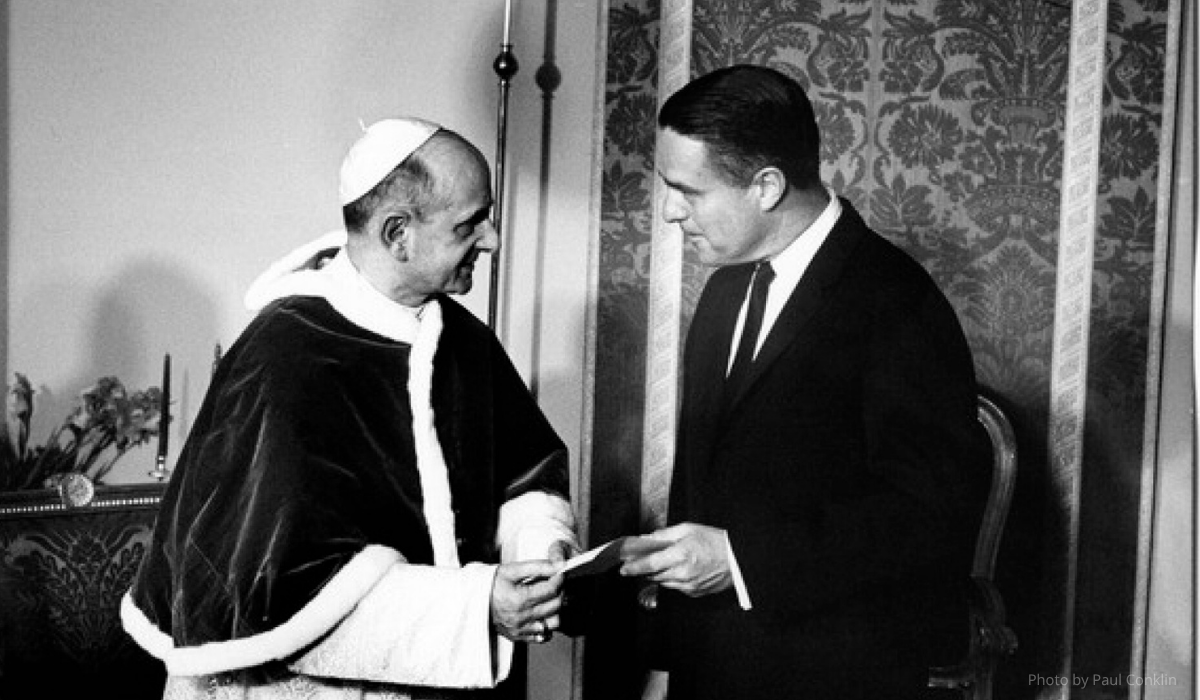
I’ll admit: when the cardinals selected an American to be the pope last year, I thought to myself, those men are shrewd. They didn’t just pick a new leader for the Catholic Church. They picked a different voice for a fractured world. A voice to remind everyone—not just Catholics—that another way of being is possible. At first, I thought maybe it was a coincidence. But then Pope Leo opened his mouth, and I thought, oh no. This is not a coincidence.
Pope Leo speaks about peace and about the poor. He speaks about our obligations to one another. He has called us to follow the Gospel, which has always been radical, and never more so than right now. It’s radical because it asks us to love not just our friends, our family, and our tribe, but the stranger. The one who looks different, prays differently, and votes differently. That is not a suggestion. That is the whole point.
The man from the South Side of Chicago is getting a rise out of the guy from New York City, and it is something to behold. These two men could not be more different. The more the Pope speaks, the calmer he becomes. And the more the president speaks, the more agitated he becomes. He’s clearly triggered by the guy from Chicago. And yet, through all this, the Pope seems to settle into something unshakeable. Something rooted. Something that cannot be rattled because it was never built on sand.
As I watched both of them this week, I focused on asking myself: who is the peacemaker here? Who is the leader for these times? Who is the one preaching the Gospel? Not the one putting himself in pictures using AI, but the one speaking, acting, and behaving in a way that truly asks us to rise? Who is teaching us to use our voices in a clear, calm, and centered manner? Who is the one asking us to tap into our better angels?
The Pope is a man who knows exactly who he is and where he comes from. That rootedness and spiritual clarity are what give him the authority to speak the way he speaks. It is not power. It is peace. And peace, it turns out, is more disruptive than any weapon.
The Pope’s words have made me think about my own journey, and maybe they have made you think about yours too. Where were you born? (The Pope and I were both born in Chicago just a few months apart, by the way.) What are your values? What have you survived, navigated, lost, and rebuilt? Every one of us is on a journey back to ourselves, and the world needs us to wake up to that truth right now. Not to the noise, not to the fear, and not to someone else’s version of who we are, but to our own truth.
My friends, I know these are complex times. And I know it’s hard to make sense of them. That’s why we so desperately need to look for the real leaders—the real peacemakers—to help us make sense of these senseless times, as my dear friend Yale Divinity School professor Miroslav Volf writes about for us below today. I’m so honored he’s “in the house” with us this Sunday because who we listen to—and who we give our hearts and minds to at this moment—truly matters.
The world needs us to rise up right now, and not just in a religious way, though I believe in that too. We’re being called to rise up in a civic way. In a way that asks us to stop scrolling and start standing up for ourselves and our country.
I know the stakes of rising are real. People can lose jobs, friends, and safety. They might lose income they cannot afford to lose. I do not take that lightly, and neither should any of us. But history teaches us this clearly: slumber and apathy have a cost. And those costs compound quietly and invisibly until one day you look up and the country you live in, the humanity you believed in, and the "you" you believed in are unrecognizable.
Every morning, God willing, we wake up, open our eyes, and take in where we are. Do that now with me. Don’t just look around your room, but look within. Wake up and look at your life. Wake up and look at our country. Are you OK with who you are, and with where we are as a nation?
Please wake up to the fact that the President of the United States is actively enriching himself and his family through the power of the office. Are you OK with this?
Wake up to the fact that American troops have been sent into harm's way right now, quietly, while our attention is directed elsewhere. If you have a loved one in the military, you already know this. But millions of Americans don't. For them, it feels like a distant story, a faraway land that doesn't interrupt the scroll. But we are in a conflict that has already cost lives and will cost more lives and your taxpayer dollars. Are you OK with this?
Wake up to a president who has torn into the White House—the people's house—to build a ballroom in his own honor, at a cost of hundreds of millions of dollars. Are you OK with this?
Wake up to an administration that placed its own name above the name of a slain president's memorial, and when artists refused to perform there out of principle, told you that this same memorial needed to be shut down for remodeling. Are you OK with this?
Wake up to the fact that research dollars are being slashed. That medical information is being muddied. That Americans are having to make life-altering healthcare decisions without accurate data or honest guidance. Are you OK with this?
Wake up to a Congress too frightened to push back. And let me be clear, I believe in the two-party system and loyal opposition. What I do not believe in is a legislature that has gone to sleep at the wheel and refuses to hold power accountable. That is not governance. That is abdication. Are you OK with this?
Wake up to the price of gas. The price of food. The fact that millions of your fellow citizens must choose between medicine and eating in what has always been called the richest, most powerful nation on earth. Are you OK with this?
If the answer is no, then the question becomes: what do we do with that knowing? Because this is not just a political moment. It is a spiritual one. And the fragmentation we’re experiencing is not an accident. But we do not have to stay there. We can choose differently.
As I wrote last week, my father spent his life asking people to rise. He was a deeply devout Catholic who, like the Pope, believed that the peacemakers would be the ones who saved us in the end. Not the powerful. The peacemakers. Through Head Start, Job Corps, VISTA, and the Peace Corps, my father ignited a spark in ordinary people. It was not a political spark, but a human one, a spiritual one. It was the spark that said: I see you. You matter. We are in this together. He understood what the Gospel was really asking.
The War on Poverty was not a political program to him. It was an act of love. It was the Gospel made policy. It was what happens when you actually believe that every human being—regardless of color, class, or creed—carries the divine within them. It is the belief that the stranger at the border, the neighbor across the tracks, and the person whose life looks nothing like yours are just as worthy of dignity, safety, and a future.
In his archives (which my brothers and I have collected into the new book We Called It War: Lessons Learned from the Fight to End Poverty), my father wrote about what happens when we stop believing that. When we begin to see our neighbor not as a fellow child of God trying to make ends meet in a complicated world, but as "the other," as a threat, or as someone to be blamed.
My father never won elected office, but he changed the world by changing the way people saw each other. We don’t have a leader like that right now here at home, which means we have to be that leader for each other. Or better yet, it means we get to be those kinds of leaders.
In recent years, I have traveled to Rwanda and Cambodia and stood in the museums those countries built to make sure the world never forgets. They were built to make sure you, I, and our children walk through those rooms and understand what becomes possible when a society falls asleep, when people become so turned against their neighbors by a steady diet of fear and misinformation that they can no longer tell truth from lies, when they can no longer see the sacred in the face of the person standing next to them.
Those museums exist because gaslighting has a body count. They exist because someone had to say: this is what happens when truth becomes negotiable. This is what happens when we stop seeing each other as human beings. Germany built its memorials for the same reason. They are monuments to the cost of looking away, of staying quiet just long enough for the unthinkable to become possible. May we learn from them. May we be the country that looks at those rooms and says: "Not here. Not us. Not on our watch."
All over the world, people are watching us right now and asking which voice speaks for us. People who just this past week voted out a dictator in Hungary, and people fighting for the very freedoms we take for granted: they are looking at us and wondering, will they rise up?
I will leave you with this: take a moment to think about the people in your life whose presence steadies you. The ones who make you feel safe, seen, and clear. Now, think about the voices that leave you feeling confused and unsettled.
You know the difference. Trust it.
Because great leaders do not diminish you. They call you forward. They point you toward the light and trust you to walk toward it yourself. Rising does not mean rising against anyone. It means rising toward each other.
You were made for this moment. My father bet his life on people rising. I am betting on it, too.
Our lives are worth rising for.
So is this country.
So are you.
Prayer of the Week
Dear God,
Awaken our hearts to truth and guide us to be peacemakers who see the light in one another and rise together in love and responsibility for our shared future.
Amen.
Also in this week’s issue:
• Pre-Order Maria's Daily Meditations for a Meaningful Life 2027 Calendar
Please note that we may receive affiliate commissions from the sales of linked products.