The Pope and the Emperor

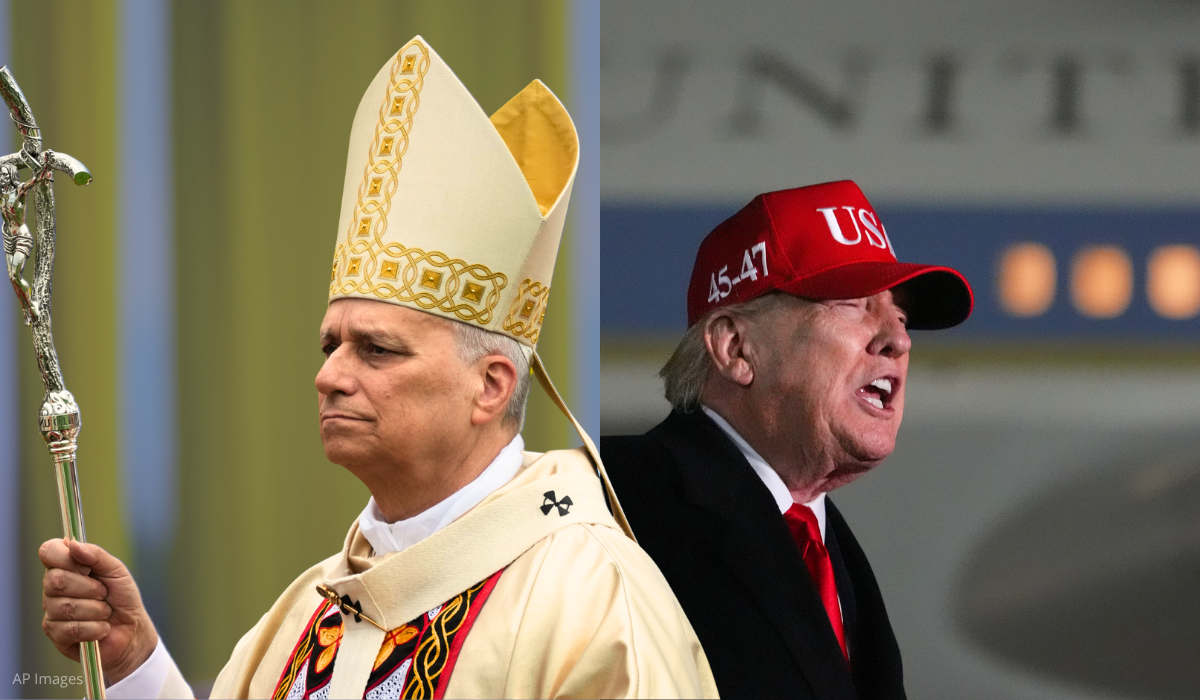
Very gently and publicly, Pope Leo has said what is plain for everyone to see: The emperor has no moral clothes.
The emperor, President Trump, responded by demeaning the Pope and posting (and later deleting) an AI-generated image of himself dressed like Jesus: with a mere touch, he is healing a sick man, surrounded by adoring acolytes, and behind him are menacing soldiers and fighter jets. The image implies the Pope is a mere vicar of Christ, a pale representative, while President Trump is the muscular, ruddy Jesus Christ himself.
We live in a world whose future is shrouded in darkness. The possibilities for good and for evil are vast, and few of us seem to have any hope, much less confidence, that good will prevail. We worry that AI will rob us not just of jobs but of humanity, that endless wars will never cease, that the gap between the destitute and super-rich will continue to widen scandalously, that our habitat is irreparably damaged, and more. Many people, especially the young, have a sense that we live in what Anthony Giddens has called “a runaway world.” Amid these challenges, we find ourselves asking: How should we live? Where can we find hope?
The recent public quarrel between Pope Leo and President Trump is important because it is a clash of two contrasting visions of living and hoping. It presents us with two alternative futures.
President Trump stands for a world of brute power and struggle for superiority, where the mighty take what they can—be it Greenland, memecoin profits, or Iranian oil. It is a world in which one’s worth is defined by the scope of one’s dominion, the magnitude of one’s possessions, and the corresponding rank in the great pecking order of life. Besides one power curbing another, the only constraint on the powerful is their own broken moral compass.
In Pope Leo’s world, in contrast, what ultimately matters is not power but love. He belongs to the Order of St. Augustine, the great fifth-century theologian who said that the phrase “God is love” contains everything one needs to know about living rightly. In Pope Leo’s world, each human is created as God’s image, and each is unconditionally loved by God. That divine love is the root of our inestimable worth, not the reach of our power, not the greatness of our wealth, not rank on any superiority scale.
***
Close to the end of the Christian Bible there is a short command that sums up what I have described as Pope Leo’s alternative to President Trump’s amoral vision. It is only two words: “Honor everyone!”
These words were written by the person whom the Catholics believe was the earliest predecessor of Pope Leo, the Apostle Peter. He wrote a letter to a small, marginal community in Asia Minor; a religious minority with no social power and much ill-will from its neighbors. Surprisingly, perhaps, St. Peter did not insist that the community be tolerated, let alone given equal rights. (The call for toleration will come later, and rightly so. Tertullian, an early church father, wrote a century or so later: “It is unjust to compel freemen against their will” to engage in religious rituals, for the gods “can have no desire of offerings from the unwilling.”)
For St. Peter, more important than tolerating others is actively honoring them. Notice that the command is not, “Honor if you are honored.” Moral life is not a matter of bartering or the exchange of equivalents. The command is also not, “Honor if you want to be honored.” Moral life is not a matter of mere strategy to influence the behavior of others. The command is categorical: “Honor, period.”
But what does it mean to honor people? It does not mean to necessarily agree with them, let alone celebrate whatever it is they are doing. To honor people means, rather, to (1) affirm that it is good that they exist, to (2) refrain from violating their integrity, and, if possible, to (3) help nurture their capacities—including the capacity to discern right from wrong. (This is how Pope Leo honors President Trump: Wars should not be fought unless they satisfy just war criteria! And threats to wipe out whole civilizations should never be made!)
***
Let’s say we agree that it is imperative to honor people. Should we not honor only those who deserve to be honored? In a world as violent as ours, why would we even consider honoring everyone, absolutely every human being? Honor those who lie, cheat, and steal? Honor those who crucify others so that their selfishness can triumph? Honor Stalin or Hitler or any other evildoer?
Yes, even the most despicable human being ought to be honored.
Because each human being—no exceptions—is created by God. Each human being—no exceptions—is loved by God. The reach of God’s love is the scope of our respect! Which is what the most important American political document, the Declaration of Independence, states: All humans are created “equal,” and “endowed by their Creator with certain unalienable rights.” (Politics is therefore a moral—and often immoral—business, which is why Pope Leo was right to intervene in the conduct of the Iran war, to the chagrin of both the President and his Catholic Vice President.)
But one big question with a simple answer remains: How is it possible to honor despicable human beings? This is how: We should honor them as persons, but we should condemn their despicable deeds. Even when many of their convictions, actions, propensities, and practices deserve the very opposite of honor and respect, they themselves should still be honored. Which is to say that we need to make a distinction between a person (a human being) and their actions (their achievements or misdeeds).
This seems like a difficult distinction to make, and yet we all make it without even thinking. For example, after I returned from seeing the play called Metamorphoses (loosely based on Apuleius’s 2nd century novel), I told my 3-year-old son, Nathanael, one of the stories from the play: A certain man by the name of Lucius was very keen on magic. After seeing the witch Pamphile turn herself into an owl, he, too, wanted to transform into a bird. Alas, he made the potion incorrectly and instead of sprouting feathers, he began growing hair, large ears, and a tail—and turned into a donkey. As I was telling Nathanael the story, he watched me with eyes wide open, his interest turning to worry. After a pause, he asked: “Daddy, would you love me if I turned into a donkey?”
Honor everyone—even when they’ve turned themselves unwittingly or culpably into “donkeys.”
***
In uncertain times in which we find it hard to know whether the twilight is a beginning of a new day or the falling of the night, I believe the possibility of rediscovering hope for tomorrow lies in our collective ability to honor everyone today. In this regard, Pope Leo has emerged as a sign and embodiment of hope. Even after President Trump characteristically lashed out against him, insulted and demeaned him, the Pope continued to honor him—and publicly disagree. It was as if he had taken as a rule of his action the words of the truly great American president, Abraham Lincoln: “With malice toward none, with charity for all, with firmness in the right as God gives us to see the right, let us . . . do all which may achieve and cherish a just and lasting peace among ourselves and with all nations.”
Miroslav Volf is a professor at the Yale University Divinity School and the founding director of the Yale Center for Faith and Culture. He is also the author of several books, his most recent being The Open Field title Life Worth LIving: A Guide to What Matters Most, which you can order here.
Please note that we may receive affiliate commissions from the sales of linked products.