Building Community

I hope wherever you are this morning, you’re able to step outside and breathe with ease. The images of black toxic smoke covering so many cities and vast spaces of land are terrifying. Canada is on fire. And as is the case these days, what happens in one country impacts the lives of millions in others. If this is not the clearest example of us living in an interconnected world, I don’t know what is.
You will see this play out today in dramatic fashion at the World Cup finals. But you can also see it playing out in other ways as well. Two U.S. service members were killed at a U.S. base in Jordan by Iranian attacks, and President Trump retaliated by striking Iran. This on top of other countries now struggling for water due to the same war the policies other countries have surrounding immigration and economic development impact the United States and, according to the president, election manipulation from foreign countries affect what is going on here at home.
You can read more deeply about these stories and more in our News Above the Noise section. But today in this column, I want to tell you about another story from this past week that impacted me deeply despite all of the news swirling around the zeitgeist.
As many of you know, Norway lost its World Cup match to England earlier in the week. I watched it from my hotel bed in London.
What happened when the Norwegian team returned home took me aback. The entire country showed up, not for a victory lap, but to celebrate a team that had given everything they had, even if they came up short. The Norwegians have a tradition called the Viking Row. When their team needs to dig deep, their fans roar the word “row” as they mimic the motion, pulling hard against an invisible current. Together. As one.
When their team came home from the World Cup without a trophy, Norway roared and rowed for them anyway. As if the team’s effort itself was worth celebrating. As if showing up and giving everything was the whole point.
I kept coming back to the images this week, first out of disbelief. But then just to let it sink in and feel it. The sea of humanity. I wanted to let it teach me something. I needed that moment. It moved me.
Watching Norway roar for a team that lost brought me straight back to a memory I have carried for fifty years.
In 1972, my father was the vice presidential candidate on the McGovern-Shriver ticket. They lost to Richard Nixon in one of the largest landslides in American history. As I stood on the stage with my father that evening, I felt embarrassed. I was humiliated. I didn’t know how to hold what had happened. And so I looked away. I didn’t put my arms around my father and tell him I was proud of him. I didn’t roar for him. I let the world’s verdict become my own, and in doing so, I failed him in a way that has stayed with me ever since.
In 1976, my father tried again, this time running for president himself. Very few people showed up for him. After just a few short months, he dropped out. And again, instead of celebrating the extraordinary fact that he had gotten into the arena at all—that he put himself out there and risked everything because he believed he had something to offer this country—I felt the sting of what the world called losing. The crowd had gravitated toward whoever they thought was the winner. And they left everyone else in the dust. I looked at my father through a winner-loser prism. And it still shames me to this day.
Because here is what I know now that I didn’t know then: my father was a happy warrior. He got into the arena. He tried. He led. He advocated for a hopeful vision of this country that still rings true today. And he deserved from me—from all of us—a roar. I wish I had put my arms around him, looked into his eyes, and said: I am so proud of you for getting out there. For trying. For leading. And I am proud to be your daughter.
That would have saved me from the embarrassment. It would have saved me from feeling angry at the public for not recognizing his brilliance. It would have taught me that my own opinion is worth far more than what the public thinks at any given moment. And it would have given my father something far more valuable than a victory. It would have given him the truth.
The truth is inside of you, and it’s inside of me. Yet the noise so often messes with our truth.
The truth is, Norway’s homecoming was surprising to me because it was so different from what I’ve experienced here at home. I saw joy in defeat. The way they had handled losing—with grace, with pride, with their heads high—has stayed with me. Since then, I have been thinking about that joy and noticing it in ways I had missed before. In fact, I noticed it big time in a room in London that was full of the same spirit that so many of us need in our lives right now.
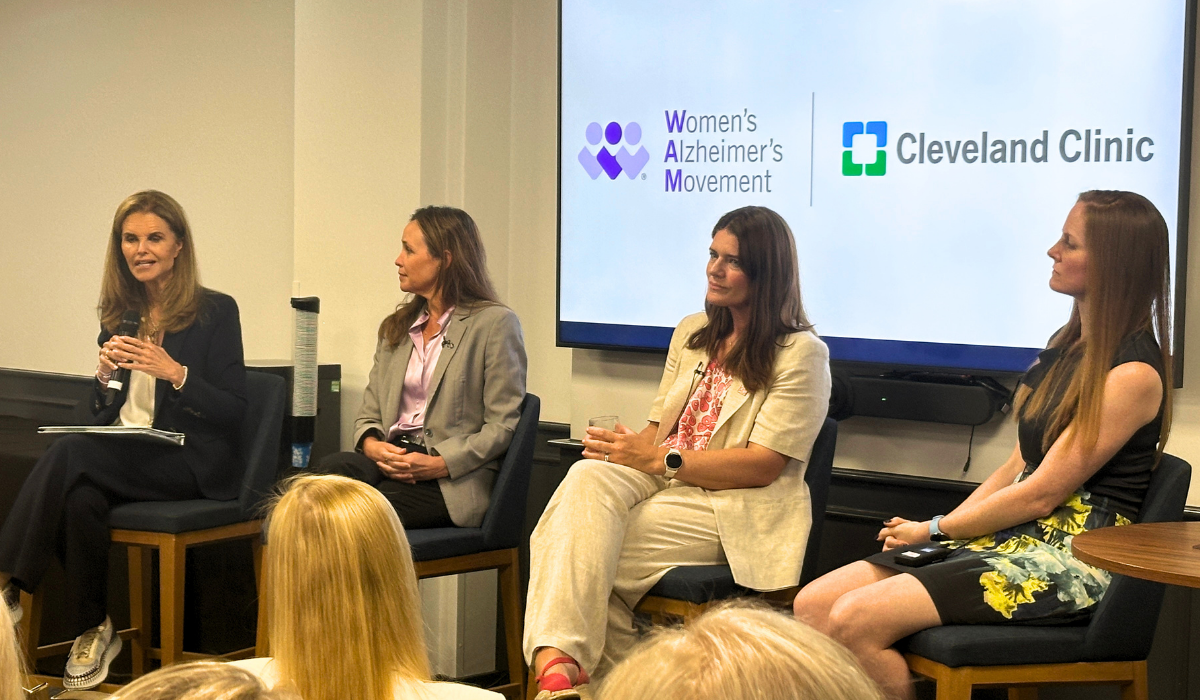
This past week I was at the largest Alzheimer’s conference in the world. And it was there that I had the privilege of hosting our WAM symposium, which brought together researchers, advocates, and other leaders in the space to talk about the advances being made for women and Alzheimer’s. We talked about what we know, what we are learning, and where we are going.
Alzheimer’s is a devastating disease. It has taken millions of people from the families who loved them, including my own. It is taking more every single day. We saw that this week when Captain Sully Sullenberger stepped forward to tell the world that he is now battling Alzheimer’s himself. The weight of that is real, and we never pretend otherwise.
And yet the people in that room were making a deliberate choice to be hopeful. To be joyful. To be optimistic. To celebrate every advance, every discovery, every researcher who has given years of their life to questions that may not be answered in their lifetime. I know from experience that keeping your spirit high is not denial. It is fuel. It is what sustains your work when things get hard and when the finish line is nowhere in sight.
I sat in that room watching scientists find joy in rowing together. They found joy in the questions, in the collaboration, and in the quiet daily act of showing up for something that matters. I thought, My father would have understood every single one of them. And then I thought, This is Norway. Right here in this room.
Speaking of Norway, let’s take a moment to acknowledge that team’s star, Erling Haaland. He has been celebrated across the world not just for his performance, but because of what he brought to every single moment he was on that field. Joy. Excellence. Resilience. A kind of luminous commitment to the game itself that transcended the scoreboard entirely.
Haaland won in all the ways that actually matter. He won hearts. He won minds. He showed an entire generation of young players what it looks like to play with your whole soul, regardless of the outcome. And Norway roared for him. They roared for all of them.
The American team played their hearts out on home soil. They ignited a passion for soccer in this country that hadn’t been there before. Crowds showed up, and our nation briefly united around a shared hope. Yet when our team lost, what did we talk about? Not what they had built. Not the fire they had lit. Not the joy they had brought to millions of people who had never watched a soccer match in their lives. We talked about how they hadn’t delivered. How they hadn’t lived up to expectations. There was no parade. No homecoming. No roar. They were met with silence. That silence says more about us than it does about them.
We live in a winner-take-all culture, and we learn this lesson early. We learn it in sports, in business, in relationships, and in the way we talk about success and failure as though they are permanent conditions rather than moments in a life. We exalt the winners. We ridicule the losers. And in doing so, we lose something essential about our humanity.
Here is what I believe with everything I have: every human being deserves to be celebrated. Not just for winning, but for what they are going through. For what they have accomplished. For their resilience. For the way they get back up. For the way they reach out to friends when they are hurting. For the way they keep trying to love even after they have been hurt.
What if instead of asking, did they win, we asked, did they show up? Did they try? Did they bring joy, excellence, and heart to whatever they were doing? Did they get into the arena? That is a different question entirely. And it leads to a completely different world.
I hate the term winners and losers. It is superficial, judgmental, and costs us more than we know. It cost me a moment with my father that I can never get back.
This ethos—roaring for effort, celebrating the heart, honoring everyone in the arena—is not new to me. I have seen it my whole life in the Special Olympics movement. In every coach who shows up for an athlete the world has written off. In every parent who drives hours to watch their child compete and cheers as if the gold medal and the last-place finish are equally worthy of celebration (because they are). Every volunteer who gives their weekend not for glory but simply to be part of a movement that says: you matter, you belong, we see you.
The Special Olympics was not built by one person. It was built by volunteers, parents, coaches, and families who decided they were going to show up for their people regardless of what the world thought. People who wanted to build a more connected, more human world and who built it one athlete, one meet, and one roar at a time. That has always been the ethos of the Special Olympics. And it is the same ethos Norway brought to the World Cup.
At its best, the World Cup is about far more than wins and losses. It is a global celebration of shared humanity, camaraderie, and joy. As you’ll see reflected in the essay below, moments like these remind us that sport can unite people across cultures, languages, and borders. And as travel expert Rick Steves shares with us this morning, some of the most meaningful lessons we learn come from finding common ground with people whose lives and experiences differ from our own.
When I watched Norway rise as one—an entire country in the same boat, rowing in the same direction, for the same team, at the same moment—I realized that I want that for my city and for my country.
Los Angeles, where I live, feels so divided right now. So does America. As a collective, we’re scared, angry, and hopeless in so many ways. I don’t think most people feel like they are rising as one.
And I have to be honest, this winner-take-all, us vs. them mentality has shown up in so many areas of my life over the years. Journalism. Politics. Media. You are only as good as your last story, your last election, your last ratings number. There is very little roaring for effort. Very little celebration of the happy warrior who got into the arena and gave everything even when the outcome didn’t go their way.
So how do we get to where Norway is? How deep do we have to dig to find that in a culture that often pits us against one another? Especially when we have a president seeking to divide us, scare us, and spin lies to us about who we are and about our institutions? It is hard to row forward if someone tells you over and over to go back.
So what is the solution? I think we start smaller than we imagine. I think we start by finding joy in our everyday lives and expressing it out loud. Not performing it, but actually feeling it and naming it. I think we start by talking about what is right about our cities and our country instead of only what is wrong with them. I think we start by gathering, connecting, and conversing. (The Sunday Paper did that this past week in our first Be Lit salon series, and it was so igniting.)
I think we start by looking at the person next to us—the one rowing quietly, who maybe didn’t win, but who is still trying—and we roar for them. Just that. Just that one act, repeated enough times, by enough people, is how you build a community. How you build unity. How you find yourselves suddenly in the same boat, rowing in the same direction, rising as one.
Norway didn’t get there by accident. They got there by deciding that this was the kind of country they wanted to be. We can decide that too. We can decide whether we want to live in a winner-loser culture. We can decide whether we want our children to see bullies succeed or to see those who find joy in the effort celebrated. We as a nation need to decide what to row toward and what to row against. Our children are watching. The world is watching. Our silence, our acceptance, is sending a message. Is it the one we are proud of?
I should have roared for my father in 1972. I should have roared for him in 1976. I should have looked into his eyes and told him what I knew in my heart but was too young and too afraid of the world’s judgment to say out loud. I should have said: you are not a loser. You are magnificent. You are a happy warrior. You got into the arena when most people never would have dared. I see that now. I wish I had seen it then.
Thinking about my father this week made me ask myself a harder question. Where else have I only paid attention to the winner? Who have I walked past in my own life without stopping to roar for them? Who is rowing right now, quietly, without fanfare, without anyone in their corner, waiting for someone to notice the effort and say: I see you. I am proud of you. Keep going.
Because here is what I keep coming back to. We are living through an epidemic of loneliness. One in three Americans says they feel alone. And I wonder now if, underneath the statistics and silence, what that really means is this: Nobody is roaring for me. Nobody sees my effort. Nobody is standing at the dock when I come home. Nobody thinks what I am doing is worth celebrating because it is not perceived as winning.
What if that is the real crisis? Not that we don’t have enough people in our lives, but that we have forgotten how to show up for each other the way Norway showed up for their team? Fully. Loudly. Unconditionally. For the effort. For the heart. For the simple sacred fact of having gotten into the arena at all.
I know I want to do a better job being a happy warrior for the issues and people I care about. And there are a lot of them.
So this week, I want to celebrate the happy warriors in all areas of life. The ones standing up for our democracy. The ones studying diseases that have eluded cures. The ones standing up against misinformation. The ones who direct sweeping films like The Odyssey that touch our hearts and ignite our minds. And the ones rowing quietly in my own life who need someone to roar for them. I want to show up for them the way I didn’t show up for my father.
If you are in the middle of something hard, and feel like you’re rowing toward a shore you cannot yet see, please take a moment to close your eyes and imagine multitudes of people roaring you forward with joy. Not because you won. But because you showed up.
In this era of loneliness, that is not a small thing. That is everything.
Roar and row, everyone. Roar and row.
Prayer of the Week
Dear God,
May we have the courage to keep rowing when the waters are hard, and the grace to roar for one another and celebrate our shared humanity.
Amen.
Also in this week’s issue:
• Rick Steves Knows the Secret to Strengthening Our Connections
Please note that we may receive affiliate commissions from the sales of linked products.