The Founder of Shake Shack Says “You Cannot See It. You Can Absolutely Feel It.”

For Danny Meyer, hospitality is about creating a feeling of welcome, whether someone is sitting at a table in one of his restaurants or walking through the front door of his home.
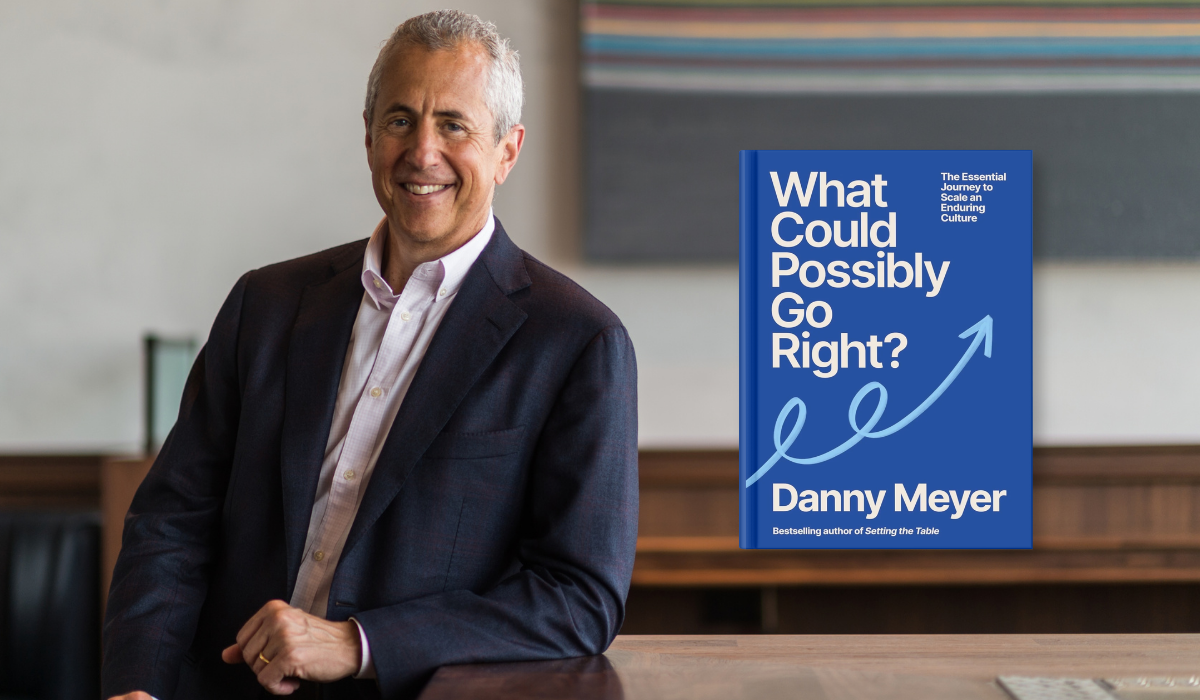
In a world where customer service increasingly means talking to an AI chatbot, Meyer believes that the key to success remains distinctly human, that to be seen and heard is to connect with people. The entrepreneur behind well-known names such as Shake Shack and Gramercy Tavern has written a new book about leadership called What Could Possibly Go Right? (out September 29)—emphasizing the need for a top-down corporate culture focused on empathy, communication, and positive expectations.
Sitting outside the Shake Shack in Madison Square Park in New York City, Meyer shares how the principles of hospitality can apply far beyond restaurants, the thoughtful gestures that remain with him, and how creating an inviting experience starts long before anyone arrives.
A CONVERSATION WITH DANNY MEYER
So what is the secret to making someone feel welcome?
The more you know about your guests and what their preferences are the better. That comes down to what you're serving to drink, what you're serving to eat, the kind of music you have on. There are certain guests we're going to play classic rock for. There are certain guests we're going to play jazz for.
It’s also about stepping out of our usual routine and making each other feel like a guest. Like today, it's a great day for me to buy flowers for the home. It's usually my wife Audrey who's buying the flowers. It's amazing how our harmony and our calm sets the tone and helps make everybody feel welcome. It's almost more important than the music and the food—it's the human energy that people are walking into.
Have you experienced that kind of hospitality yourself?
I wrote about this in “What Could Possibly Go Right?” where I checked into a hotel room, and when I accidentally hit the mouse of the computer, the computer screen lit up—and the wallpaper was a picture of this Shake Shack right here (in New York City.) I was in Colorado, and I was like, "Someone's pretty thoughtful here."
Then I went into the kitchenette, and there was a collection of not only Setting the Table, but every cookbook we've written. There was a bookmark in the page of our book Mix Shake Stir—it happened to be the cocktail that I had created in honor of my father, named for him. And then I looked further, and on the dining room table were all the ingredients for that cocktail.
I mean, that’s a place where somebody was really, really awake at the wheel. If you want to know if you feel welcome at a place, that took it a lot further than a plate of chocolates with a standard note from the general manager saying how happy they are to see me there.
What is it about those details that makes such a difference?
It's the human energy that people are walking into. And I cannot overstate that.
If you walk into one of our restaurants, I really believe and I hope that you will actually feel a different, more uplifting human energy than you would feel at the restaurant next door, and it's because our first requirement is that our staff offer hospitality to each other.
Human energy is like the wind; you cannot see it; you can absolutely feel it.
You have talked about the importance of dialogue at a time when people are really struggling to connect person-to-person. How does that relate to hospitality?
I don't think we've ever been at a time in history where there's been more connectivity and ways to connect, but there's also never been a time when there's been less human connection, and there's a reason that we have this loneliness epidemic because people are mistaking, you know, virtual connectivity with human connection.
One of the things I love about the business I'm in, and you can go to any restaurant and see this, is that the life that's happening in restaurants is human to human.
Human beings are cooking the food. Human beings are bringing you the food. Human beings are hosting you at your table. Hopefully, looking you in the eye, thanking you, deriving joy when you feel happy with the food you got.
That's not something that an AI agent is going to do. That's not something a robot is going to do. It's just, it's just never going to work.
People are afraid to have people over now because they’re afraid something will go wrong. How do you handle those sorts of disasters?
Stuff will always happen, and that's why putting people at ease emotionally before you serve anything is so important. And having a sense of humor helps.
The worst thing that happened for me was we had a few couples over for dinner, and I had spent a fair amount of time that day making smoking ribs outside—they were some of the best ribs I've ever made in my life.
I went to the kitchen to open a second bottle of wine. I was in a hurry to open it because people were already seated. As I'm opening the bottle of wine, I have my left hand around the neck of the bottle. Instead of the cork coming out of the top, the glass neck of the bottle snaps off and slices my thumb right where the thumb meets the hand.
Now I have to ask one of the guests to take me to the hospital, so that my wife can host the rest of dinner. I just said, "I'm going to get stitched up, and I'm going to come back here. Please just save me a plate of those ribs because I put all day into making them!" And everyone had a great time at the party.
What did you take away from that experience?
No animal on earth makes more or better mistakes than we do, and so my question is: What do you do with those mistakes?
You can be the person who pretends it never happened. You can be the kind of person that you blame your mistakes on someone else, or you can be the kind of person that owns it, acknowledges it, and actually ends up in a better spot than they would have if they had never made the mistake based on how they handle it.
What is one thing people can do every day to create more of that connection?
I think the theme that runs through my new book is the title itself. What Could Possibly Go Right? And I believe that I start every day asking myself that question: What could possibly go right today?
I do believe that all the really good things, all the really good ideas, all the really good moments, all the really good parties I've ever thrown, all the really good restaurants I've ever opened, including the one right in back of me, started with that question: What could possibly go right?
I've never had any great thing begin with, "Here's an idea: What could possibly go wrong?"
So for any human being on Earth, whether you're starting your day and putting your kids in a school bus or making them breakfast in the morning and getting them dressed, I don't think it's a bad idea to start with what could possibly go right today? I think that we can actually make better things happen and do better things for the world when we adopt that mindset.
Danny Meyer is the founder and executive chairman of Union Square Hospitality Group, which operates restaurants including Union Square Café, Gramercy Tavern and The Modern. He is also the author of several books, including Setting the Table and his latest, What Could Possibly Go Right?, exploring hospitality, leadership and human connection.

Please note that we may receive affiliate commissions from the sales of linked products.