Defining Our Own Sense of Freedom
The summer I turned 21, I sang about freedom every hour on the hour.
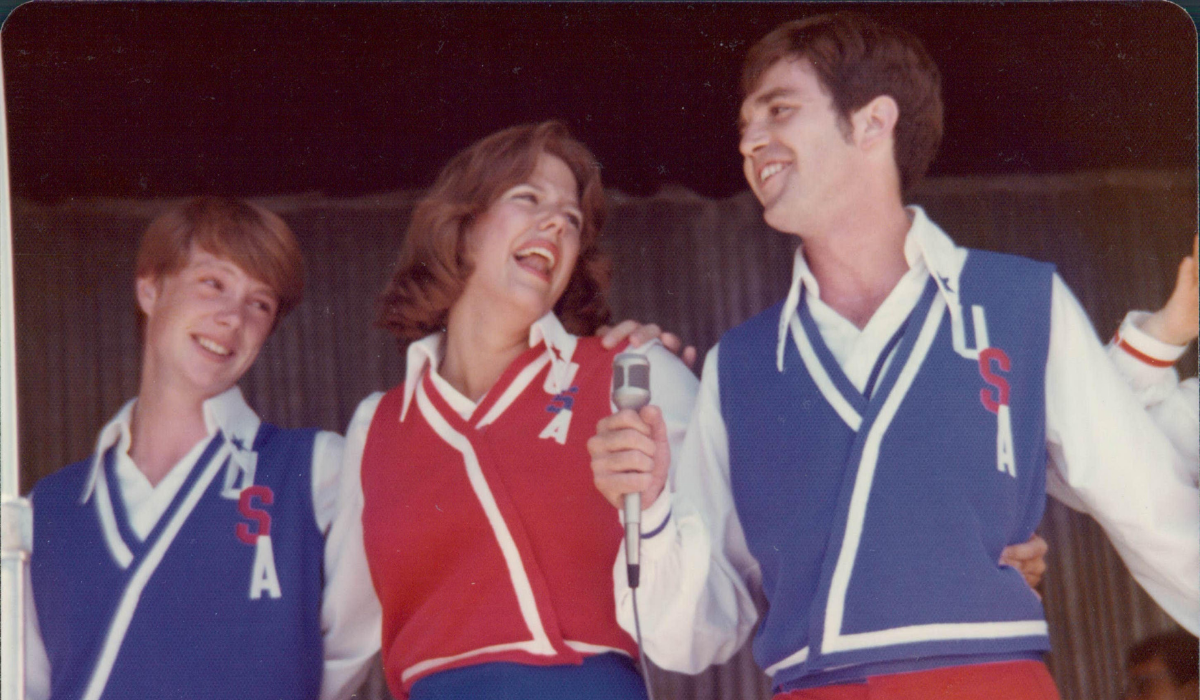
It was 1976, the Bicentennial summer, and I had just been cast in a dream job at Disneyland. One of 12 college students sorted into six guy-gal pairs and dressed in red, white, and blue, we performed a 35-minute Americana medley.
For the Fourth of July, my parents flew out from Illinois. I danced across that stage, baking under the California heat in my polyester blouse and wool vest with USA stitched across my chest and felt the pride of representing my country. I was my parents’ daughter; my mother, a staunch conservative who sent op-eds to the Chicago Tribune. I had no political self-awareness of my own yet. I mimicked theirs, embracing a patriotism that felt like love. I looked into the faces of sunburned moms and dads wrangling little kids clutching ice cream cones, the grandparents quietly attentive from their folding chairs, and I felt the pure joy of someone who believes she is exactly where she is supposed to be, doing exactly what she was put here to do.
Twice each day, at 2 and 9 p.m., we were part of the Bicentennial parade. I ran up and down a float, singing a song from the musical Shenandoah: “Freedom is a flame that burns within ya. Freedom’s in the state of mind.”
The words moved me. I believed that America was freedom’s steward on earth, that we were the good guys, that our role in the world was to spread that light to all who desired it. I had grown up watching Jimmy Cagney in Yankee Doodle Dandy, stirred by the notion that Americans had crossed an ocean to keep the world from falling into darkness.
What I could not have imagined, as our float glided down Main Street, was that 50 years later I would watch my country embracing the very thing we had once sacrificed lives to defeat. The freedom I sang about that summer was real to me, but it was abstract. It was Stars and Stripes on a flag, a feeling of goodness and truth. It had not been tested against anything I had actually lived.
I didn’t yet know who I was beneath the costume.
The Road to Freedom
For 21 years I’d honed a performance of self, the seventh of eight kids in a high-achieving family, my sunny smile masking the pain of a turbulent home life. I was taught that imperfection and negative emotions made me unlovable, so I shut them down. I didn’t understand that with each act of denial, I was becoming more lost. That reckoning came in my early thirties, when I found myself trapped inside another performance of happiness, weathering a painful marriage. Freedom was no longer a shiny ideal for me to salute. It was my deepest longing.
The road back to myself was messy and hard, but once I dropped the mask and gave myself permission to feel what was true without apology, I got my first real taste of liberty. With it came the freedom to stop curating myself for an audience. The freedom to step off the float of my own life and ask, for the first time, what I believed. Who I actually wanted to be.
That’s when I understood that real freedom is a byproduct of responsibility. We cannot be free in any domain where we refuse to be fully accountable. Every place we hide, deflect, or deny, every story we tell ourselves to avoid looking at what is actually true, is a place we remain shackled, no matter how loudly we sing about liberation.
America is a nation that has never fully felt what it has done. We have the mythology down, the tale of the scrappy colonies defeating the empire, of the Greatest Generation making the ultimate sacrifice. We return to these stories the way I returned to that stage every hour: the costumes on, the lights up, the audience hungry for exactly what we have rehearsed to give them. What we have never fully done, what we have deferred and suppressed and legislated away from public view, is sit quietly offstage and feel the weight of what we have not yet answered for. Like a person, a nation that cannot feel its own wound cannot heal it. It can only keep performing around the pain, which grows louder and more insistent as the pressure builds.
Genuine responsibility insists we sit down with our history and honestly tell the whole story about who benefited and who paid, not to punish but to finally, actually, see ourselves. That’s the courage America must now find. The willingness to be changed by what we discover when we stop performing. To make amends and choose to do better.
Other nations are watching us. Longtime allies who once trusted us with their security see a country that was once a beacon, albeit a flawed one, and wonder whether the light is going out. Others wait with the cold calculation of those who can now capitalize on our instability. And here at home, millions of Americans are watching, horrified and uncertain, wondering whether the country we love will find its way back to itself. What we choose to face or refuse to face here ripples outward to every border.
I know the terror of coming clean, facing the unknown consequences of dropping the act. I also know that the moments I’ve dared to expose my failures to someone I love, bracing for the loss I thought would surely follow, have often created connection and surprising joy.
I am seventy-one years old now and full of hope. I believe in it more than I did on that float, because now I know what it costs and what it’s made of. Fifty years ago, I sang about freedom to a country that wanted, more than anything, to believe it already had it. The wanting is not enough. The belief is not enough. Real freedom is not a feeling you perform. It is a deep, emotional sense of responsibility you claim.
The float is still moving. And all over this country, in living rooms and quiet moments of private conscience, people are already beginning to feel the weight of what is true and choosing not to look away.
That is how true freedom is found. Not with a declaration or a performance.
True freedom comes from a willingness to feel.
Leza Danly is the creator of the one-woman show Soul Breadcrumbs, now streaming. She is a life coach, workshop leader, and founder of Lucid Living, Inc., where she offers transformational online programs, including Radical Nurturing. She lives in Bainbridge Island, Washington.
Please note that we may receive affiliate commissions from the sales of linked products.