How Alive Are We?

My friend Elizabeth sent me a poem the other day, but it wasn’t just any poem. It was one she had read many times before, but on this particular day, it reminded her of me. She said it reminded her of what I’ve been writing here over the past several weeks about opening ourselves up to the grief of the world. About staying in the fight. About all of it.
The poem was “Flare” by Mary Oliver, one of my dear late friends and favorite poets. I’d read this particular poem before, but this time it landed differently. Poems have a way of doing that.
I made a note to write Elizabeth back, but then my day got away from me, as days often do. Many things in life have been getting in my way and under my skin lately. Sometimes I wonder why they aren't getting under more people's skin.
Ever since our Secretary of Defense announced he was going to film a live execution and share it with the world, I had been waiting for the collective outrage.
“People are busy,” a friend said.
“It's just too hard to keep up,” said another. “One minute it's this, the next minute it's that. You can't let it all in.”
Mary Oliver writes in "Flare": “Nothing lasts. There is a graveyard where everything I am talking about is, now."
I guess that's where these stories go, to the graveyard, I thought to myself earlier in the week.
The live execution story.
The story of another tragic school shooting, this time in Oregon. Three elementary school children and a teacher at the start of her career, taken from us in an instant.
The story about a mother who drove her child thousands of miles to a hospital and had to sleep in her car because she couldn't afford a room.
The countless stories about people who can't afford food, gas, or medicine while those in power rake in millions and billions.
The story graveyard.
But guess what? By the end of the week, the president had canceled the live execution after widespread condemnation. This story didn’t stay in the graveyard after all. People started speaking up, saying, “No way, not on our watch. This is not who we are.” Bravo, fellow humans.
I hope the same can be true after this heartbreaking school shooting. As more reports came out on Friday, we learned that a teacher at the school threw her phone at the 16-year-old suspect and tried to wrestle the gun away from him. Then a father, who just happened to be driving by and saw the suspect firing in the parking lot, ran inside with his own weapon and opened fire, killing the teen. Both of these adults did what they could in that moment to intervene. Both said “not on my watch.” Now what will the rest of us do to say the same?
In her poem, Mary continues:
“The voice of the child crying out of the
mouth of the grown woman
is a misery and a disappointment.
The voice of the child howling out of the tall, bearded,
muscular man
is a misery, and a terror."
Misery and terror. Everywhere. And yet, where is it, really? So many people don't have the time to cry out their disappointment, their heartbreak, or their rage. So Mary asks the question I keep asking myself:
“Therefore, tell me:
what will engage you?
What will open the dark fields of your mind,
like a lover
at first touching?”
What will open the dark fields of our minds? I ask myself. If the tragedy of more little children losing their lives won’t do it, then what will? If rage isn’t enough, then what is?
While all these unthinkable and heartbreaking stories rattled my mind, I stopped and realized something. My friend Elizabeth hadn’t sent me Mary Oliver’s poem to cause my mind to spiral. She had sent it to me because it reminded her of my words and work. Sharing it with me was an act of love. A specific, tender, intentional act of love. And I had skipped right past that.
I'd skipped over the receiving. I hadn't paused. I hadn't let it land. I hadn't let myself be loved, even though just last week, in this exact space, I wrote that I am here to love and be loved. So you see, receiving love is hard to do. Even when you know you should. Even when you've just said it out loud.
That’s the thing about love. It’s right there, showing up at your door, sitting at your feet, flashing like a light at the intersection. And we run right by it, lamenting that we don't have enough of it in our lives.
Elizabeth's love was sustenance. Hers is the kind that nourishes. The kind we long for and walk past every single day.
So in that moment of realization, I paused and let myself be touched by what my friend had done. My shoulders dropped. My breathing slowed. Tears came to my eyes. I had been loved. And I had almost missed it.
Mary writes:
“When loneliness comes stalking, go into the fields, consider
the orderliness of the world. Notice
something you have never noticed before,
like the tambourine sound of the snow-cricket
whose pale green body is no longer than your thumb."
I look down at my thumbs and smile. I moved them around and think to myself, How few of us are truly alive in our lives? Myself included. And so I take a moment to give thanks that I can move my thumbs, move my legs, and see with my eyes.
So many of us move through the world numb and with our heads down. I’ve been that person in the past, so I know her well. But today, that version of her is in the graveyard. Today I’m grateful to be alive, and I’m here for all of it.
Are you alive like the snow-cricket? Like the moth? Like the birds moving south?
So many things make me feel alive. My kids’ laughter. My grandchildren’s hugs. My brothers’ voices. My friends who check in. My work. It all pushes me to the outer edges of my being, constantly and continuously. It pushes me to expand into the unknown.
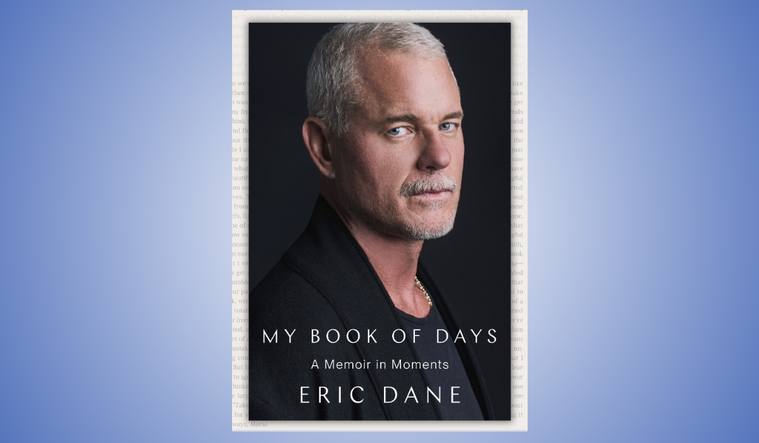
Today I am honored to share with you, for the first time, an excerpt from actor Eric Dane’s memoir My Book of Days, which releases November 3rd. I’m the publisher of his book, which means I have the honor of being a messenger for his story.
Eric, who died of respiratory failure caused by ALS in February, was best known as an actor. But after his ALS diagnosis, he became an advocate too. He wrote this book for his daughters. He told me he wanted them to know who he was. He wanted them to know the life he lived and didn’t live, and how hard he fought. He wanted to teach them how he learned to live once he knew he was dying.
Eric also wanted his daughters to know him for who he truly was—not the version of him the world saw, but the man underneath. The one who struggled. The one who wasted years. The one who came, finally and fiercely, alive.
Eric became a different man when his ALS diagnosis hit him like a blade. It was a death sentence that, paradoxically, woke him up. He didn't want to wait anymore. He didn't want anyone else—his daughters, or you—to wait as long as he had.
His words are a wake-up call. And so are Mary Oliver’s, but from a different direction. Their words are a flare sent from the grave. The afterlife. They beckon us: Are you using what you have? Do you even know what you have? Are you alive in this? (Speaking of the afterlife, please check out the piece below from Taryn Delanie Smith, better known as “Denise, Heaven’s Receptionist” on TikTok.)
My friends, we are all living out our own book of days. Each of us gets to decide what will make us feel alive. What we will not let go to the graveyard without a fight. We can choose to be numb to the collective pain we witness. We can choose indifference to the stories journalists offer us. We can shrink our lives as we age because it’s all too much.
Or.
Or.
We can wake up.
We can wake up to the beauty all around us, while also mourning its horror and grief. We can wake up to the love being offered to us right here, right now, in the everyday, unremarkable moments we keep rushing past. We can wake up to this country and decide it is worth wrestling back from those who have lost their minds and their souls.
Mary closes her poem “Flare" with this:
“Rise up from the stump of sorrow, and be green also,
like the diligent leaves.
A lifetime isn't long enough for the beauty of this world
and the responsibilities of your life.
Scatter your flowers over the graves, and walk away.
Be good-natured and untidy in your exuberance."
When I finally wrote my friend Elizabeth back, I thanked her for reminding me of this beautiful poem. But more importantly, I thanked her for loving me. Then I asked her, “How are you? No, really, how are you?”
“What a great question,” she wrote back. “How am I truly? Multiple truths are alive in me all at once. Each one as true as the other. I am outraged and saddened by the state of humanity. But I am also calm and sanguine—we’ve been here before, and worse. This is what literature is good for. Anna Karenina, Circe, Joseph Campbell, etc. I’m reading a novel about what it was like living in Ireland and England in the 1500s. Not good for girls and women (or anyone, actually)! I am also so freaking blessed—a beautiful home, kids who are awesome, grandkids the same, health, a kind and funny husband, work I can’t wait to do each morning, coffee…FRIENDS and FAMILY. Relatively good health for a girl in her 70s. Faith. Faith. Faith.”
“Now, your turn!” she said.
So my friends here, I pass the baton to you. It’s your turn to answer this question. How are you truly?
As for me, I’m sad and filled with joy. I’m outraged and at peace. I’m concerned and hopeful. A lifetime isn't long enough to tell you how I truly am. I’m grateful for all that I have and all that I don’t. I’m grateful that the Pope seems to be on the mend after his lung cancer diagnosis this week. I’m grateful for his voice and that I’m alive to hear it.
I’m also grateful for the beauty of this world. For the people who love me and those who love you. I’m grateful and excited for the work we are still here to do. I’m hopeful that I can be a part of wrestling our country back from the brink and helping write a new beginning that will include us all.
“Be good-natured and untidy in your exuberance,” Mary wrote. I would add: Be alive in your love and in your outrage. Both. At the same time.
Mary’s poem reminds me that everyday love is the sustenance we need to move forward. It’s so easy to let the stuff of life take you away from the important things, like responding to a friend. So slow down. Remember that voices that rise above the noise do get heard. They do make a difference, from Main Street to the Oval Office. Your voice matters, and things change when enough people say, “This is not who we are.”
Hope is alive, and so are you, so don’t let busyness overtake what is critical to how you feel.
Wake up to your life. Do not wait for a death sentence to become grateful. Do not get so busy that you miss the love being offered to you on the daily, right at your feet, flashing like a light at the intersection, asking only to be noticed.
Do not rush past the stories that tug at your heart. Or the ones that stop and stun you. Like a live execution announced with a shrug. Like a school shooting shattering lives. Like a mother sleeping in her car. Like a country that could be so much more and is choosing not to be.
This is not a dress rehearsal. Those who are playing gladiators in the people's house do not get to have the last word. You do. We do.
You get to be outraged. You get to be enraged. You get to be heartbroken. And you get to vote to change it all.
You get to send up a flare and watch it light up the world.
P.S. What has opened the dark fields of your mind lately, like a lover at first touch? Write to me and let me know. I read everything. And right now, more than ever, I want to know what is making you feel alive.
Also in this week’s issue:
• First Look Excerpt: Eric Dane Inspires You to Live and Love Fully, Right Now
• The Afterlife is Alive and Well
• A Sunday Paper Exclusive Guest Op-Ed: This World Menopause Day, Medicine is Still Failing Women
Please note that we may receive affiliate commissions from the sales of linked products.