I Thought I Understood Breast Cancer. Then I Got It.
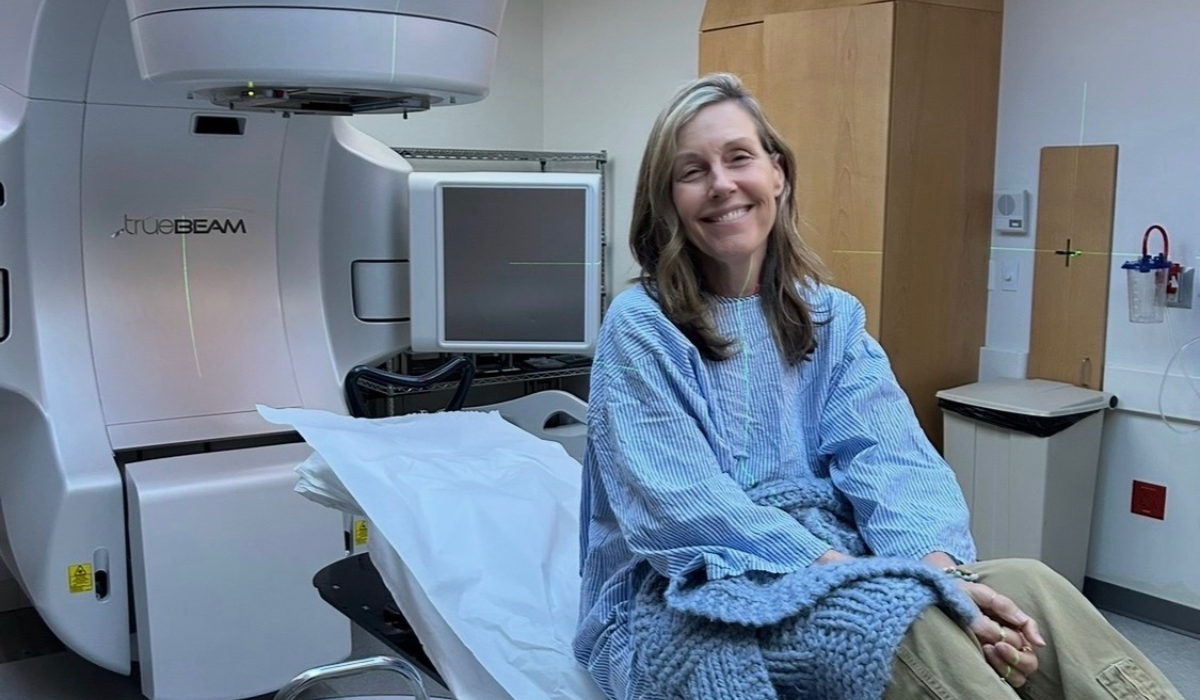
Last October, I was driven to radiation therapy every day for four weeks at Smilow Cancer Hospital in New Haven, Connecticut, an hour from my home. My preferred route bypasses the highway, and runs through old brick mill towns. The whole region was decked out in the pink balloons of Breast Cancer Awareness Month.
In one town, even the funeral home bore a giant Barbie-pink ribbon, and in another there was a newly painted pink strip between the yellow centerlines on the street. Another one featured something more sobering: dozens of banners bearing names and photos of women who had survived breast cancer or died from it. It was an odd gauntlet to pass through twice each day: reminders with human faces of the disease that women, including me, are suffering from in staggering numbers.
My cancer story started a couple of months earlier. On a hiking trip in Scotland, I felt a lump in my left breast—the same mass that was biopsied 5 years prior and deemed benign. Since I first noticed it in 2020, I had followed this lump every six months with mammograms and ultrasounds, each time getting an all-clear, so I was certain nothing was amiss. And yet, the lump seemed to have turned overnight from a tiny cocktail peanut to a painful, bumpy raspberry. I have no particular risk factors or family history: I’m the youngest of four girls and none of them, nor my mother, had breast cancer. I was not—ever—expecting this diagnosis.
Perhaps because I believed myself unlikely to get breast cancer, I never spent energy fearing it. With my particular genetics, neurodegenerative diseases and strokes were the monsters under the stairs. I’m hardly brave, and many things cause me terror: riptides, snakes, getting T-boned by a texting teenager when I exit my driveway. And ticks (I live in New England). And yet here I was.
Two weeks later, after multiple images and a biopsy, my husband and I drove to the hospital for the conversation with my breast oncologist. I already sensed the news my doctor would deliver. It was early in the day and a rabid coyote stood in the median strip. I loved this creature so much, the poor confused thing, how terrifying to be on a highway with cars and trucks zooming by. The vulnerability in her face mirrored my own, and split my heart in two.
During my forties (I am 65), one friend after another was diagnosed with breast cancer. Up close, I witnessed the waiting, surgeries, the aftermath, hair loss, exhaustion, fear, and anxiety of being treated for malignancy, and shared their relief when the ordeal was behind them. My diagnosis served as my entry ticket into the grueling and unrelenting limbo of the cancer world.
Today, breast cancer is alarmingly close to common. Upon learning of my diagnosis, countless people said, “Oh no, you too?” I read that insensitivity as a statement on breast cancer’s ubiquity: an estimated 382,000 cases of invasive cancer are diagnosed each year in the United States—one in seven women—and nearly 61,000 of Ductal Carcinoma in Situ (DCIS), which is Stage 0 and non-invasive, but can in some cases be a precursor to something more insidious if untreated.
Almost no one is unaffected by breast cancer through a relative or a friend, but despite being surrounded by “awareness,” I realized immediately that I knew shockingly little about the disease, beginning with the initial, infuriating mystery. How did a lump that had been followed for five years suddenly go from benign to malignant?
Inconsolable, I sought the wisdom of oncologist Kevin Cullen MD. As the thirty-year (and recently retired) director of the Greenebaum Comprehensive Cancer Center at the University of Maryland, Cullen has seen this—and almost everything else—before so my case was not entirely surprising.
First, he explained, benign masses can “change their stripes over time,” and become cancerous. “Unfortunately, your story is not unique,” he said. Perhaps even more scary: biopsies are not perfect, and sometimes not a complete representation of what is going on the moment it is performed, meaning that, for me, the cancer cells might not have been in the sample five years prior. “Most often, a biopsy gives you complete clarity, but sometimes it doesn't. And I think for you, the latter was the case.” His advice, which I desperately needed at the time, was not to dwell on why this happened, or who was at fault (did someone miss it? Did I? Should I have insisted on removing it preemptively?) but to look ahead and focus with a clear head on my treatment. You cannot control the onset of cancer, he said. Vigilance is the most important thing and because I was aware of changes in my breast, I caught the cancer early.
And so began what is colloquially called a cancer “journey.” As a travel writer, my life’s work is actual physical journeys, navigating the seen and unseen topography and spirit of unknown places. My specialty is to land somewhere in the dark without a map and often, without a plan, and make sense of it all. When the journey is over, I craft a narrative with a beginning, middle, and importantly, an end.
Cancer, by contrast, is a long, sometimes bright, sometimes pitch-dark tunnel. It is full of false exits that lead right back into another dim passageway, that lead into another patch of light. The radiant parts are accompanied by doctors or nurses that brim with knowledge and compassion, or friends that arrive at my doorstep with muffins or a roast chicken. There is a lot of waiting—for results, for appointments, for tests. All that time in the cancer tunnel “hijacks your brain,” as a friend told me. By extension, it also hijacks your life.
After months of diagnostics—a second tumor found, a third suspicious mass, all of which needed to be investigated, imaged, biopsied—I finally had my surgery. It was about seven weeks after the fickle lump was found to be cancerous, and another seven before my radiation began.
I had many questions for my oncologist, Eric Winer MD, Director of Yale Cancer Center (may we all have such a brilliant, kind healer to accompany us). I wanted to know—from him, and not the Internet—what exactly I had. “Breast cancer is not one entity, but a family of diseases,” he told me. I knew that some tumors were aggressive, but was in the process of learning that there was a wide range of pathologies and subtypes. My tumors got a stage, a grade and after surgery, a score from a genomic assay that helps determine whether chemotherapy would be helpful in addition to endocrine therapy and radiation.
Breast cancer is classified into four distinct subtypes, and it is likely that there will be additional classifications in the future. The subtype of the tumor affects the treatment and the prognosis. There are ductal tumors and lobular tumors (I had one of each) and the latter is considered somewhat distinct in its behavior. And a tiny cancer, according to Winer, no matter what the subtype, no matter how aggressive, has a much better prognosis than a larger cancer or one that involves lymph nodes. My treatment, like everyone else’s, would involve a calculation entirely unique to me.
There are too many variables that affect prognosis and treatment. That is why it is hard to compare one patient with breast cancer to the next. My cancer was likely different from your aunt’s, sister-in-law's, or college roommate’s breast cancer. Though people meant well, I was not particularly interested in hearing how cousin Cathy was doing now.
There is no quick way to navigate cancer, and you can't rush treatment either. Time moves slowly in cancer world. My work stopped, my ability to focus tanked, and I have no idea how I kept busy during the day. It turns out I had a deep well of patience that I drew from, and I forgave myself for achieving absolutely nothing. Not once did I think of myself as a “warrior” or a “fighter”—this reductive positivity exhausted me, as I was anything but gutsy. My doctors told me what to do, and I did it. Morning followed night, and milestones boosted me forward. I had my first day of radiation, and eventually my last. I greeted my physicians and technicians with grateful hugs, and they all let me know, when the day came, how delighted they were to see me on the other side.
When I was diagnosed, there was a reflex from the people around me: Why do you think you got cancer? This was painful, because blame is implied. Of course, it must have been my fault. I’m a light drinker, but still - was it alcohol? Was it a lifetime of microplastics, my poorly regulated anxiety disorder, the weed killer and pesticides that are everywhere, the horrifically processed foods I ingested when I was younger, before I understood what they were? Was it the hormones, even though the research linking HRT to cancer was refuted? I lived downtown on 9/11—was it the deadly toxins in the wind that lasted for months? “I think assessing blame is not productive, and just makes someone feel badly,” says Winer. “And also, it doesn't change anything we're going to do to treat it.” Breast cancer might be caused by a constellation of things, some of which can be controlled in the future. But mostly, it’s bad luck.
At first, I demurred from asking for help, or accepting it when it was offered. But eventually, I needed every hand that reached out to me. And yet, some of the loneliest moments of my life were in the changing room at Smilow before and after my treatments. This experience would unlock the deepest grief for my mother and father, the latter of whom died only one year earlier. Only then did I face my mortality and finally my fear.
A year later, I remain ensconced in breast cancer’s continuum, dealing with the side effects of medications that will help block a recurrence, and other enduring emotional and physical scars. My learning curve was more like a precipitous cliff. But as I write this, female flight attendants on Delta are wearing bubble gum pink dresses, and I feel a visceral solidarity to this club no one chooses to join. I am in cancer’s aftermath, and for now cancer-free in large part due to the lifesaving research that Breast Cancer Awareness Month helps to fund. The pink bows represent my education. They represent hope.

Please note that we may receive affiliate commissions from the sales of linked products.