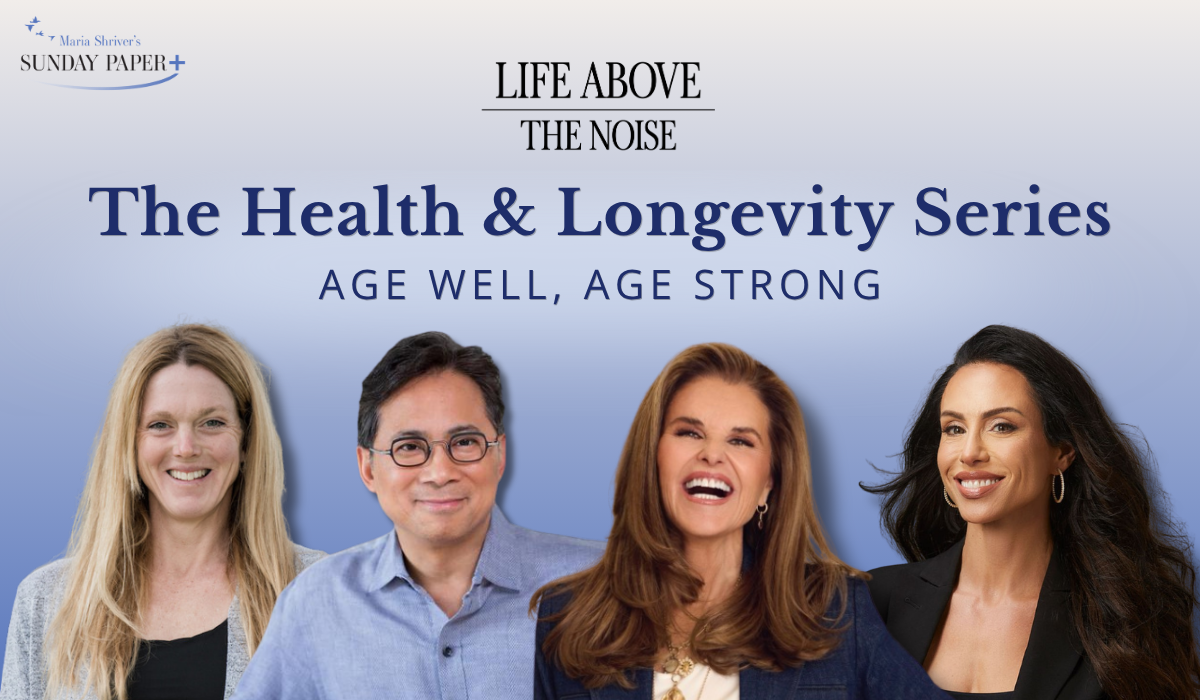
The Health & Longevity Series: Age Well, Age Strong
So many of us want to take good care of ourselves—and we're trying to, in-between our job and our kids and our parents who need us. But the advice keeps changing. It's gotten harder to know what's actually true, and harder to know where to start.
So Maria sat down with three doctors who have spent their careers separating what's true from what's noise, and asked them the question she hears often from women in this community: how do I age well, age independently, and age with strength?
Here is what these three conversations teach us, over and over: we have far more say in how we age than we've been led to believe. And it starts today, whatever decade we're in.
Maria asks the questions that you’ve likely wondered too: "What do I need to do now so that I can keep lifting my grandchildren moving forward. What do I need to do now in order not to fall? In order to be strong? In order to go up and down the steps?"
That's what these three conversations are for. We hope the science and the guidance inside them help you build the strength to live the life you want—whether that’s carrying your own suitcase or your grandchildren.
Stacy Sims Breaks Down the Secret to Good Health at Every Age—and It’s Something You Can Start Right Now
Women are not “small men,” and Stacy Sims, PhD, has spent her career proving it. In this conversation, she walks Maria through what changes in a woman's body and brain in her 40s, 50s, 60s and beyond, and what to do about it at every stage. It's practical, it's specific, and you can start today. As Stacy puts it, "We want to be able to carry our own suitcases when we're 90." Here's some of what you'll learn:
- The four factors that make up a healthspan, and the two Stacy would pick if she could only pick two: sleep and strength training.
- What "heavy" actually means. Her simple rule: a weight you can lift eight times with two more left in the tank. Start with your body weight and work up.
- Why finishing worked, not smashed, is the goal, and how the "big sweaty session" mindset works against women in midlife.
- Proof that you can start at any age: research on women up to 80 building bone and muscle with heavier loads, and why doing it with friends makes everything better.
Dr. Gabrielle Lyon Shares the Playbook That’ll Build Your Physical and Emotional Resilience
Gabrielle's mission began with one patient: a mother in her mid-50s who had followed every rule, stayed thin, done her cardio, and whose brain scan looked like the beginning of Alzheimer's. That moment changed everything for her. She and Maria talk about muscle as an organ, protein as fuel, and why strength is a responsibility, not a luxury. Together they explore:
- Why muscle is the organ of longevity, the only one you have complete control over, and why what's good for your muscle is good for your brain.
- How to build strength at home, three days a week, with your body weight and a $15 pair of dumbbells. You've been lifting your whole life: groceries, luggage, grandchildren.
- Why protein comes before salad, and why the current guidelines are set to prevent deficiency, not to support aging well.
- If you're on a GLP-1, the one thing you must protect, and what Gabrielle tells her own patients.
Dr. William Li on Eating to Beat Disease
In medical school, William asked his professors to teach him about health—and was told that health is simply the absence of disease. He found that answer unsatisfying, so he built a career answering it. He and Maria talk about food as medicine, the anti-diet, and why aging doesn't have to be a bummer. In this conversation, they discuss:
- The experiment that convinced him: he disguised 20 food extracts as drug candidates and ran them through the cancer-drug pipeline. About half were as powerful as the drugs, or more.
- The landmark study showing human metabolism holds steady from 20 to 60. A slow metabolism doesn't cause weight gain; extra weight slows the metabolism. In his words, 60 can be the new 20.
- The everyday foods research links to memory and brain health, including the one-cup-a-day study that improved memory in people with early cognitive changes.
- Why it's about adding in, not cutting out, and why the good stuff is the simple stuff your grandmother cooked.
Wherever you are in your own health journey, we hope the science and wisdom inside these conversations help you feel stronger, clearer, and more in charge of the years ahead. Thank you for being here with us!
P.S. We'd love to hear from you in the comments: What's one change you've made for your health that's made a real difference? Or, after watching, what's one thing you want to start today?