The Research Gap Women Can’t Afford

Earlier this week, the White House announced a new initiative to advance women’s health. I welcome the growing recognition across political parties of the importance of women’s health research coupled with a commitment to the translation of findings into clinical care.
The announcement also prompted me to reflect on the goals and accomplishments of a significant experience in my professional life—chairing the first-ever White House Initiative on Women’s Health Research, spearheaded by First Lady Jill Biden under President Joe Biden’s leadership. Having spent decades in research and academia, I was honored that Dr. Biden recruited me from the Yale School of Medicine to help lead this historic effort.
When I began my career, women were not required to be included as participants in NIH-funded clinical trials, and the prevailing scientific tradition was to exclude women from the subject pool. The result has been a very large knowledge gap on the health of women and in understanding sex differences in health and disease. Since then, we have made progress due to landmark changes, including the 1990 creation of the NIH Office of Research on Women’s Health that advances studies on the health of women across the NIH Institutes and Centers, the 1993 NIH Revitalization Act that requires the inclusion of women and analysis of data by sex, and the NIH’s 2016 Sex as a Biological Variable policy that requires laboratory science to include female vertebrates in the development of model systems.
Even so, persistent research gaps continue to limit our ability to prevent, diagnose, and treat conditions that affect women uniquely, disproportionately, or differently than men, and funding has not kept pace with the need for research. A 2024 National Academies report found that only 8.8% of NIH grant funding from 2013 to 2023 was dedicated to women’s health research. Private investment also has been minimal. These gaps are found in an extraordinary scope of conditions, ranging from cardiovascular disease to cancers to Alzheimer’s Disease to autoimmune disorders to endometriosis, menopause, and maternal health.
A Historic Commitment from the White House
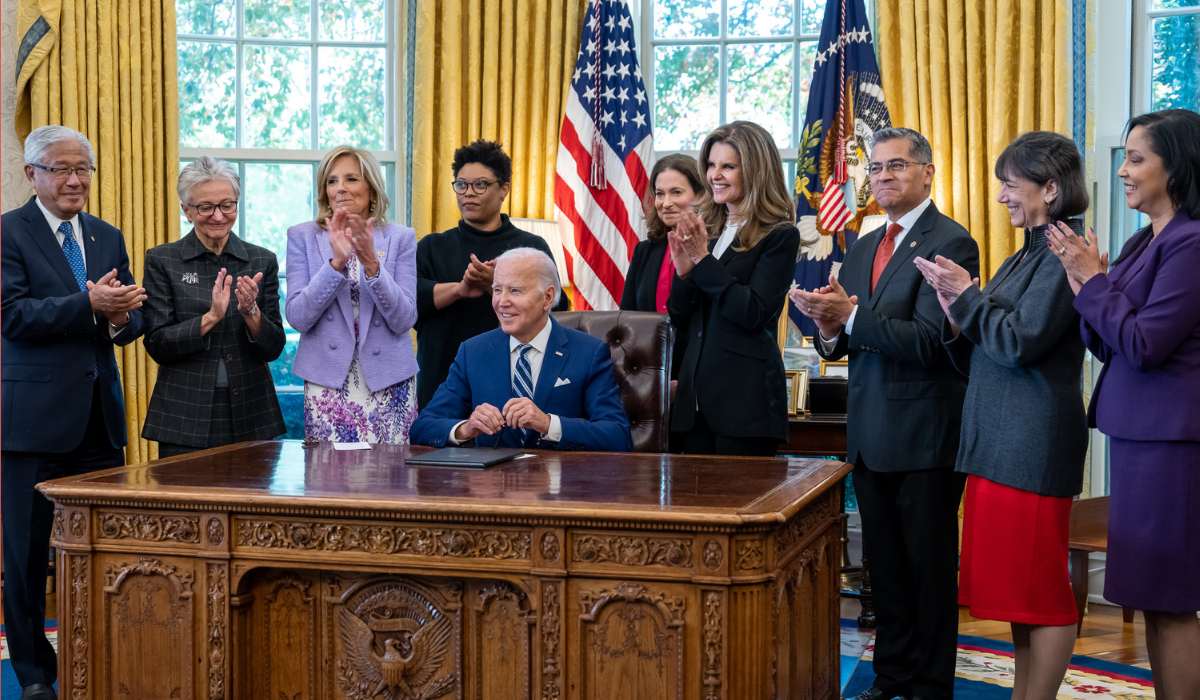
On November 13, 2023, I stood in the Oval Office as President Biden signed the memorandum establishing the first-ever White House Initiative on Women’s Health Research, elevating women’s health to a presidential priority spanning the federal government. He declared, “Women make up more than half the population, but for too long they’ve been underrepresented when it comes to health research and the money spent on that research. That’s going to change today.”
The initiative brought together 15 federal agencies and subagencies to identify opportunities to transform research and to translate discoveries into better care. Working with Jennifer Klein, Director of the White House Gender Policy Council, and many other colleagues across government, we developed recommendations that informed President Biden’s March 2024 Executive Order on Advancing Women’s Health Research and Innovation.
The order directed federal agencies to strengthen research standards, leverage artificial intelligence, advance translational science, and address women’s health across the life course. Because new congressional appropriations specifically for the initiative were not an option, we focused on prioritizing women’s health within existing federal budgets and programs. Moreover, our challenge was not simply to announce new priorities, but to translate these priorities into actions and deliverables that improve women’s health.
Turning Priorities into Progress
In just over a year, working with all 15 agencies, we galvanized nearly $1 billion in federal funding commitments, and more than 150 actions were taken or pledged across government. These commitments used resources within existing budgets, not newly appropriated funding, and the following provides a snapshot of some of our accomplishments.
At the National Institutes of Health, working with NIH Director Dr. Monica Bertagnolli and colleagues, we secured a $200 million commitment to interdisciplinary women’s health research. NIH also issued its first agency-wide call for research proposals on women’s health, identifying more than 175 priority topics and generating nearly 400 applications. The goal of this interdisciplinary effort was to integrate women’s health into the research portfolios of all 27 NIH Institutes and Centers, rather than confine this broad area of investigation to a single specialty.
Our collaboration with the Deputy Defense Secretary Kathleen Hicks and Principal Advisor to the Secretary of Defense Seileen Mullen resulted in the Department of Defense committing $500 million annually to women’s health research and adoption of a new policy requiring researchers in its Congressionally Directed Medical Research Programs to account for sex in research design, analysis, and reporting unless a compelling scientific justification indicated a different approach. Given the department’s substantial biomedical research investments, this represented an important opportunity for lasting change.
Another milestone was the Advanced Research Projects Agency for Health’s first Sprint for Women’s Health. Under Director Dr. Renee Wegrzyn’s leadership, ARPA-H awarded $113 million to 24 research teams and startups pursuing ambitious innovations, including approaches to advance treatment of brain-based diseases, such as Alzheimer’s Disease, and noninvasive diagnostics for endometriosis. By supporting high-risk/high-reward ideas, ARPA-H “de-risked” investment that traditional investors might hesitate to finance and is continuing to accelerate discoveries into treatments and technologies that benefit patients.
Changing How Research Is Conducted—and Applied
Funding alone cannot close decades of research gaps. We also sought to change how science is designed, evaluated, and translated into care.
NIH strengthened implementation of its Sex as a Biological Variable policy, while the Department of Veterans Affairs reinforced requirements for including women and reporting sex-disaggregated data. The Food and Drug Administration advanced guidance addressing sex differences in clinical trials, drugs, and medical devices. Together, these measures aimed to ensure rigorous consideration of sex differences as a routine part of biomedical research.
We also worked with the White House Office of Management and Budget and federal agencies to initiate a process to comprehensively track government spending on women’s health research. Better measurement is essential to transparency and accountability, and to identifying overlooked conditions needing research, such as menopause.
Recognizing the emerging potential of artificial intelligence, the executive order encouraged agencies to explore how AI could advance women’s health. NIH committed $20 million to AI-powered research on women’s cardiovascular health, while NIH and the National Science Foundation convened biomedical researchers in conjunction with computer scientists to examine menopause. These actions encouraged the development of comprehensive and representative data that could then be used to build the foundation for technologies that improve diagnosis, drug discovery, and treatment.
Equally important, we focused on translating discoveries into better care. For example, NIH initiated an evidence review to inform menopause research and treatment. The Centers for Medicare and Medicaid Services strengthened its evidence-review guidance to better consider whether medical technologies and treatments work effectively in women. The Agency for Healthcare Research and Quality advanced efforts to translate menopause research into clinical practice, while the Centers for Disease Control and Prevention developed tools to help clinicians manage hypertension during pregnancy and postpartum.
Ultimately, the goal of research is to improve women’s lives. Consequently, our focus was to determine how new data and funding commitments would result in improved prevention strategies, diagnostic capabilities, effective treatment, and access to care.
Building a Movement Beyond Government
Of great importance, Dr. Biden understood that government action alone could not overcome decades of underinvestment. Private companies, investors, philanthropists, academic institutions, and patient advocates would all need to help drive progress.
Working alongside longtime advocates, particularly Maria Shriver, Dr. Biden brought women’s health research to audiences across science, business, and finance. She visited research institutions, met with scientists, and engaged business and investment leaders to highlight both unmet needs and opportunities for innovation. In his March 2024 State of the Union address, President Biden called on Congress to establish a $12 billion fund for women’s health research and innovation. Although Congress did not provide that funding, the scale of the need remains.
On December 11, 2024, the President and Dr. Biden convened the first-ever White House Conference on Women’s Health Research. Researchers, investors, industry leaders, advocates, and policymakers explored scientific opportunities, the business case for investment, and ways to elevate women’s health in public discourse. Dr. Biden captured the spirit of the gathering in her closing remarks: “Today isn’t the finish line; it’s the starting point.”
That message remains essential. Women’s health has gained visibility, and companies, investors, philanthropists, and academic medical centers are increasingly recognizing its importance. In April 2025, the Milken Institute established its Women’s Health Network, bringing leaders together to advance investment and innovation, and move discoveries to needed products in the marketplace. The Network is chaired by Dr. Biden, and I serve as the Senior Science Advisor for the Network.
The Work Ahead
It was a personal and professional privilege to be Chair of the White House Initiative on Women’s Health Research. In my view, the Initiative demonstrated how federal agencies can effectively support research and development to advance women’s health and the consideration of sex differences in health. At the same time, it raised the national consciousness about the health of women—resulting in needed transformations in interest, advocacy, development, and private investment in improving women’s health. However, the work is far from finished. My hope is for long-term commitment across administrations and sectors to close the gaps in our scientific understanding, which remains substantial, and for the women’s health community to continue its valuable work mobilizing public and private investment, accelerating innovations, and translating discoveries into better care.
Serving alongside First Lady Jill Biden and President Joe Biden to lead this first-of-its-kind initiative was both challenging and energizing. I am proud of what our colleagues inside and outside government accomplished together. The initiative demonstrated what presidential leadership, scientific expertise, and collective action can achieve. Now, we must build on that foundation—with sustained investment, accountability, and a shared commitment to ensuring that women’s health is a central priority in science and medicine.
Carolyn M. Mazure is Professor Emerita, Yale School of Medicine, and Director Emerita, Women’s Health Research at Yale.
Please note that we may receive affiliate commissions from the sales of linked products.