Iran Is Rising. The World Is Looking Away.
The country where I was born is under siege.
As I write this, Iran is entering its second week of nationwide protests against an authoritarian regime that has denied its people basic human rights for more than four decades. The government has shut down the internet to silence dissent, deployed military-grade force against its own civilians, and responded to peaceful protests with mass arrests, torture, and executions. Reports continue to emerge of thousands killed and detained, with some sentenced to death just for demanding freedom.
I grew up on these streets. That corner where they just massacred people in Tehran is where we used to buy my favorite warm beets from a street vendor. Watching what is happening from afar, knowing how little I can do to help, is devastating. I know the tyranny and fear they are facing; I have looked into the eyes of these monsters who take joy in the persecution they impose.
“This is not a fringe uprising. It is one of the most serious challenges to the Islamic Republic since it seized power in 1979, and one of the most consequential democratic movements unfolding anywhere in the world today.”
What makes this moment different is not a single incident, but the total collapse of legitimacy. The economy is in freefall. Inflation has devastated millions of people. The national currency has cratered. Water shortages and corruption have made daily life unbearable. Entire sectors of commerce have shut down.
And for the first time in decades, millions of Iranians are no longer asking for reform. They are demanding an end.
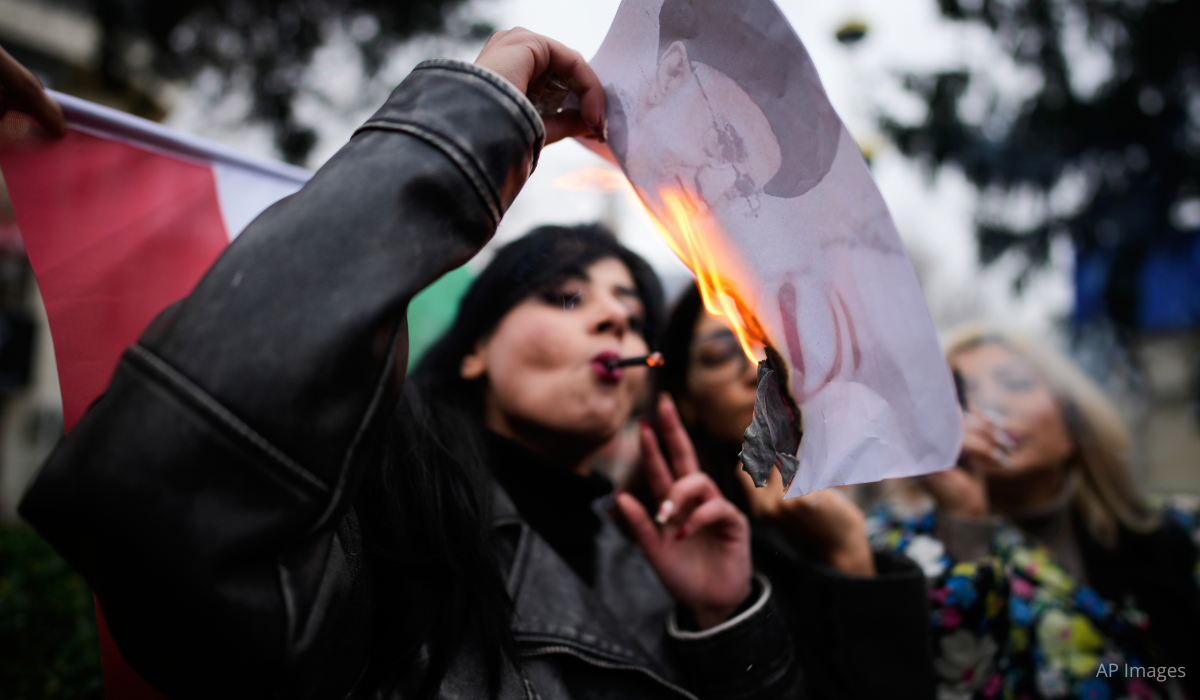
Across cities and villages, people are openly rejecting the regime’s rule, tearing down their symbols, and confronting the tyrannical security forces that govern through fear and violence. But that fear is breaking. Women and girls are not just participating in this movement - they are leading it, becoming the defining faces of resistance despite the unimaginable consequences they know they face.
At the same time, the regime’s power has eroded. Years of economic pressure, internal decay, and recent military setbacks have left it weakened and exposed. Its leadership is aging, isolated, and ruling over a population that does not believe in its authority or its future.
And yet, despite the scale of this uprising and the clarity of what Iranians are asking for, the global response has been abysmal.
There has been no meaningful accountability. No consequences for mass violence, sexual assault in prisons, public executions, or the systematic repression of women. The Islamic Republic continues to fund proxy wars, train militant groups, and destabilize the region, while much of the international community treats these crimes as unfortunate but unavoidable facts of geopolitics. As some acceptable consequence. As if this is just how it’s always been and doomed to be.
For those who do not know our history, it is important to understand this: Iran was not always defined by repression. It was once a thriving, outward-looking nation, respected by the world, rich in culture, art, architecture, science, and intellectual life, and deeply connected to global innovation. Iranian women were educated and visible. Iranian artists, filmmakers, scientists, and writers shaped culture far beyond our borders. That legacy was violently taken when this regime seized power, dragging the country backward thousands of years, through force and fear, in the name of control.
This silence is not neutral. It is a choice.
Over the past two years, I have watched crowds flood the streets of Western cities day after day, chanting slogans they parroted from 30-second TikTok reels. I watched as people and outlets cited statistics provided by a terrorist organization without any context or hesitation. I have watched curiosity replaced by hate and ignorance, and any compassion or understanding replaced by volume. And yet, at the same time, I have watched Iranians inside my country lose access to the internet, to speech, to safety—begging the outside world to be their voice—and be met with near silence. The contrast is impossible to ignore. Those who can speak loudly often say nothing of substance. Those who have everything at stake are unheard.
What makes that silence even more disturbing is that this is not a distant or narrow struggle. This is a fight for nearly every value we claim to hold. The Islamic Republic is violently oppressive to women and girls, criminalizes LGBTQ identity, murders dogs, and responds to dissent with rape, torture, and execution. It has devastated Iran’s environment through corruption and neglect, brutalized civilians as a method of control, and governs through fear at every level of daily life.
But this is not only a domestic tyranny. It is a global one. The Islamic Republic is the world’s largest exporter of terrorism, financing and training extremist groups, destabilizing the Middle East, and standing as one of the greatest barriers to peace in the region. It is openly hostile to democracy, to the United States (every morning as a child under this regime I was forced to chat over and over: “death to America, death to Israel”), and to the principles of pluralism and freedom. It exports its ideology wherever it can, interferes beyond its borders, and fuels extremism far from its own—even on our campuses and in our elections.
To pretend this is someone else’s problem, or to reduce it to a “complex” regional issue, is to ignore reality. Supporting the Iranian people is not a distraction from the causes we say we care about. It is inseparable from them.
Growing up, the image of the Ayatollah was the most frightening thing I knew. It haunted me. It paralyzed me. He represented pure evil. To see that image now rehabilitated in some circles as a distorted symbol of resistance is not only painful, it is dangerous. It erases the lived reality of millions of Iranians who have spent their lives under surveillance, censorship, imprisonment, and fear dictated under his tyrannical rule.
“This is the moment for governments, media institutions, human rights organizations, activists, and social platforms to act with moral clarity.”
The Iranian people have been cut off from the internet, denied global platforms, and left without protection. Still, they are risking everything for the chance to determine their own future.
They are not asking the world to fight their battle for them. They are asking to be seen, heard, and supported as they demand a democratic transition rooted in dignity, human rights, and safety. That call for unity and sovereignty has been led by Crown Prince Reza Pahlavi, the son of the late Shah, Mohammad Reza Pahlavi, who has long positioned himself not as a ruler, but as a responsible steward of Iran’s democratic future. Forced into exile as a young man after the 1979 revolution, he has spent the last several decades working tirelessly to engage Iranians inside and outside the country around shared democratic principles. He has been unwavering in his belief that Iran’s future must be decided by its people. Ultimate power should not rest with a monarch or any single figure, but with the people through free and fair elections. After being robbed of so many years of their past, Iranians must have the right to choose their future.
My heart is with my brothers and sisters who are sacrificing everything for that right. I am grateful to those who have used their voices and platforms to stand in solidarity. And I hold onto the hope that one day I can take my daughters to Laleh Park across from my childhood home, where I once played, in a free Iran.
Mandana Dayani is a business leader, human rights activist, and leading voice on democracy, antisemitism, and women’s rights. She serves on the United States Holocaust Memorial Council, founded I Am A Voter, The Calanet Foundation, and Garde Ventures, and publishes a weekly newsletter on Substack, All of It.
Please note that we may receive affiliate commissions from the sales of linked products.