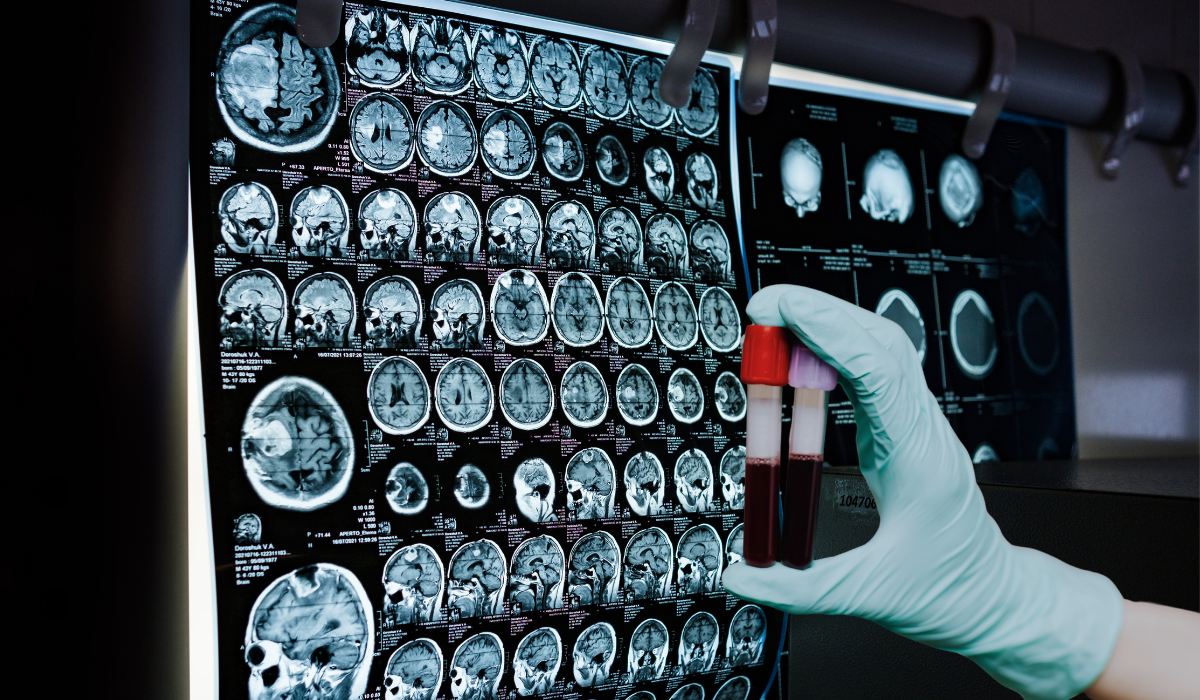
A New Blood Test Can Detect Alzheimer’s Early. Should You Get It?

If you could take a blood test that detects changes in the brain linked to Alzheimer’s years before symptoms begin, would you take it? It’s a question more of us may face, as new blood tests promise to identify signs of the disease earlier than ever before.
Yet with that promise comes questions. What can these tests tell us? What can’t they show? And how can we decide if the results will feel empowering—or overwhelming?
The Sunday Paper sat down with Paul Aisen, MD, one of the leading experts in Alzheimer’s research, to help us make sense of this scientific breakthrough and to understand what these blood tests mean for the future of Alzheimer’s prevention, detection, and treatment.
In this article, you’ll learn...
- What the new blood tests for Alzheimer’s actually detect
- The silent signs Alzheimer’s disease is developing in your brain years before symptoms show up
- Who should consider testing, and who may want to wait
- The difference between normal brain aging and early signs of Alzheimer’s
- Where the science is headed, and why there’s reason to hope for new and better detection and treatment options
A CONVERSATION WITH PAUL AISEN, MD
What do the blood tests for Alzheimer’s Disease actually measure?
First, it’s helpful to understand that Alzheimer’s disease has two major abnormalities: plaques and tangles. The plaques are made up of a material called amyloid, and the tangles are made up of a material called tau. What we know is that Alzheimer’s disease is a long process—it lasts about 25 years—and the start of that process is the accumulation of amyloid. Eventually, there is accumulation of the tangles. We also know the amyloid appears many years before the onset of symptoms.
The blood tests for Alzheimer’s disease are accurate indicators of amyloid in the brain.
Does the presence of amyloid in the brain definitively tell you that the brain has Alzheimer’s disease?
In my view, and in the view of many of my colleagues, the presence of amyloid in the brain defines the onset of Alzheimer’s disease. But the reason that’s not so clear to everyone is that amyloid can accumulate 10 or 15 years before the onset of symptoms.
So, do you consider that the presence of disease? Or does disease start when the symptoms start?
I believe the disease starts when amyloid accumulates, because unless you die of something else in the next 10 or 15 years, you’re going to develop symptoms.
So, if someone takes one of these tests and it’s positive for amyloid, it means they’ll develop Alzheimer’s disease?
We have done studies that aim to answer this question, and we’ve found that it is very likely that in time, you will develop symptoms if amyloid is accumulating in your brain. Now, these symptoms could appear in a year or two, or they could appear in five, 10, or even 15 years. But if you live 15 years, you are very likely to develop symptoms.
How do you help people think through whether they actually want to take this test and know the results?
As of today, we have no treatments for the pre-symptomatic stage of Alzheimer’s. There are two large studies underway now testing whether the drugs that are on the market for symptomatic Alzheimer’s may work in those with no symptoms. For now, we are not recommending the test unless someone is interested in joining one of the clinical trials.
If you have worrisome cognitive symptoms that may be due to Alzheimer’s, I think you should have the test. That’s because the therapy that we have now removes amyloid, and the sooner you start that therapy the better.
How can you tell if cognitive symptoms are worrisome and may be due to Alzheimer’s disease—or if they are signs of normal cognitive aging?
Everybody has cognitive change as they get older, and so it’s not so easy to distinguish normal cognitive aging from the kind of decline that signals a disease like Alzheimer’s.
In normal cognitive aging, there is difficulty finding the right word or recalling a name; difficulty multitasking; slowed reaction speed. These are all unavoidable aspects of aging and not an indication of disease. When you get older, your brain atrophies, meaning it gets smaller, and these symptoms invariably occur.
So, what are the indications of Alzheimer’s disease? Well, the most important signal that cognition is declining due to Alzheimer’s is a failure to be able to learn new information. We call it a failure of encoding, which often leads to repetitive questioning. Let’s say you ask your spouse a question, like, “Where are we going for dinner tonight?” Your spouse answers, and you say, “Okay, I like that restaurant.” Encoding that answer entails hearing it, understanding it, and storing it in your lasting memory. Issues with encoding mean 10 or 15 minutes after asking that question, you ask it again. That’s a characteristic early manifestation of Alzheimer’s disease, and is not caused by normal aging.
If someone takes one of these blood tests for Alzheimer’s disease and gets a positive result, what comes next?
The first thing is to decide whether someone should start on one of the two approved disease slowing medications, Lecanemab or Donanemab. This is an important choice, because these drugs work. They don’t stop the disease, but they slow it down by 30 percent. And the sooner you start the therapy, the more effective it is.
What does the future look like when it comes to earlier detection and treatment of Alzheimer’s disease?
The future is very promising, and our ability to slow this disease is going to get better and better. It took us a long time to get this far, but now we know how to build on what we’ve done.
I would say there are three broad approaches to building on the success we’ve seen so far. First, we must further refine and improve the drugs that remove amyloid from the brain so that we’re able to take out more amyloid faster and safely. Second, we need to start screening people before they have symptoms and treating them if there are signs of amyloid in the brain. Third, we need to develop combination therapies, combining drugs that remove amyloid with drugs that target the tau, the component of tangles.
We still have years to go. But we think that within a decade, we will be preventing Alzheimer’s disease.
Dr. Aisen has been a leading figure in Alzheimer’s disease (AD) research for nearly four decades. To learn more, click here.
Please note that we may receive affiliate commissions from the sales of linked products.