She Thought a Bad Fall Was the Beginning of Decline
When I fell on black ice, beyond the blinding pain, my immediate concern wasn’t the fall itself. It was my hand.
As an eye surgeon, my hands aren’t just tools—they are central to how I work and, in many ways, how I understand myself and who I am. Lying there, I immediately began to wonder: How seriously was I injured? Would I still be able to operate? What would this mean for my future?
But underneath those questions was something deeper; a quiet fear that this moment might represent more than an injury.
Was this the beginning of decline?
We are conditioned to interpret moments like this through the lens of aging. A fall, an injury, a diagnosis—these experiences quickly become internalized as signs of decline. But what if that interpretation is not the only one available?
This is not just philosophical; it’s supported by science. Research by Dr. Becca Levy at Yale has shown that attitudes toward aging can significantly influence health, recovery, cognition, and even longevity.
As a physician, I had spent years thinking, writing, and speaking about how mindset, meaning, and identity shape the experience of aging. In fact, these ideas formed the foundation of a book I had already written on empowered aging before my accident.
But understanding these ideas intellectually is different from having to live them personally. The fall did not introduce these ideas to me, it deepened them. What had once been conceptual suddenly became immediate, requiring me to apply my own thinking in real time, within my own uncertainty and recovery.
Here are the 5 ways my fall changed my relationship with aging:
Lesson No. 1: When something changes—health, role, or identity—notice the reflex to label it as decline and loosen the hold of that narrative.
In the days after my fall, I noticed how quickly my mind moved to a familiar conclusion: This wasn’t just an injury, it was the beginning of decline. That interpretation came instantly, without conscious thought. And that’s what made it so powerful.
We are conditioned to interpret setbacks this way. Changes in health, ability, or stability are often viewed as evidence that life is narrowing. Aging becomes associated with fragility rather than resilience or adaptation. Even with years spent thinking and writing about mindset and aging, I could still feel the pull of that automatic narrative: This is how it starts.
But over time, I began to recognize that the first story we tell ourselves is not always the truest one.
Lesson No. 2: What happens to us matters, but so does the meaning we assign to it.
One of the most important realizations after my fall was that the event and its meaning were not the same. The injury was real. The disruption to my life and work was real. But the conclusion I immediately attached to it—that it signaled limitation or decline—was an interpretation, not a certainty.
We often collapse these things together. A setback becomes a prediction about the future. A diagnosis becomes an identity. A difficult moment becomes proof that life is shrinking.
We cannot prevent every loss or disruption. But we do have influence over what those experiences come to mean in our lives. Pausing between the event and our interpretation creates the opportunity to respond differently, and to recognize that loss and growth can exist within the same experience.
Lesson No. 3: It’s important to shift from fear-based thinking to a more thoughtful, intentional mindset.
As I reflected more in the weeks and months after my injury, I became aware of something I had long understood intellectually but was now experiencing personally: our beliefs about aging are not neutral. They shape how we live.
Research has shown that attitudes about aging influence health, cognition, recovery, and even longevity. What we believe affects how we behave, how we cope, and how we see ourselves. If we expect decline, we may unconsciously begin to narrow our lives. We withdraw, limit ourselves, or interpret normal changes as evidence that our best years are behind us. The stories we tell ourselves can become self-fulfilling.
What helped me most was learning to notice my thinking and question automatic pessimism. I did not need to pretend everything was positive, but I could remain open to the possibility that this experience did not have to define me entirely. We cannot control every event. But we can choose how we respond.
Notice and gently challenge the belief that it is “too late” or that you are simply “slowing down.” Ask yourself: What might still be possible from here?
Lesson No. 4: Broadening what defines you can make change feel less threatening.
One of the quieter realizations after my fall was how tightly I had anchored my identity to my role as a surgeon. Like many people, I had organized much of my sense of self around a profession that gave structure, purpose, and meaning. But when identity becomes too
narrowly defined, it also becomes vulnerable. A disruption in one area can begin to feel like a disruption to the whole self.
I felt that tension acutely in the uncertainty surrounding my hand. Beneath the practical questions was a more personal one: If this changes, what does that mean about me?
Over time, I began to see identity differently. The fall brought greater attention to other parts of myself—writing, reflection, and broader forms of contribution—that had always existed, but had long remained secondary. This was not reinvention. It was a fuller expression of parts of myself that had previously received less attention.
Lesson No. 5: Growth and difficulty can coexist.
One of the most meaningful shifts was learning to hold two truths at once.
There was real loss in this experience: uncertainty, limitation, and fear about what might change. But there was also new perspective, new clarity, and a growing awareness that difficult experiences do not automatically erase meaning or purpose.
For a time, I moved between these perspectives as if I had to choose one. Either this was a loss or it was an opening. But that turned out to be a false choice. Growth does not erase loss; the two can coexist. Acknowledging difficulty does not cancel hope. In fact, resilience may depend on our ability to hold both at the same time.
Eventually, my internal dialogue shifted from What has happened to me? to How do I want to move forward? The fall changed my life in ways I had not expected. Not because it erased uncertainty, but because it challenged me to remain open to change without seeing it as diminishment. Sometimes continuity is not expressed through staying exactly the same, but through allowing ourselves to evolve while remaining fundamentally ourselves.
We will all face moments that feel like turning points—a fall, a diagnosis, a loss, a disruption we did not choose. In those moments, it is easy to assume our life story is shrinking. But that assumption is not the only one available.
My fall did not simply force me to think differently about aging. It forced me to live differently within it—with greater awareness of the stories we tell ourselves, the identities we cling to, and the possibilities we often overlook.
Aging is not about losing ourselves or becoming someone entirely new, but about allowing more of who we already are to emerge.
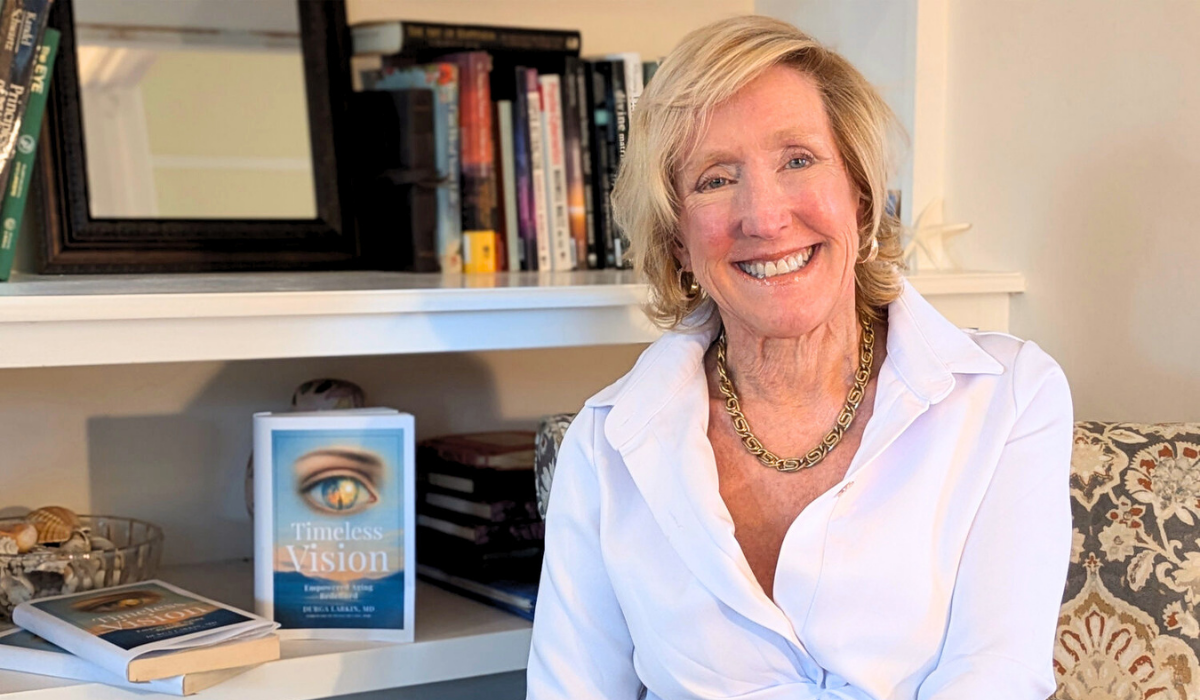
Durga Larkin, MD, is a board-certified ophthalmologist, speaker, and author of Timeless Vision: Empowered Aging Redefined. To learn more, visit www.durgalarkinmd.com.

Please note that we may receive affiliate commissions from the sales of linked products.