The Explosion of Social Ghosting


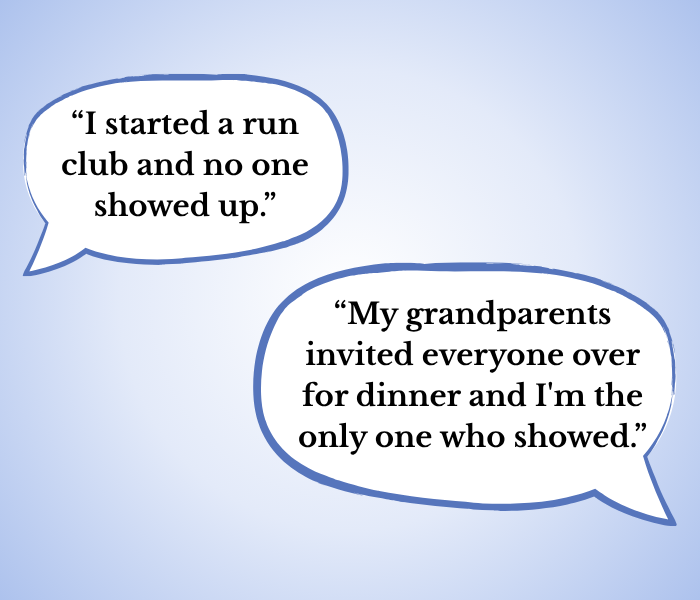
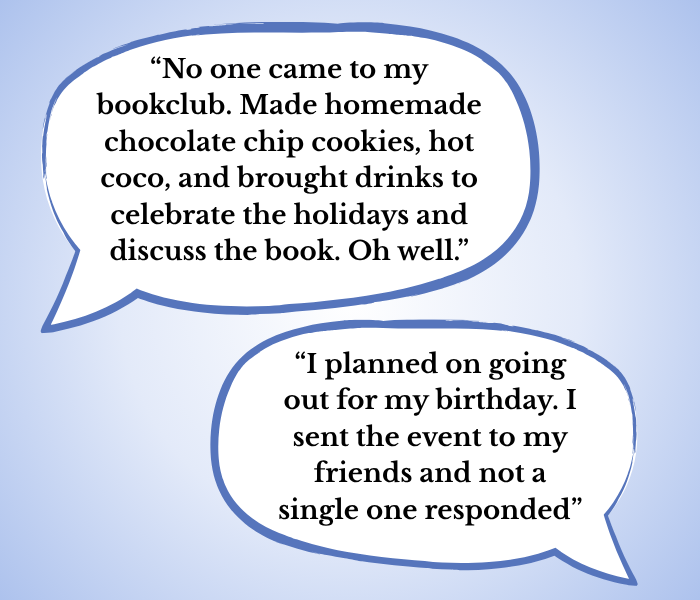
Joy hosted a book club. She made cookies and cocoa. She was nervous no one would come. “Update: no one came.”
Avery threw a girl dinner party. Her video shows a table covered with beautiful berry-decorated water glasses—and no guests.
Daisy spent $250 to throw herself a birthday bonfire. “Now I just feel like an unlovable idiot with no friends,” she posted online.
Social ghosting—where people RSVP “yes” but fail to show, is exploding at a time when people say they feel more lonely than ever. We are a nation in the middle of a loneliness epidemic—about 20 percent of men and women say they feel lonely, and 16 percent said they felt “lonely all the time.”
Social media is overflowing with posts from people who realize they have no friends, asking “How do I make connections?” and canceling medical appointments because they have no one to drive them home. But those hosting community gatherings, dinner parties and book clubs to create community (and sometimes keep family together) say they are burnt out and hurt, and done making plans.
I became interested in this issue myself as organizer of a Philadelphia Meetup with more than 500 women over the age of 50. Over the course of 10 days, I posted gatherings for two happy hours, a showing of The Goonies at a local park, and a pop-up art show. Either no one signed up, or no one showed up for any of them. People mostly bailed at the last second or said “maybe” they’d drop by, expecting me to sit by myself just in case.
The group ended up closing. Organizers got tired of putting in the energy, time and money—hosting a Meetup group costs $300 a year for people who said they wanted to be part of a village, but didn’t make the effort to be a villager.
The Opposite of the Spotlight Effect
Danielle Bayard Jackson, a nationally renowned friendship coach and educator, said she’s seen the posts and heard from her own clients who are trying to create community. She’s even been ghosted herself: At a book club she hosted, she braced for a packed house because of the RSVPs, but only three people showed.
Although she says there is no excuse for the rude behavior, she believes there are several issues contributing to the problem. Often people underestimate the impact their absence will have on the people who invited them, particularly when multiple people are invited, they think they won’t be missed—the opposite of the “spotlight effect” where someone expects to be the center of attention. The problem is that, particularly in a larger group, everyone thinks that way and no one shows.
There’s also the increasing cultural validation of “protecting your peace,” where people who promised to show up at the barbecue or book club decide not to show—often without any notice—simply because they’re not in the mood anymore. The reaction online is often one of honoring the energy and putting yourself first, but that’s not how you build community or treat friends, she says.
“I wish there was more emphasis on commitment,” she said. “Yes, your mood changed, but you said you were going to go, so you get up, you put your shoes on, and you go. I think what surprises me is that we're doing this to people we have established relationships with—there is a real person on the other side of this, and there's a real risk that you might threaten the relationship, or disappoint a person who you know cares about you.”
Why Friendship Advice Often
Doesn't Work for Lonely People
Many studies about loneliness are based on surveys, and news stories tend to focus on people who make friends easily. But in 2018, I spent a year interviewing people who identified as lonely. They were mostly in their 20s and 30s, including men, women, college students, hairdressers, carpenters. One man in Oklahoma hadn’t spoken to anyone in three months because all his communication had been through screens. After a telephone call, he said it hadn’t been that bad.
What I found in my interviews (which I presented at SXSW, on a panel called “Generation Lonely: 10,000 Followers and No Friends”) was that, overwhelmingly, people wanted others to invite them, check in on them, bring soup when they were sick. They just didn’t want to make that effort for other people.
They gave many reasons for their lack of reciprocity. Some feared people would reject their invites. Some said they didn’t know what to do or say in social situations, like when someone died or was sick. Some were afraid to ask too much of their friends—one woman hired someone from TaskRabbit to go with her to the emergency room rather than burden her friends who lived nearby. It was just too much to ask, she said.
But while friendship is not transactional, like any healthy relationship, it requires some reciprocity. No connection is 50/50, but when the people who are inviting and bringing soup and organizing get silence in return, it’s hurtful.
Why Getting Ghosted by a Stranger Still Hurts
Denise Dixon Bartley is a 34-year-old entrepreneur who recently moved to Duluth, Georgia, outside Atlanta, and she describes herself as a person who is comfortable reaching out and organizing. Last month, she posted on Nextdoor, looking to create a social group of married women for connection. So many people responded, they maxed out the group size limit.
But when she tried to organize a picnic—even start a conversation about TV and books—no one responded. After two weeks of silence, she shut the group down. She believes that people have to stop being so passive with their lives, waiting for someone to reach out and do the work of friendship for them. She knew the silence wasn’t about her.
“I was hurt, but I couldn't process that as something that was against me. Like, oh, it's me. Nobody wants to be my friend,” Dixon Barley said. “I couldn't internalize it that way, I just had to look at it from a larger scope—I'm not willing to do the work for other people to make them feel a part of something.”
A similar situation happened to Juliene LoDolce, a 39-year-old music therapist in Hinsdale, Illinois, who was excited to see the seven people who RSVP’d to her first book club gathering. She runs a business called The Enchanted Table, creating tablescapes for parties, and when she lived in California, she’d hosted quarterly “fancy” brunches for as many as 13 friends.
Although all seven people confirmed that they were coming, and all agreed on a meeting time, only one person showed. She reached out to one woman who had been particularly “overzealous” about coming but ghosted completely. The woman said she had laryngitis.
LoDolce said too many people are caught up about saying the perfect thing and won’t host gatherings because Instagram makes them think everyone has the perfect house. She thinks excuses about being busy and that technology has ruined time are easily dismissed. Although she might not have another book club, she is still going to put herself out there, and hopes others do as well.
“Nine times out of 10, there's going to be someone who's so excited that you hosted that thing, and they're going to say, ‘How can I help?’” she says. “And you just bring them in, and it snowballs, and all of a sudden you have this beautiful community that you built because the focus was always about community in the first place.”
Bayard Jackson, the friendship coach, says that it’s important for hosts not to make light of the situation, and say “oh no worries, I understand.” Particularly with friends, she recommends being direct and letting the ghosters know that you were disappointed that they didn’t show up. Then look to see how they respond.
“I wouldn't write a person off because they did that, because we all make choices sometimes,” she says. “I'm more curious about how they respond once they are confronted about it. Is there an entitlement? Is there indignation? Is it ‘I had other things come up. Well, I mean, I got busy. Well, I just had a hard week,’ or is it ‘You are so right. I'm sorry…I should have told you beforehand, or I shouldn't have said yes in the first place, and I can't wait to come to the next one. What's an opportunity for me to make this up to you in repair?’”
For me, I have a three strikes rule. After I’ve invited, reached out, and checked in three times, I wait to see if they respond. If they don’t, I move on.
And when people ask for advice on making friends, I give what I call the “no, but yes” response: If someone invites you to something, and you aren’t interested, offer something else in return. “I’m sorry I can’t make that yoga class, but how about this nature walk on Thursday?” “I’m not really into museums, but would you be dying to check out the new ice cream place.” Make some effort to move the friendship forward.
As for me, I got tired of being the social director, of being told “oh, invite me to things, that sounds cool!” only to be rejected over and over. My closest friends don’t live in Philadelphia, so now I mostly go alone to the craft show or sound bath (I’m woo) or Shakespeare in the Park. I haven’t given up entirely, but I’m taking a little social break.
But just FYI, I’m going to the Moonlight Kayak tour in September, in case you want to come.
Looking for your roadmap to friendship? Watch Maria’s most recent Life Above the Noise with Danielle!
Please note that we may receive affiliate commissions from the sales of linked products.