The Practice of Resilient Optimism

I was seven months pregnant with my daughter when my water broke, 10 weeks ahead of schedule. The doctors had me admitted to the hospital to be closely monitored for infection. The hope was to give my baby as much time to develop as possible, but they said an infection would likely come.
Six days later, in the middle of the night, I felt a stabbing pain and was rushed in for an emergency C-section. Zoë was born weighing three pounds, seven ounces, and was immediately placed on a feeding tube and a breathing machine.
For the next 50 days, Shawn and I lived in the NICU. I remember sitting beside her isolette with the monitors beeping, wiping away quiet tears and holding a hand so tiny it could only wrap around the last section of my finger.
By then I had spent a decade studying optimism. I had a master’s degree in positive psychology from the University of Pennsylvania and had written a book on happiness, and none of it prepared me for sitting beside that incubator at three in the morning wondering whether my daughter was going to be okay.
Those nights changed my definition of optimism. I had no idea whether everything would turn out fine, so optimism could no longer mean believing that it would. It meant doing the next right thing even when I couldn’t see how the story would end, whether that was asking the nurse one more question or downloading an app to record her weight gain or reading every single scientific article on preemies and success rates.
At one point, I showed up at my neighbor’s house with a notebook and asked every question I could think of about how she had made it through the NICU with her premature twin boys. Those actions did not give me certainty, but they gave me a way to keep moving.
That was 2018. Zoë is eight now and thriving. In the years since those 50 days, I’ve kept returning to what I learned beside her isolette: optimism is not a feeling. It’s a behavior.
The Good We Keep to Ourselves
That distinction feels especially urgent now. Across the world, people are navigating sustained uncertainty, rapid change, and a steady stream of information about what is going wrong. Most of us are not lacking awareness of problems; we are flooded with it. What we need alongside that awareness are credible signals of progress, possibility, and personal agency. Resilient optimism does not ask us to look away from reality or assume everything will turn out fine. It helps us stay clear-eyed while continuing to believe that what we do next matters. And in hard times, that belief is what keeps us engaged enough to act.
For 11 years, my research team and I have been gathering data through the Success Scale, an assessment we developed to measure optimism at work and the behaviors that go with it. Our research now involves more than 25,000 professionals, and when I recently went back through the data, the first finding was reassuring. Nearly 8 in 10 people still describe themselves as optimists, remarkably close to where we were a decade ago.
Then I looked at how people actually behaved.
While the overwhelming majority still consider themselves optimists, their behavior tells a different story. These days, if they feel optimistic, they are less likely to express that optimism to the people around them.
When someone presents a new idea, they are less likely to say something positive or express encouragement. When starting a conversation, they are less likely to lead with something positive.
Everyday Optimism
Think about how this can play out in an ordinary day. A friend tells you she is thinking about applying for a bigger job, starting a business, or finally doing something she has talked about for years. You may genuinely believe she can do it. But instead of saying, “You would be great at that,” you ask about the risks, mention how competitive it is, or simply move on. Nothing you said was particularly negative. The encouragement just stayed in your head. That is the kind of shift our data captures. The optimism may still be there. We are simply expressing less of it.
This change didn’t happen all at once. It happened gradually, almost like someone was turning down a dimmer switch. Because this is a large data set rather than a nationally representative sample, I can’t say every American workplace has changed in exactly the same way. But the pattern was striking enough to make me look closer.
What struck me most was what didn’t happen. People didn’t become more critical. The percentage of people whose first reaction to a new idea was criticism held steady at around 5 percent. The optimists simply became quieter.
When Optimists Go Quiet, Pessimists Get the Floor
I don’t mean that pessimists suddenly took over our workplaces. I mean that when encouragement, good news, and signs of possibility stay inside us, there is less in the environment to counterbalance the problems we already hear so loudly. Optimism is not merely an internal belief. It is also the signals we give each other that progress exists and our behavior matters to overcome challenges.
This matters at home as much as it does at work. Our children hear how we talk about the difficult teacher, the bad day, the bill we weren’t expecting. Our partners hear whether we mention only what went wrong or also what worked. Long before I began using the term resilient optimism, I wrote about the fact that we are all broadcasters.
The Stories We Repeat Out Loud to Others, to Ourselves, Become Part of Everyone’s Emotional Environment
I spent years in newsrooms, most recently as a national news anchor with CBS News in New York, so I say this with real affection: our brains can be terrible journalists. Under stress, they often grab one piece of the story and report it as the whole thing, and whenever information is missing, they tend to fill the gap with the worst possible version.
I learned this the hard way in my mid-20s. On paper, my life looked wonderful. I had landed a job in London and had a kind boyfriend, but nearly everyone I knew was back in the United States, and I felt lost in my career. Over the course of a year, I slid into depression.
I needed support. Something needed to change. While I would never suggest that depression can be solved by simply changing the way we think, one small practice did help me begin finding my way back. When an anxious thought showed up, I went looking for other true facts that completed the story and would write them down. I wasn’t pretending the hard things away. I was making sure my brain wasn’t reporting one painful part of reality as all of reality.
Recently, I led a virtual book club with a group of professional women who had been experimenting with the tools to build resilient optimism I share in my new book, in the middle of their very full lives. What stayed with me was how often resilient optimism showed up in small decisions about where to put their attention, energy, and time.
One woman found herself double-booked with a business meeting and a standing lunch with dear friends. She had already shared everything she needed to contribute, so she declined the meeting and went to lunch. When I asked how that felt, she said it felt powerful.
The work still moved forward, and several colleagues acknowledged that the meeting probably could have been an email. But what interested me most was that her choice became visible. By protecting something that mattered to her, she gave other people permission to reconsider what really required them, too.
How to Increase Hope: Start With Behavior
Resilient optimists don’t wait to feel optimistic before they act. They take a clear-eyed look at what’s happening while holding on to the belief that their behavior still matters. Just as importantly, they make that belief visible to the people around them.
Here are four places to begin.
Fact-Check Your Story
When your mind starts spinning, especially at three in the morning, ask whether the story you’re telling yourself is true and whether it is complete. Then look for other equally true facts that reveal what is still working or possible. You aren’t glossing over the problem. You are making sure one painful fact hasn’t crowded all the others out of view.
Curate Your Best Moments
In early 2021, amid the chaos of pandemic life at home, I started texting my husband, Shawn a few of the best moments from my day before bed. Some nights it was a hug from Zoë that made me feel so loved. Other nights it was a new recipe that turned out better than expected or laughing with our son over something ridiculous. I now have more than 1,500 of those texts. The practice trained my brain to notice moments I might otherwise have rushed straight past. Shawn never had to reply, and if you choose to send your notes to someone, you can let them know they don’t need to either.
Say the Good Thing Out Loud
This is the one our data suggests we may need most. When you feel optimistic about something, tell someone. If a colleague makes your job easier, tell her exactly how. If your child handles something well, say so while the moment is still fresh. Start your next meeting or family dinner with something positive. In my first book, I called this a “Power Lead” because the way a conversation begins can shape where it goes.
Triage One Commitment
Look at the week ahead and find one obligation that could be dropped, delegated, delayed, or simply done with less of you. Then give some of that reclaimed time to a person or activity that restores you. Social connection is one of the strongest predictors of long-term happiness we have in the research, so that lunch with friends is far more than a luxury.
When I think back to the NICU, what carried me through was never certainty. It was the next right thing, done again and again. I could not control the ending, but I could choose how I met the next moment.
The world has no shortage of voices telling us what’s wrong. Sometimes the most useful thing we can offer is one true reason to believe that something can still be done. Your optimism may be exactly what someone near you needs to hear.
But it can only help them if you say it out loud.
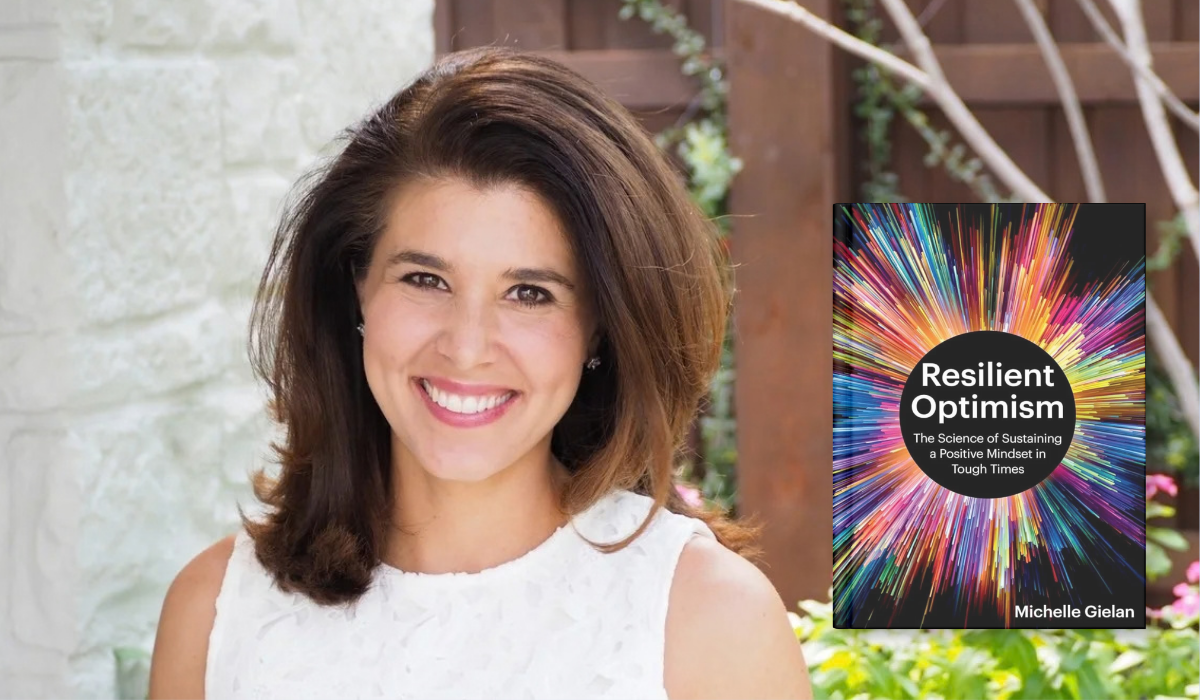
Michelle Gielan, former CBS News anchor turned positive psychology researcher, is the bestselling author of Broadcasting Happiness and a featured professor in Oprah’s Happiness course. Her research has been featured in The New York Times, The Washington Post, and Harvard Business Review. Her new book, Resilient Optimism: The Science of Sustaining a Positive Mindset in Tough Times, is published by Harvard Business Review Press. Take the free Resilient Optimism Assessment at resilientoptimism.com.

Please note that we may receive affiliate commissions from the sales of linked products.