Yes, We’re Divided, Says Ken Burns. But There’s More to the Story

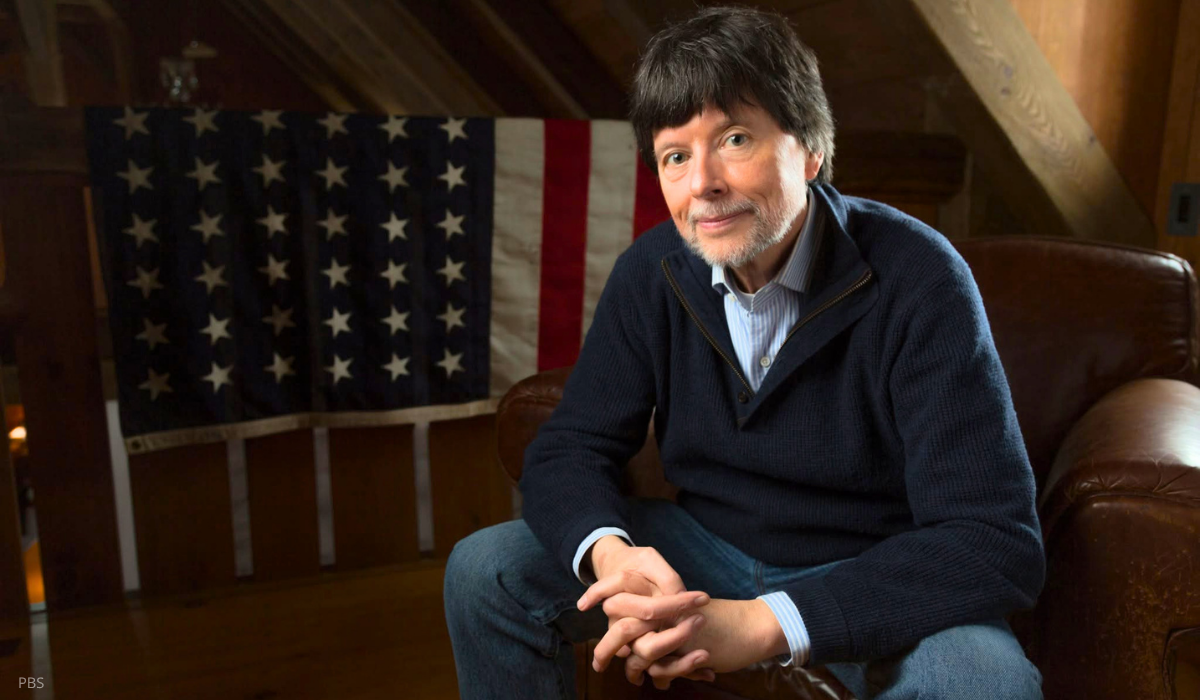
At 72, and after nearly 50 years making historical films, Ken Burns seems both an industry veteran and a wide-eyed first-year student: endlessly experienced and passionate. Burns’ work—as a producer, director, and writer of films and series that tell of American history—has given US and global citizens an unvarnished look at the makings of a nation and the inner workings of its people. In his most recent project, The American Revolution, a six-part, 12-hour docuseries that debuted on PBS in November, Burns shares the stories of those involved in the epic political movement too often overlooked—that of the women, African Americans, Native Americans, and soldiers from around the world.
“I like to say that I have spent the last 50 years of my life making films about the US, but I also make films about us—the lowercase two-letter plural pronoun,” he tells us. “All of the intimacy of us and we and all of the majesty, complexity, contradiction, and even controversy of the US.”
Burns has also reminded us that, as much as we may feel our current state is one of paramount complexity and divisiveness, our past proves otherwise. He shares why with The Sunday Paper, with a passion only he can bring, that’s endured for decades.
He also delivers levity and light—so much so, he tells of the family July 4th ritual he’s honored for 32 years, which continues to pull at his heartstrings.
“My voice always breaks, every time.”
A CONVERSATION WITH KEN BURNS
It’s common these days to hear that Americans are “more divided than ever.” What do you say to this?
We were way more divided during our Revolution, way more divided during our Civil War, way more divided in the period after the Civil War, often called Reconstruction. Certainly, we were way more divided during the Vietnam period. So, I think you can exhale a little bit and say, yes we're divided, but Americans are, in essence, always divided. We're always arguing. What happens is that if you superimpose a media culture over that, in which everything's binary with an on-off switch, or good-bad, you lose perspective. I like to say that I have spent the last 50 years of my life making films about the US, but I also make films about us—the lowercase two-letter plural pronoun. All of the intimacy of us and we and all of the majesty, complexity, contradiction, and even controversy of the US. If I've learned anything, it's that there's only us, no them. It is the convenience of authoritarians to create them, to create an enemy, either foreign or domestic, or both, that galvanizes the control and the distraction that people have.
We are citizens celebrating our 250th Anniversary. At the heart of it is this great gift, not just to Americans, but to humankind. The idea that before our American Revolution, everybody was more or less a subject under authoritarian rule, and there were a few people—admittedly white males living on the East Coast of North America—who were suddenly citizens able to govern themselves, is a great gift to humankind. And it requires a kind of active engagement with the story and promise of that origin, which is what each of us has to secretly have a relationship with, and then pass on to our posterity. That’s the obligation of being an American.
In our narcissistic world where it's always the worst or the best time, and we know more than anybody else that we can feel this helplessness, maybe if we just think of a soldier who's spending a winter at Valley Forge, who is trying to fight for an idea that's never been tried in human history against the most far-flung empire on earth, and is animated by the abstract idea called liberty. It was a lot more uphill struggle for them than it is for us.
Your American Revolution series is so wide-sweeping and inclusive, offering perspectives rarely, if at all, told—those of women, African Americans, Native Americans, Germans, Irish, and many many others around the world. How do you and your team approach that abundance, complexity, and diversity both for this series and in your overall work?
We live in a world of highlight films, in which we only show the home runs being hit, and that we're in the business of calling balls and strikes. One thing to understand is, we're not building a film; we're actually distilling a film from 400 hours of material and finding out what's essential. We've always had this sense that we wanted to call those balls and strikes, that we understand the big home runs, but they also strike out a lot. That doesn't mean you dismiss them, but that's part of the game. In fact, if you fail seven times out of 10 in baseball, you're a 300 hitter. If you do that for 20 years, you're in the Hall of Fame. And you only come up to bat once every nine times, so it means other people are engaged in this. So, it’s this philosophy—and I'm so happy to be able to use a baseball metaphor!—that permits us to see a complex history, and to understand, as you suggest, that a majority of the population, women, are a huge part of the story. And a fifth of the population was either free or enslaved Black people. There are Native Americans who have fully integrated or are trying to coexist within the 13 colonies, and there are many distinct nations, all of which have been players on a world scene for 150 years, diplomatically, economically, and militarily. This is an incredibly complex dynamic that has to be honored.
You include the promising, wonderful aspects of our Revolutionary history, as well as the dark and horrible aspects, and everything in between. Tell us more about that.
Unfortunately, most of the way we've told our Revolutionary history is a sanitized Madison Avenue version, and that doesn't serve anybody well. One may be able to forgive that we're so proud of the big ideas that came out of Philadelphia in 1776 and then 11 years later at the Constitutional Convention, that we think if we are faithful to the violence that we were born in, it'll diminish those big ideas. But the opposite is true. Those ideas are even more impressive in the fact that they were born out of not only a bloody revolution, but a bloody civil war, and also a bloody global world war. So again, this is a wonderfully complex thing, and it has all the familiar characters who are no longer expected to be perfect or tossed out in an unforgiving revisionism, but are made dimensional and human, which makes them relatable. We can aspire to be like George Washington or John Adams if we understand their flaws, and at the same time, we can introduce you to scores of other people that you'd never heard of before, who are as important to the story.
In the 12 hours of the series, we have 400 first-person voices, representing 150 different people, and they're read by 61 of the finest actors in the world. In a way, that provides the richness and texture to what we think is a familiar story, but is actually not so familiar once you get into the nitty-gritty. It's appalling and violent and scary, and it's also ennobling and uplifting, and all the things in between: there's treason, there's treachery, there's people making profits off both sides. There is unbelievable courage and unbelievable improbable victors, and lots of different losers. All of that happens to be true, and you are obligated to try to contain as much of that complexity as possible.
This underscores your sentiment that nothing is binary in our history.
There’s nothing binary in nature. Period. We’re in a media culture where it's so simple to reduce it to a thing and the opposite of a thing, but often, both things are true at the same time, and that's okay. George Washington can be deeply flawed as a human being in some dimensions and be incredibly powerful as a human being in others. He’s actually more accessible when you don't try to make him this perfect statue in a park.
Or a figure on our money!
And that’s another point, and it's very important to me. David McCullough, the late historian, said there's no foreseeable future in the past. George Washington didn't know he was going to be on a dollar bill or a quarter, or that there'd be this tall spiky thing in the middle of the national Capital that's named for him, or that there’d be a state named for him. He was fighting for an idea. He may have been the richest man in the world who was sacrificing, as it’s said in the last line of the Declaration, our lives, our fortunes, and our sacred honor. We can't imagine anyone in our current boldface name array who would be willing to do that.
It's remarkable, and [George Washington] convinces people who are from New Hampshire and Georgia that they're the same. They saw themselves as from different countries, and he reminded them they were this new thing called Americans, and he inspired people to fight for an abstract cause with almost zero chance of success at the beginning. Then he gives up his military power at the height of that power, and he gives up his political power at the height of that, which has allowed us to be able to celebrate this July 4th 250 years later. So, as much as I champion a bottom-up and incredibly diverse array of characters, we can also say with a certain amount of exhilaration and satisfaction that there's one indispensable person in this story, and that's George Washington. Without him, we don't have a country.
You’ve been making films for five decades, and to hear you talk about it now, it sounds like you’re in your first year. There’s so much interest. What have you discovered about yourself doing this work, and, specifically, what did you learn working on the Revolution series?
I have always been passionate about the story of our country. I've kidded, almost from the beginning of my professional life, that I was like Samoa or Guam: I was an American possession. Since I was a little boy, I’ve always loved the story of us, and it's been an animating part of not only my professional life but my inner life, as well. I'm not without awareness of the way in which we fail and continue to fail the full promise. This is not a Pollyannish patriotism. This is a complex patriotism that understands exceptionalism but knows that the price of exceptionalism is a constant and vigilant self-improvement. This is why we're in pursuit of happiness and a more perfect union that makes us a country unusually restless, innovative, unsatisfied, and willing to be better and to go forward.
Working on the Revolution series really made all that real because I was suddenly in the interiors of something I thought I knew something about, and realized how little I really knew. The dimensions of the people who were familiar to me were now even more captivating, like Washington or Adams. At the same time, all the other people, and the dynamics of the world at that time… We say the 13 British colonies, we think the enemy is the British 3000 miles away when, in fact, our own countrymen were opposed to [this change]. For the [British] loyalists, the British constitutional monarchy may be the best form of government that there is, and their health, literacy, and prosperity come from that. Why would you change that for some abstract, never-before-tested idea? These are reasonable questions to ask, and I think it’s incumbent upon everyone who considers the Revolution to stop assuming that you'd be a Patriot and think about: Would I have been a Patriot? Could I have fought for an abstract cause [of liberty] that had never been articulated before? Could I have killed someone in the name of that cause? Could I have risked my life and my fortune and my sacred honor?
This was a wonderfully emotionally powerful place for me to be in, and it was important not to sentimentalize or make that nostalgic in the film, but to make it real. One of the earliest shots in the opening musical montage is of women. You don’t see their faces, but you see their bare feet and legs standing in a stream, washing bloody clothes. The next thing you see is a Black hand on a musket in a Continental uniform. The next thing you see is a woman lifting a lantern in a camp. You begin to realize there are all sorts of hidden stories that are part of this, and we allow them their full breadth. Combined with all the other stories, you get a better sense of the complexity of our origin, and therefore a bigger stake in its success today.
Considering our stakes today, as we approach our 250th Anniversary, if you could ensure American citizens knew or felt one thing in this time in history, what would that be?
I don't think there's one thing. I think there's a whole set of responsibilities that being an American citizen brings up. A lot of it is that the pursuit of happiness was not about the acquisition of objects in a marketplace of things, but about lifelong learning. That they wanted us to become more virtuous and more understanding. It is in the interest of authoritarians to have the populace distracted; to have their subjects distracted by misinformation and disinformation, conspiracies, and superstitions. But the pursuit of happiness means you learn the apparatus to discern between what is true and what is not true, and then make decisions that are best not only for yourself but for your community.
There's a lot about our world today that is fractured, and we're independent free agents, and that works against a democracy, in a way, and we have to be ever vigilant about that. I sometimes use a spiritual or religious term, that the opposite of faith is not doubt, but doubt is central to faith. The opposite of faith is certainty. And we have a lot of people who are absolutely certain that it's their way or the highway, and that one of the great gifts of democracy is the ability to listen and to understand where someone else is coming from. To stop making a them of the people you disagree with, not demonizing them. The periods of America where we are at our best are when we've understood those differences, and that they’re always going to be there, and always have been there, and always will be there. It's how you deal with those differences. Make an enemy of them if you denigrate someone who thinks differently from you, then you have no possibility of compromise and no possibility of coming together, and so our Latin motto that they picked very consciously is e pluribus unum, which is out of many, one.
Where are you finding hope for our country these days?
I feel very hopeful, and a lot of it comes from the last year and a half I've spent on the road. Mark Twain once said, “If you tell the truth, you don't have to remember anything.” It's a great one-liner, and funny, but also true. So, as I traveled the country, I said the same things to Joe Rogan as I did to the New York Times editorial board, to inner-city kids in Detroit, to suburban kids in Chicagoland, and to the 40 different cities and 80 different screenings we had. What I found reflected back was the fact that we are divided, but I think that division is a lot less thick than we think it is. I think it may be a mile wide, but it's only an inch thick, and I think people are tiring of it. People are wearying of the people who are in our media culture making money off division and are beginning to realize that they're not fools, and nobody wants to be a fool, and that it's important to look up and say, ‘what is true?’ and to investigate it; to not just trust that your own echo chamber, but to do that work of the pursuit of happiness, which is about us becoming something. It’s an improvement, and you can sense that spirit of improvement in people, and you begin to realize that we were way more divided during the Revolution, the Civil War, and Vietnam, and what can I do now as a citizen to listen to the other to help?
The opposite, of course, is a pervasive cynicism—yet no one wants to spend their life mired in the muck of cynicism. You want to have something to believe in, something to hope for. That belief and that hope and that future only come from the whole story of us, which is e pluribus unum. We gather our strength from each other and not from making distinctions between people.
Ken, how will you be celebrating the Fourth of July this year?
With family and friends, as we've done for the last 32 years! We have a little cottage on a lake, and I do the horrific thing that fathers, and now grandfathers, do, which is: I don't let anybody eat until I've read the Declaration. And they listen! I don’t read the 18 injuries and usurpations, that’s a little too much. But I do the first several sentences and the last beautiful paragraph. My voice always breaks, every time I read it. I've read it every single Fourth of July for 32 years. Sometimes I get rolling eyes and blank stares, and sometimes the grandkids are a little bit too young to get it. But we are all together. And there's swimming, cooking, ice cream, and fireworks, and that's the great thing. John Adams predicted it when he talked about the reading of the Declaration. He said there should be celebratory bonfires. He was anticipating exactly what we should do on the Fourth of July.
Everybody knows what it's like to go to a ballpark. They don't ask you whether you're a Democrat or a Republican when you go in, and when you sing the National Anthem before the game, everybody sings it together. It's the same way when you spread out your blanket on the lawn to watch the fireworks display. You don't know what your neighbor thinks of this or that, and it doesn't matter. For a moment, we're one thing. If you can figure out a way—it takes discipline and a good deal of willpower—to dismiss the demons of division and make it possible to reinvest in the United States, the dividends will pay spectacularly for years to come. And we'll be able to anticipate a time when our great, great, great, great-grandchildren will celebrate the 500th anniversary of us.
Learn more about Ken Burns and his latest series, The American Revolution, here.
Please note that we may receive affiliate commissions from the sales of linked products.