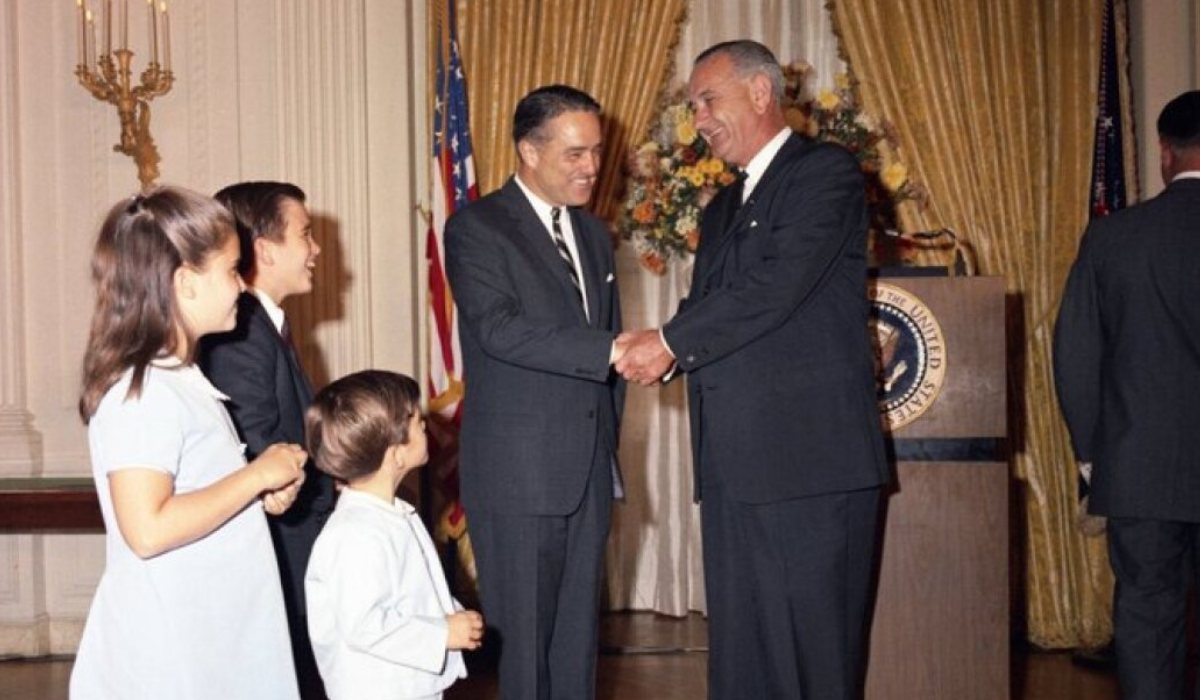
When America Did Bold Things

There are moments in a nation’s life when conscience stirs and action follows—when we summon not only the power of government, but the purpose of a people. For me, that summons came in the voice and example of Sargent Shriver, who led a war on poverty in the 1960s and after 9/11, mentored me as we grew opportunities for Americans to engage in national and volunteer service.
So, it is fitting that at a time of disruption with a nation troubled at home and at war abroad, his long-unpublished manuscript, We Called It a War, now comes to light and might help us regain our footing. It speaks not only to a past campaign against poverty, but to a larger truth: America has done bold things before—and can do so again.
On college campuses today, I often invoke Sargent Shriver’s name to inspire the next generation. Too often, I am met with puzzled looks or the question: Who was this “military leader”? I explain that his was a different command that created the Peace Corps and led a White House office of economic opportunity—the mobilization of idealism in service to others with a greater impact on society than anyone of his generation.
He understood that leadership begins with opportunity—extended to all, especially those too often denied it—and that the measure of a life is not only what one gains, but what one gives.
As a result of his audacious vision and inspired leadership, more than 250,000 Americans joined the Peace Corps, serving in 144 nations. At home, 220,000 Americans enlisted in Volunteers in Service to America, waging a different kind of war—one against want. Head Start opened doors for 40 million children and their families. Job Corps prepared more than 2 million young people for work and dignity. And through Special Olympics, millions found joy, purpose, and belonging.
These were not modest undertakings. They were bold, urgent, and unapologetically ambitious.
The debate over President Lyndon B. Johnson’s War on Poverty endures, as all great national efforts invite scrutiny. But the record is breathtaking.
In a single decade, poverty fell from 19.5 percent to 11.1 percent. Between 1968 and 2012, programs born of that era lifted some 27 million Americans out of poverty each year. Landmark initiatives—Medicare, Medicaid, the Food Stamp Act of 1964, and the Child Nutrition Act of 1966—extended care, nutrition, and hope to millions. Later, bipartisan measures like the Earned Income Tax Credit and the Child Tax Credit continued that work, lifting millions more from despair to hope each year.
There were, and remain, legitimate questions. Did some programs foster dependency? Did others unintentionally discourage work or family formation? Did federal ambition outpace fiscal prudence or local wisdom? These are not trivial concerns. They deserve honest answers—and thoughtful reform. But they do not excuse inaction.
It’s the 250th anniversary of the Declaration of Independence, and I remember that Sarge wrote a “Declaration of Interdependence.” So, I can hear Sarge’s voice today and what he might ask of us and the nation.
The more urgent question is not whether the past was perfect, but whether the present is sufficient. Are we, today, equal to the promise first set forth in our Declaration—that all are created equal not only in dignity, but in opportunity? Where, in our time, is the call to wage a new war on poverty—to empower the 36.8 million Americans, 11 percent of the population, living in poverty today?
The outlines of an answer are already emerging. Innovative ideas—universal basic income, maternal and infant cash supports, baby bonds, reducing barriers for entrepreneurs to start a business, new systems of economic identity and credit, multigenerational strategies, partnerships to welcome refugees, and clean slate laws for those reentering society after prison—are now entering the mainstream. They reflect a search not only for new policies, but for renewed purpose.
For if Sargent Shriver taught us anything, it is this: The fight against poverty is not the work of government alone. It is the shared responsibility of a free people—public, private, and civic—bound together in common cause. Empowering the vulnerable and needy with equality of opportunity helps us fulfill our country’s core ideals.
The release of his book should challenge us still. Not to replicate the past, but to rise to the present. Not to choose between compassion and discipline, but to demand both. And not to ask whether bold action is possible, but whether anything less will suffice.
America has done bold things before, and Sargent Shriver showed us that a single person can make a significant difference.
Let us be inspired by his life and example and remember his words to a class of Yale graduates: “I hope you remember to believe in things ‘til you die. I hope you remember to be guided by beliefs powerful enough to change the world. I hope you remember the example of the Peace Corps Volunteer, the Head Start parent, the Special Olympics athlete. They each in their own way are waging peace.”
John Bridgeland is Founder & CEO of More Perfect, an alliance of all 44 Presidential Centers and 100 partners working to revitalize American democracy, and former Director of the White House Domestic Policy Council and National Service Czar after 9/11.

Answer
A wartime nurse and pharmacist during WWI
Fun Fact: Agatha Christie became very familiar with poisons, leading to many of her novels being inspired by her work, including her first one: The Mysterious Affair at Styles.

Please note that we may receive affiliate commissions from the sales of linked products.