Why “Little House” Continues to Capture Our Hearts

Button lamps. Maple syrup snow candy. Living in an underground embankment next to Plum Creek. Laura Ingalls Wilder filled our heads with the fantasy of the frontier as her family embodied the Manifest Destiny, which called for Americans to head west, plant their wheat, and establish a country.
Since Little House in the Big Woods was first published in 1932 (when Wilder was 65), millions of children and adults have fallen in love with Ma, Pa, Laura, and her sister Mary as they moved from Wisconsin to Minnesota to South Dakota to Missouri.
The writer created the fantasy version of today’s tradwife, happily canning and gardening and tending to both children and husband with few complaints or concerns—an image recreated in the television series “Little House on the Prairie,” which ran from 1974-1983 and receives a reboot this month on Netflix.
The nine-book series (the last was published posthumously in 1971) focused on family togetherness and the power of resilience. The truth was that Laura Ingalls Wilder’s life was one of poverty and struggle—her sister went blind, her husband became disabled, and her son died shortly after he was born.
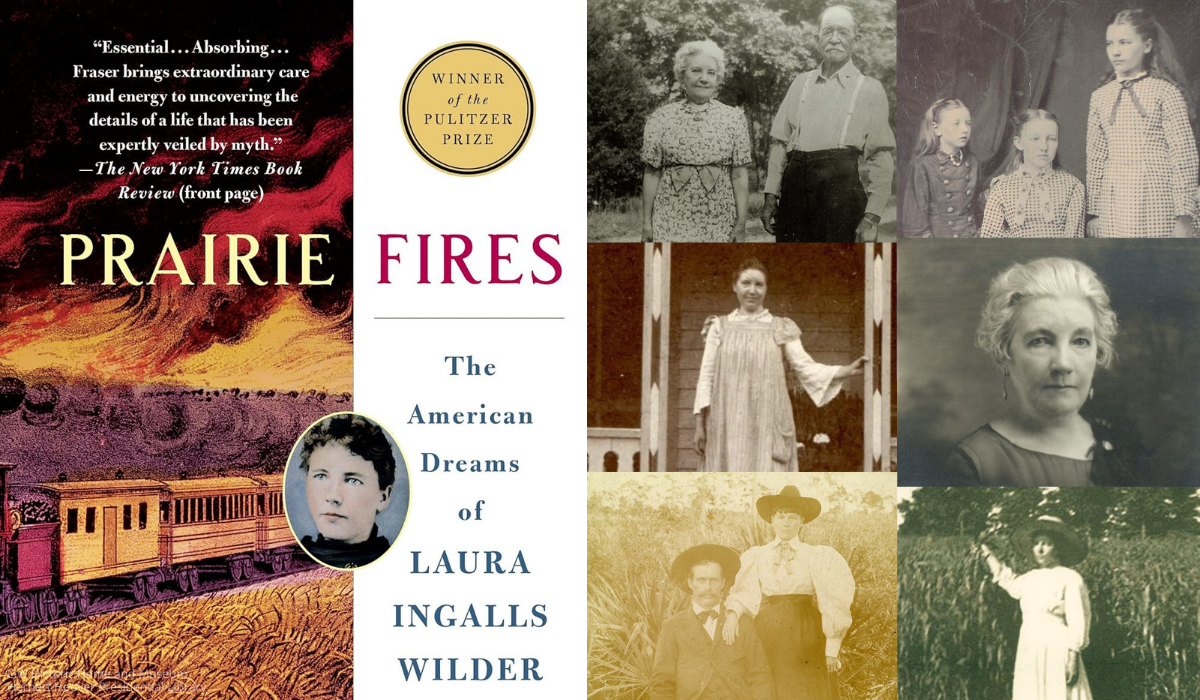
In her 2017 book Prairie Fires: The American Dreams of Laura Ingalls Wilder, author Caroline Fraser used diary entries, property and tax documents, and interviews with Ingalls’ daughter Rose Wilder Lane to create a deeper, more complex picture of life beyond the simple life depicted in the books. It was Lane, a writer and journalist in her own right who died in 1968, who strongly encouraged her mother to write down her stories and heavily edited them.
Prairie Fires won the 2018 Pulitzer Prize for Biography or Autobiography, and Fraser, a former staff writer for The New Yorker, said she was struck by how Wilder’s life “overlapped with so many major historical movements—the Plains Indian Wars, the degradation of the Great Plains, recurrent economic panics, and of course the Dust Bowl and the Great Depression.”
From her home in New Mexico, The Sunday Paper talked to Fraser (whose latest book, Murderland, focuses on the connection between serial killers and environmental contamination in the Pacific Northwest) about why the Little House books remain so endearing, the complex portrayal of Native Americans, and why she has a twisted bale of hay in her office.
A CONVERSATION WITH CAROLINE FRASER
Why do Laura Ingalls Wilder's books continue to resonate with readers today, especially younger generations?
Part of their lasting appeal comes from the television series, but the books themselves remain remarkably readable because they immerse readers in everyday frontier life. Laura Ingalls Wilder described ordinary tasks with extraordinary detail, from building a cabin and cooking over an open fire to washing clothes in a stream. Those descriptions allow readers to imagine exactly how people lived. For children in particular, there is something almost hypnotic about following those hands-on processes and wondering whether they could do the same things themselves. The books invite readers into another world in a very tangible way.
How much of the Little House series reflects reality, and where does fiction begin?
Wilder's descriptions of daily work and household routines are generally accurate. The fictional elements appear more in the broader themes. The books present a stronger sense of westward expansion than the family's actual travels reflected. In reality, the Ingalls family moved in multiple directions rather than steadily west, traveling between places like Wisconsin and Kansas before eventually reaching what became South Dakota. The books also present ideas about Manifest Destiny that deserve closer examination. Their portrayal of Native Americans is especially complicated and troubling, making it an important area for readers to consider when separating history from literary interpretation.
While researching Prairie Fires, what discoveries surprised you the most?
One of the biggest surprises involved Laura Ingalls Wilder's political views later in life. I already knew she and her daughter opposed Franklin Roosevelt's New Deal, but reading Wilder's letters revealed just how strongly she expressed those opinions. She was especially critical of Eleanor Roosevelt. What struck me most was how familiar the language sounded. Some of the rhetoric echoed political arguments that still circulate today.
There is renewed interest in traditional domestic life and farming today. How does that compare with the realities described in Wilder's life?
There is a great deal of manufactured nostalgia surrounding that lifestyle. Looking back at the actual experiences of the Ingalls and Wilder families tells a much different story. Farming was incredibly difficult, and both families experienced repeated failures because they lacked sufficient capital. Later in life, Laura and Almanzo Wilder operated a more successful farm at Rocky Ridge, producing milk and much of their own food, but they still struggled with expenses like medical bills. The idea that farming naturally produces a self-reliant, independent life ignores its economic realities.
Why do Americans continue returning to Laura Ingalls Wilder's story?
It is a story many people want to believe because it speaks to American origins, particularly for descendants of white settlers. There is comfort in imagining a heroic frontier story that built communities and established cherished values. The historical reality is much more complicated. Wilder's life raises difficult questions about ideas such as Manifest Destiny and self-reliance. Her own experiences suggest those ideals often collided with economic hardship and disappointment. Even the subtitle of Prairie Fires, The American Dreams of Laura Ingalls Wilder, reflects how those dreams were frequently frustrated rather than fulfilled.
Wilder began writing later in life. Did that affect the tone of her work?
She was already in her sixties when she began writing the Little House books and in her seventies by the time she completed the series. Her unpublished manuscript, The First Four Years, feels very different because the material itself resisted becoming an uplifting children's story. It chronicles one hardship after another, including crop failures, illness, Almanzo's disability, financial struggles, and the death of their son. Those experiences were so painful that she seemed overwhelmed by them. She never completed or published that manuscript, and part of the reason may simply have been that she was physically and emotionally exhausted by then.
Did your research inspire you to try any of the pioneer skills Wilder described?
I never made a button lamp, but I did spend about six months living off the electrical grid at a writers' retreat above Oregon's Rogue River. We had running water but no electricity, so I experienced some of the challenges that come with living that way. It was enough to convince me just how difficult that lifestyle really was. It certainly reinforced my appreciation for modern conveniences.
Are there places connected to Laura Ingalls Wilder that you especially recommend visiting?
Rocky Ridge in Mansfield, Missouri, offers an excellent view of Wilder's later life. For people interested in her childhood, however, I especially recommend Plum Creek, which is just a few miles north of the town of Walnut Grove in Minnesota. It's one of the few places where you can really kind of see what she was seeing. It's a beautiful spot; the creek there is really lovely in the summertime, and it's very unspoiled… you can see where they lived in the dugout on the side of the riverbed. One of the things that I think is great about her writing is that she does give you a sense of how beautiful the landscape was, how intensely she loved these places, and that's one of the sites where you can really see what she was seeing.
Did you keep anything from your research—an object or a document—from that time that inspires you?
One of my favorite keepsakes is a hay twist that I made at the Little House site in De Smet, South Dakota. This is from The Long Winter, this is what they had to make to burn in their fireplaces. It was hard to do.
Beyond Prairie Fires, are there books about America that you often recommend?
Two biographies come to mind immediately. One is Annette Gordon-Reed's The Hemingses of Monticello: An American Family, which examines Thomas Jefferson, slavery, and the complexities of the nation's founding. Another is Fawn M. Brodie's No Man Knows My History: The Life of Joseph Smith, which offers a fascinating introduction to Mormon history and religious movements in the United States. This is an earlier book, which was published in the 40s. These books are incredible in terms of what they have to say about American history, and how complicated and involved it is.
Looking ahead, how do you think people 150 years from now will view America today?
I have to think that a lot of it is going to relate in some way to the environment and climate, because we're either going to pull our fat out of the fire or we're not, and it's kind of looking not so good at this moment. I hope in 150 years there's better news, and I hope we get our act together. I mean, who knows, maybe that problem will somehow go away. I wish it would, but I don't see that, so I would have to say it would be something in relationship to how we've altered the environment.
Caroline Fraser is a Pulitzer-Prize winning author. Learn more about her work here.


Please note that we may receive affiliate commissions from the sales of linked products.