With the Midterms Just Two Days Away, Every Conversation Counts
After years of Instagram activism and campaign-donation spam texts, people are putting down their phones and stepping away from the doomscrolling.
But that doesn’t mean they’re tuning out. People still care about what’s happening in the country; they’re just looking for more meaningful ways to engage, grounded in real connection and community. From neighborhood meetups to local organizing, they’re finding their people, their joy, and their power in friendship, the opposite of the division and loneliness we’ve been living with.
Now, women need to use their community's power to get friends, neighbors, and family members to the polls.
With Donald Trump deploying federal agents to polling sites, voting rights under attack, and politicians gerrymandering states left and right, the stakes are too high to sit this one out. We need to vote for common-sense candidates up and down the ballot. We need to pay attention to the local races that rarely make national headlines but directly affect our daily lives. And with Election Day just days away, we need to make sure the people around us do the same. Because sometimes, the best way to get someone to vote is a nudge from someone they know.
That’s why, over the past six weeks, I’ve traveled to three swing states—Ohio, Michigan, and North Carolina—to rally suburban women to get out the vote ahead of Tuesday’s critical midterm elections.
I founded Red Wine & Blue seven years ago to connect women through political advocacy. Since then, I’ve hosted and attended countless events, including gatherings with the Red Wine & Blue Network, our nationwide network of more than 700 local groups organizing in their own communities. And yet, I still can’t quiet that little voice in the back of my head asking, “What if no one shows up?”
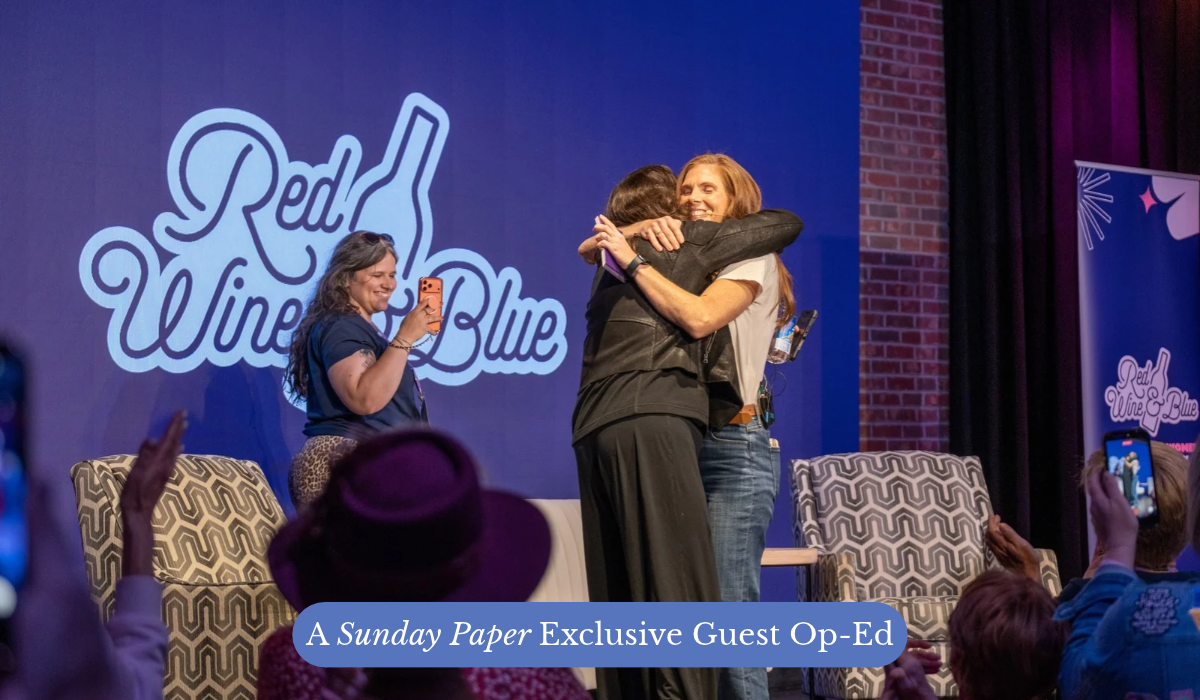
I’ve been proven wrong time and again. The truth is, when you offer women a place to gather and connect with their community away from social media, they’re going to take it. Nearly 2,000 people attended the three events, filling auditoriums and theaters in suburban districts and big cities alike.
The energy was palpable: women who had never met before found friendship easily as they talked about the issues affecting their families, communities, and futures. They laughed, danced, and exchanged phone numbers.
But it’s not just the camaraderie they’re longing for. They want to get their hands dirty, too. Since 2018, Ballotpedia reports that 660 elections have been decided by 10 votes or fewer. One conversation, one vote, could be the deciding factor in whether your child’s school receives funding, whether your city allows Flock cameras, whether you have a data center in your community, or whether your neighbors are protected from ICE.
That’s why, at the end of every event, I turned to the audience, a sea of smiling faces and rally signs, and made one simple request: leave that afternoon and talk to the people in your life about voting. Ask if they have a plan to vote. Offer to walk through their ballot with them. Anything and everything that encourages people to get out and vote.
Research shows that voters are at least 2.5 times more likely to be swayed by a friend or family member than by a stranger. That’s a lot of power in our hands, and we need to use it.
At each of the three events, my team gave attendees a card to record how many people they committed to talk to before Election Day. Altogether, they pledged over 31,000 conversations with friends and family, a number that could change the outcome of critical state and local elections.
While the number of attendees and pledges are big, flashy metrics, a community’s impact can’t be measured by numbers alone. I’ve felt the same energy in packed auditoriums as I have around kitchen tables and in local coffee shops. You don’t need a crowd to make a difference. Sometimes, ten people, or even one conversation, can change everything.
A few weeks ago, I was invited to a meeting hosted by Hope in the Heights, a local Ohio group in the Red Wine & Blue Network. Nineteen of us met in a local church meeting room, squeezed together on an old couch and struggling to fit enough chairs around the cramped table, where we talked over cheap wine and double-stuffed Oreos about our plans to get out the vote. I asked them to imagine waking up on November 4th and thinking, ‘I did all I could to win these elections.’
That’s the feeling we should all be chasing.
The room buzzed with energy as we threw out names of people we could reach and talked through how we’d support them ahead of Election Day.
And we weren’t just thinking about people we assumed wouldn’t vote. You might be surprised by how many people in your own circle, even those who love talking politics, vote only in presidential elections. I’ve lost count of how many times I’ve heard someone say, “Wait, there’s an election this year?”
Even people who vote every election, without fail, often skip important down-ballot races, like school board and city council, that directly affect their communities. The goal is to make sure no one slips through the cracks, whether it’s your closest friend or a work acquaintance you run into at the water cooler.
The room quickly got to work. I could barely hear myself talk over the excited chatter.
By the end of the night, we had a plan to reach out to hundreds of voters across Ohio.
Lisa Vahey, an attendee and member of Shake Off Flock, a group of neighbors fighting against Flock cameras, said it best: “When good people gather and speak together, good things can happen.”
This is why I do this work: to remind women their voices matter and to give them a reason to keep showing up long after Election Day. By the end of this year, Red Wine & Blue will have hosted over 6,000 events across the country. The friendships we build now can carry us through the next election cycle, the next local fight, and the challenges our communities will face for years to come.
But first, we have a Midterm election to show up for. This Tuesday, November 3, the issues that matter to our families and communities are on the ballot. We need to show up. Because when we step away from the algorithm and connect with our community, we show up not just on Election Day, but long after the polls close, too.
Text your group chat. Start a conversation with another parent at school pickup. Invite anyone you can to go vote with you. Because change begins with conversations and connections.
Editor's Note: Every week, The Sunday Paper's team of journalists sift through the news to find what Rises Above the Noise, makes sense of what's happening in the world, and provides hope for your week to come. While we do our best to provide our own informative summary of each piece, some publications require their own subscriptions beyond our control.
Please note that we may receive affiliate commissions from the sales of linked products.